



The House Human Rights Committee will invite the Organisation for Security and Cooperation in Europe to Cyprus to examine a contested protest legislation, committee chairwoman Irene Charalambides announced on Monday during a heated session that saw clashes over a violent crackdown of a pro-Palestine protest last week.
The OSCE issued a 32-page opinion in September responding to the law on assemblies and marches that parliament passed by majority vote in July. Charalambides, who also serves as OSCE vice-president, requested the opinion from the OSCE Office for Democratic Institutions and Human Rights following concerns expressed by numerous parliamentarians.

The session became contentious when parliamentarian Giorgos Koukoumas referenced incidents during Saturday’s protest against interception of the Gaza-bound flotilla, triggering reactions from Justice Minister Marios Hartsiotis and parliamentarian Christos Senekis.
Justice minister defends law as OSCE raises concerns
The OSCE opinion identified vague terms including “spontaneous” for protests, excessive organiser responsibilities, and other concerns previously highlighted during the parliamentary vote, according to Charalambides.
The organisation recommended merging spontaneous and emergency assembly categories with clear descriptions, establishing explicit limits on police intervention, ensuring assembly rights, designating dissolution as an emergency measure, and abolishing imprisonment provisions.
Hartsiotis questioned whether critics understood the law’s philosophy. “Nowhere in the law does the verb ‘prohibited’ appear. Where is the terror law? The junta? The silencing?” he stated.
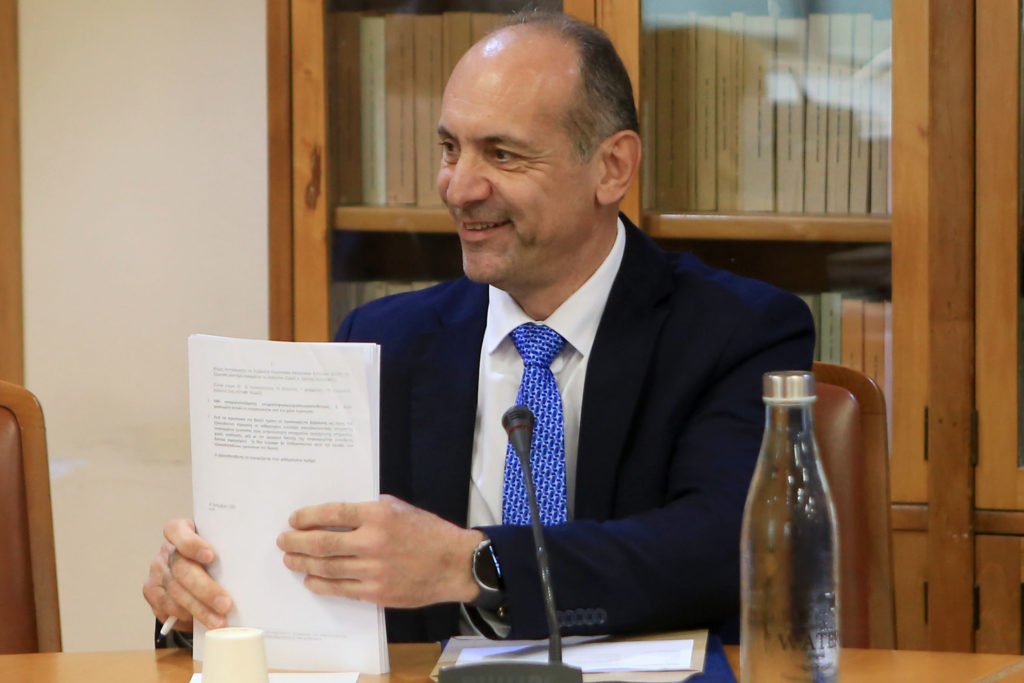
The minister said that organisers have no obligations but the right to inform authorities, whilst authorities lack power to prohibit demonstrations. “The voluntary character is obvious. There is no question of any prohibition of assembly,” Hartsiotis said.
He noted that police have obligations to suggest changes regarding direction and location when deemed necessary and useful. Two offences are specified, concerning acts of violence intended to affect the peaceful character of demonstrations, he stated.
Regarding the OSCE opinion, Hartsiotis said the ministry clarifies that several provisions are incorporated in existing legislation and legal order. “There are inaccuracies in the OSCE recommendations. For example, page 11 gives police the ability to cancel a protest. This is not valid. Page 16 refers to arresting a demonstrator, which is not valid. You will not find such a provision in the law,” he stated.
The minister indicated willingness to consider certain points for potential amendment, including page 23 regarding organiser notification timing and page 27 concerning Article 9, that isolated acts of violence do not render an entire event non-peaceful.
“Nowhere does OSCE alter the legislation’s philosophy. On the contrary, it strengthens it. We will proceed with necessary improvements and are open to dialogue,” Hartsiotis said.
Heated exchanges over Gaza flotilla protest policing
Koukoumas stated that both the law and its implementation present problems. The law should facilitate demonstrations, he said, adding that discussion occurs under the shadow of incidents at the 2 October protest.
“I was present if police want to call me as an eyewitness. The demonstrators never blocked the road, as they claim,” Koukoumas stated.
This prompted response from Hartsiotis. “There are two issues. One is the OSCE opinion. The second is incidents outside the Foreign Ministry and Presidential Palace,” the minister said.
Senekis intervened, requesting focus on substance to avoid defending security forces. Koukoumas responded that the previous demonstration was a dress rehearsal for how new legislation would be applied.
The exchanges intensified as Hartsiotis warned: “We are off topic. I warn you, I did not come to hear the opposition’s positions.”
Deputy Police Chief Panicos Stavrou stated that police members have guidelines for demonstration conduct for the first time. Addressing Koukoumas, he said police did not attempt to dissolve Saturday’s protest.
“Our members tried to move citizens to the pavement. When there was no compliance, they pushed them with appropriate force to the pavement. No attempt was made to dissolve the protest,” Stavrou stated.
International comparison shows varied protest regulations
Hartsiotis questioned why no one examines what applies in member states. Greece is considered the strictest, with police having the right to prohibit protests, he said. Organisers have obligation to compensate individuals harmed by protesters.
Germany prohibits demonstrations when deemed dangerous, the minister stated. In Belgium, every demonstration is subject to the relevant mayor’s approval. The Netherlands requires notification to municipal authorities. England requires written notice to police, he added.
The minister challenged opposition consistency, noting that parliamentarians from the same party submitted contradictory positions. “Have we truly entered pre-election period?” he asked.
He stated that AKEL General Secretary requested changes from President Christodoulides three days before the discussion, whilst three other AKEL parliamentarians submitted a law proposal for repeal, and Koukoumas wants return to the previous law.
“When else did a party within two months request repeal of a law passed by parliament majority? What is the logic of repeal?” Hartsiotis questioned.

Read more:

