


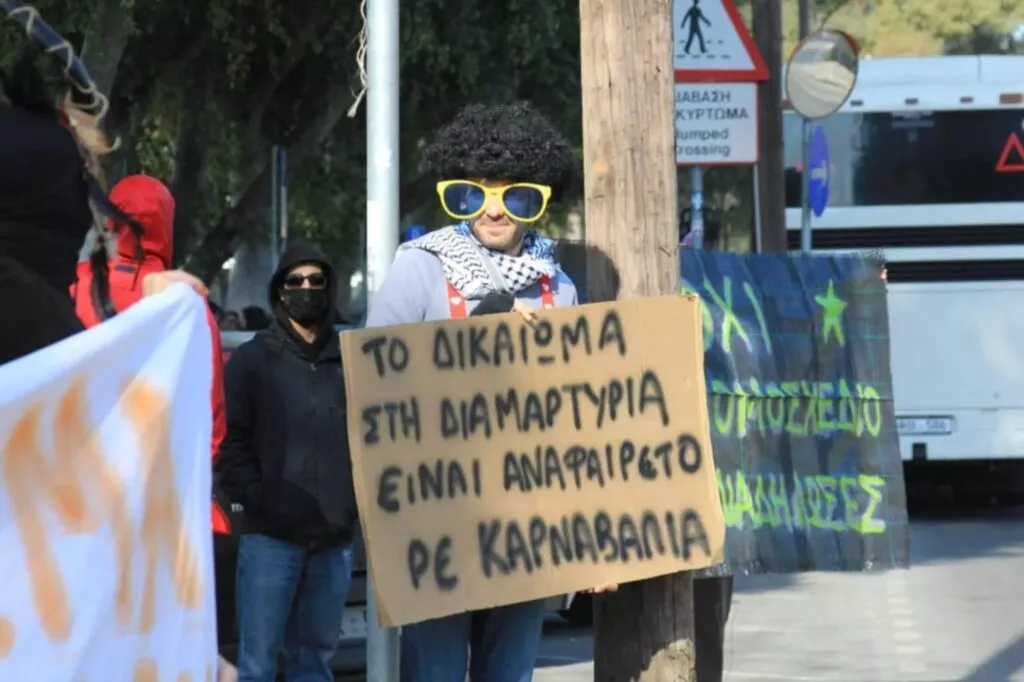
The Office for Democratic Institutions and Human Rights (ODIHR) of the Organisation for Security and Cooperation in Europe (OSCE) is preparing an urgent legal opinion on Cyprus’s “Public Assemblies and Parades Law of 2025,” which was passed by the House of Representatives last week.
This development follows a letter sent on 17 July 2025 by MP Irene Charalambidou, in her capacity as Chair of the House Human Rights Committee.
Charalambidou expressed concern over potential violations of the right to peaceful assembly, as guaranteed by European and international laws. The law has also drawn strong criticism from Cypriot civil society organisations, with a coalition of 35 groups jointly describing it as a “tool of repression” and a “threat to democracy.” Among these, afoa has specifically labelled the law an attempt to “criminalise the right to protest.”
Charalambidou’s letter requested the assistance of ODIHR Director Maria Telalian, citing previous collaboration on the draft media freedom law. Charalambidou raised concerns about the new law’s compatibility with OSCE commitments on freedom of peaceful assembly, as well as with the European Convention on Human Rights.
Opposition political parties, such as AKEL, have also criticised the lack of adequate consultation during the bill’s drafting, while independent MP Andreas Themistocleous has stated that the bill “evokes undemocratic regimes.”
Charalambidou indicated that the new law raises concerns that it could unjustifiably restrict fundamental rights to peaceful assembly and freedom of expression.
Critics, including civil society groups, specifically point to excessive requirements for obtaining permits prior to a protest, which they argue places fundamental rights at the discretion of administrative officials. They also highlight concerns that the new regulations could deter citizen participation, as organisers and participants face threats of disproportionate fines and/or criminal penalties. For instance, reports indicate fines of €2,000 for participants in unnotified protests and €10,000 for organisers of “illegal” gatherings, alongside potential imprisonment for certain violations.
Another problematic aspect, according to Charalambidou’s letter, is the broad powers granted to the Police for controlling or dispersing assemblies based on unclear criteria. Civil society groups fear these powers could legitimise arbitrary bans on gatherings and potentially lead to excessive force.
According to information obtained, Charalambidou’s letter received a response today, 21 July 2025, from the ODIHR Director. The response clarifies that ODIHR will urgently prepare a legal analysis of the Public Assemblies and Parades Law, assessing its compatibility with international standards and OSCE commitments.
The opinion is expected to be ready by September 2025 and will be publicly released.

