


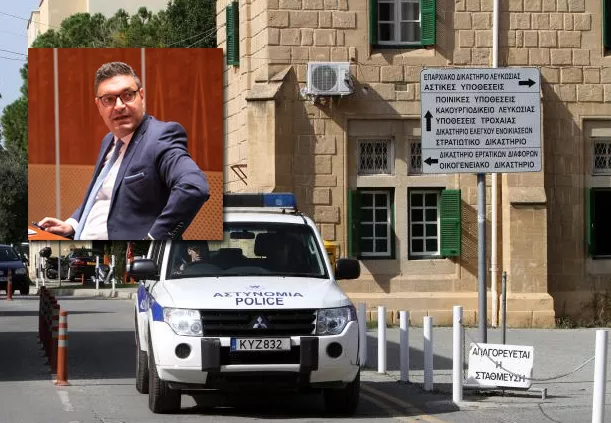
Former minister Constantinos Petrides told police he approved controversial citizenship applications based solely on humanitarian grounds and standard procedures, according to testimony obtained by Phileleftheros in a high-profile golden passports corruption case.
Petrides, who served as interior minister from May 2017 to December 2019 under former president Nicos Anastasiades, gave evidence on Friday as a prosecution witness in the corruption trial of ex-parliament speaker Demeitris Syllouris and former MP Christakis Giovanis.
The defendants face charges related to citizenship applications for Zaine Hilmi Armoush and Nikolai Gornovski, which were processed during Petrides’s tenure. Both investors purchased properties from the Giovani Group.
The court heard details of Petrides’s 2021 police statement, which included 32 questions about the applications. The statement was considered read rather than presented aloud during Friday’s hearing.
Zaine Armoush case
Police questioned why Petrides approved Armoush’s application despite regulatory violations. Under Cyprus’s Citizenship by Investment Programme rules, children over 18 can only apply after their parents have gained citizenship and while remaining financially dependent until the age of28 for students.
Armoush had already turned 28 when Petrides issued approval instructions to ministry official Christina Kaoulla on 20 October 2017, before her parents obtained citizenship.
“I must have considered the request reasonable given that her application would not be approved before the investor’s approval,” Petrides told police. “Either way, the investor would have to be approved first, then his dependants.”
The former minister said he did not recall the specific case but found it logical to accept the application for processing after the father’s citizenship was granted.
Family connections
Police asked whether Petrides knew about connections between Savas Poyiadjis, who presented himself as representing one of the investors, and Syllouris.
“I don’t know Savas Poyiadjis, but I know they have some family relationship – that Mr Poyiadjis is Mr Syllouris’s son-in-law,” Petrides responded, referring to circumstances in April 2021.
When asked if this relationship influenced his decision, Petrides said: “As I see it now in the documents you’ve shown me, I would have made the same decision for any investor. The same happened with other providers.”
Gornovski case
The testimony revealed Petrides initially rejected a request for Nikolai Gornovski to provide biometric data at the Cyprus embassy in Britain due to health reasons, citing the ministry’s strict approach to such exceptions.
However, Petrides later approved the request in August 2019, noting “approval and acceleration” on ministry correspondence.
“Ultimately, with the submission of two medical certificates recognised abroad, and given the strict control criteria he would pass through due diligence, no reason emerged not to accept the request,” Petrides explained.
He described the decision as humanitarian, given Gornovski’s inability to travel to Cyprus for health reasons.
Communication channels
Police presented an email from lawyer Andreas Pittadjis dated 19 January 2019 regarding Gornovski’s citizenship, which had been forwarded to the ministry’s director general via fax from Syllouris’s parliamentary office.
When asked why Syllouris sent the fax, Petrides said: “I don’t know, but I assume that speaking in hindsight, it’s due to the position Mr Syllouris appears to have with Mr Poyiadjis.”
Pressure allegations
Investigators referenced ministry officials’ testimony about repeated phone calls from Syllouris’s office regarding Ali Armoush’s application.
“I don’t know this, but from what I know, Ms Kaoulla and Ms Adamidou generally received quite a few phone calls,” Petrides responded.
When asked about interventions from the individuals mentioned, Petrides said: “I don’t remember them making interventions, but I don’t rule out that they did, as many pressures were exerted. In my opinion, the issue wasn’t the pressures that existed but whether I made concessions as interior minister that were reprehensible and endangered the country’s reputation.”
He denied ever meeting or speaking with Pittadjis, saying their only connection was when the lawyer “attacked me crudely on Facebook regarding local government issues”.
Trial developments
Petrides was the prosecution’s final witness in the case, which has been marked by the suspension of proceedings against two defendants – Pittadjis and Antoniou – and the removal of certain charges.
The trial now enters the phase where judges will determine whether a prima facie case exists against the remaining defendants.
Background
The Cyprus Citizenship by Investment (CIP) programme allowed wealthy foreigners to obtain Cypriot citizenship by investing at least €2 million in Cyprus. These passports, nicknamed “Golden Passports,” granted holders EU citizenship with the right to live, work and travel freely across all 27 EU member states and visa-free access to more than 170 countries.
The Al Jazeera investigation
The scandal was exposed by Al Jazeera’s investigative documentary “The Cyprus Papers Undercover,” released in October 2020. Undercover reporters posed as representatives of a fictitious wealthy Chinese criminal seeking to obtain a Cypriot passport through the investment programme.
In the undercover footage, former parliament speaker Demetris Syllouris was shown meeting with the fake representatives and promising to help the supposed criminal obtain citizenship, despite providing citizenship to convicted criminals being against CIP requirements and Cypriot law.
Al Jazeera’s investigation revealed that Cyprus had sold passports to dozens of people from more than 70 countries who were linked to crime and corruption, including convicted fraudsters, money launderers and political figures accused of corruption.
A 2021 government inquiry found that 53% of the 6,779 citizenships granted between 2007 and 2020 – the vast majority to Russians – were unlawful.
Within days of the documentary’s release, the passport scheme was cancelled, Syllouris and former MP Christakis Giovanis resigned, and the European Union and Cyprus government launched investigations. Thousands protested against corruption outside parliament in Nicosia.
Read more:

