


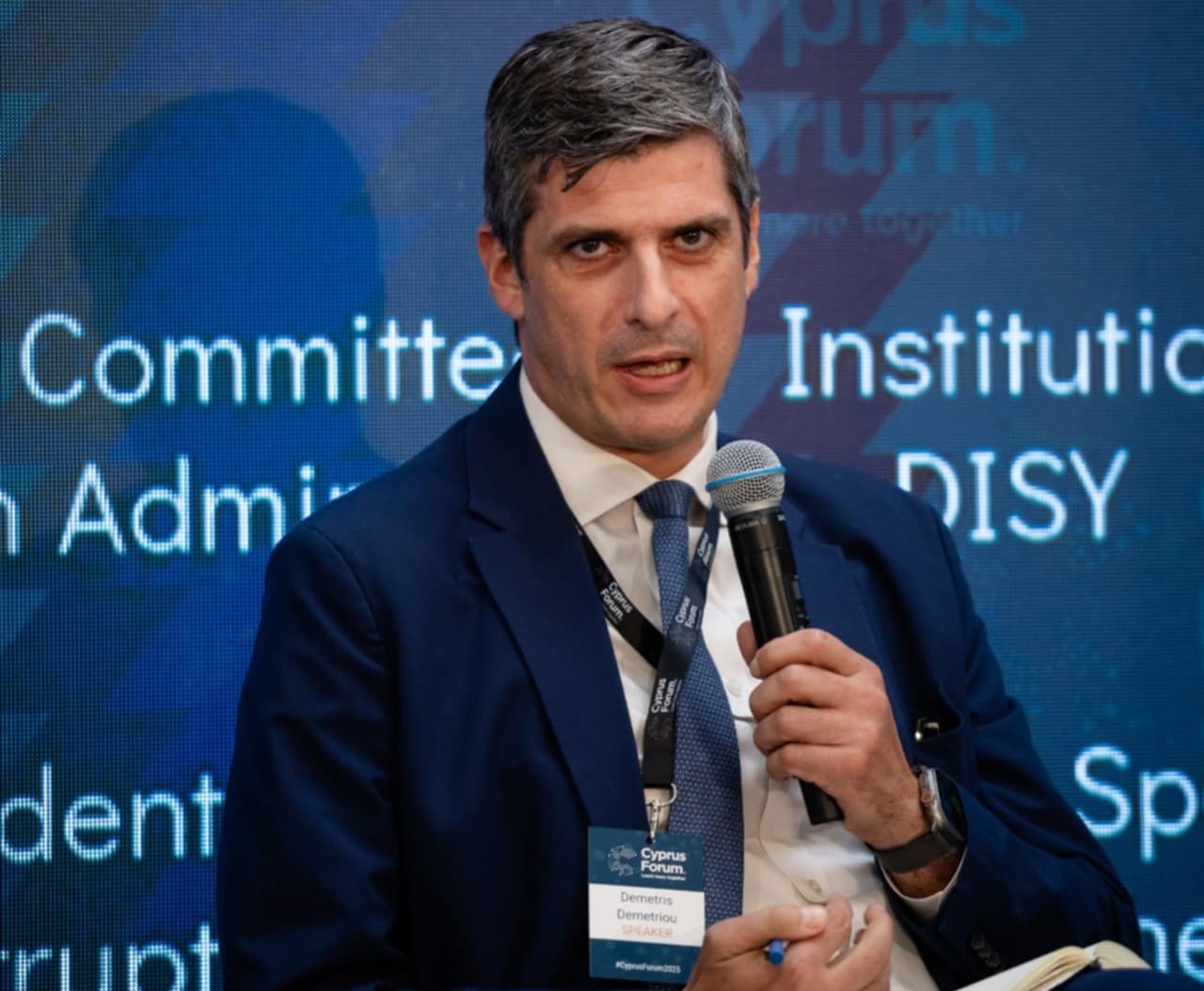
A debate over the Attorney General’s sweeping, unchecked powers was the highlight of the Cyprus Forum on Thursday, as politicians and officials called for constitutional change, better oversight of the Law Office and stronger safeguards to defend democratic institutions.
Lawmakers Demetris Demetriou (DISY) and Irene Charalambides (AKEL), alongside former Auditor General Odysseas Michaelides, warned that Cyprus risks institutional imbalance unless parliament asserts new controls over the executive and the Law Office.
Speakers stressed that reforms must not stop at splitting advisory and prosecutorial roles, but extend to regulating the Attorney General’s discretion on prosecutions and insulating independent offices from political pressure.
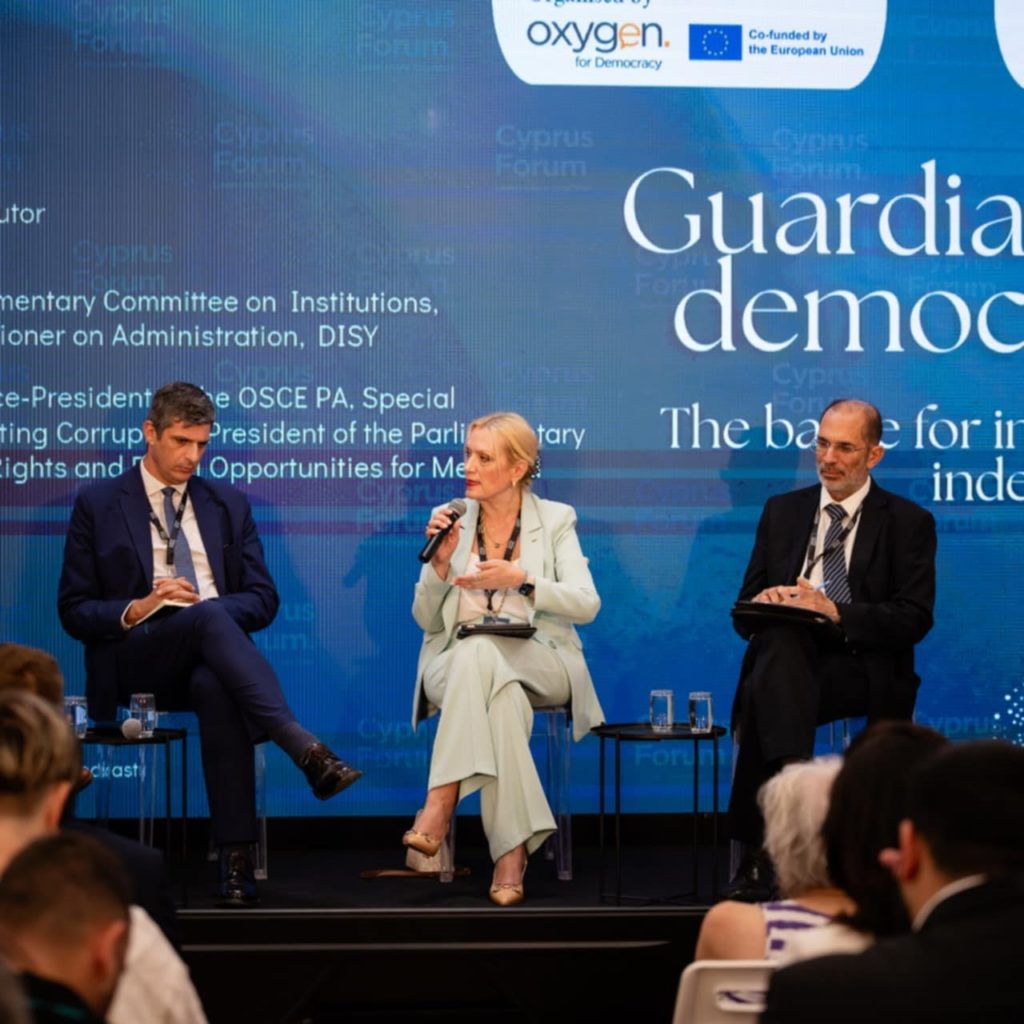
DISY MP Demetris Demetriou, chairman of the House Institutions Committee, said Cyprus has operated since 1963 with an imbalance of power. “The President of the Republic wields imperial powers — and in some respects the Attorney General has even more,” he said. Demetriou proposed that all appointments of independent officials require House approval, adding: “A horizontal requirement for 29 votes in parliament would create the necessary institutional counterweight.”
Welcoming bills to split the Law Office’s advisory function from public prosecution and to impose single, non-renewable terms, Demetriou warned the package falls short without scrutiny of prosecutorial discretion. “Without regulating the ‘unreviewable’ — decisions to suspend or not bring prosecutions — this is half a reform,” he said. He noted 38 draft laws are before parliament and pledged the House Institutions Committee would not advance the Law Office bills until the government tables measures on the Attorney General’s unchecked powers. “We cannot reform one pillar and leave a basic problem untouched,” he said.
Corruption hurts investment and the economy
AKEL MP Irene Charalambides, OSCE PA Vice-President and Special Representative on Fighting Corruption, called for root-and-branch change. “We have a duty to defend Cyprus — not the corruption of those who govern it,” she said. “The Constitution must change. It cannot be an instrument for opacity and the absence of accountability.”
Charalambides said corruption was not only a political problem but an economic one. “Corruption undermines democracy, erodes the economy and creates an environment that does not inspire trust for investment,” she said. “It discourages companies from coming to Cyprus and that is why we must move within strict frameworks of accountability and transparency.” She added that even the judiciary, so far untouched by scrutiny, must come within that framework.
Referring to the citizenship-by-investment scheme, she said: “For the first time, ministers who took part in cabinet decisions later found themselves as prosecutors expected to scrutinise those same decisions.” She added that external oversight had been decisive in the Vasilikos LNG affair: “EPPO’s intervention confirmed what the Audit Office recorded and what the opposition had been saying — this was a huge scandal with fiscal costs.”
On transparency, Charalambides recalled the battle to require asset declarations by the Attorney General and Deputy Attorney General. “We heard lectures that prosecutors are ‘quasi-judges’. She also warned: “If you do not separate the powers and introduce review mechanisms, international courts will force you to do so.”
Charalambides added that the system should give more leverage to independents, saying: “If we want change in this country, the message must be clear and strong from citizens — and our institutions must be designed to hear it.”
Cyprus cannot be the exception forever, Odysseas Michaelides says
Former Auditor General Odysseas Michaelides, now leader of ALMA, described the pressures faced during his decade in office. “I experienced repeated threats of dismissal — sometimes public, sometimes behind closed doors. That is the reality of being an independent official in Cyprus,” he said.
He argued that Cyprus’s system for dismissing independent officials must be corrected because it does not allow a full right of appeal. “At present, an independent official who is removed cannot obtain full judicial review. That gap leaves institutions vulnerable to political pressure,” he said.
Michaelides said the Attorney General’s sweeping discretion over prosecutions should not remain beyond all scrutiny. “International practice shows that limited judicial oversight of non-prosecution decisions is possible. Cyprus cannot be the exception forever,” he said.
Turning to Audit Office reform, he backed term limits and financial autonomy but criticised a government plan for an external council to opine on the service’s work. “It is an international patent — nowhere in the world does an external body intervene in an audit office’s annual work plan or draft reports,” he said. He argued that in countries with audit boards, “they are internal to the audit institution, not external overseers.”
Michaelides also stressed that institutions depend both on strong procedures and the individuals who lead them. “Personalities matter greatly, but so do processes. The two must go together,” he said. Drawing a comparison with the United States, he added: “When the US had a different president, opponents did not risk imprisonment because the mentality was different. Now, with Donald Trump in office, he still cannot jail people at will because there are correct procedures that stop him. That shows why processes are as vital as the individuals themselves.”
Moderator Christophoros Christophi closed by stressing that clearer separation of powers and safeguards against political interference remain decisive for democracy. “External mechanisms such as the European Public Prosecutor’s Office can provide backstops,” he said, “but domestic checks and balances are what ultimately count.”
Read more:

