


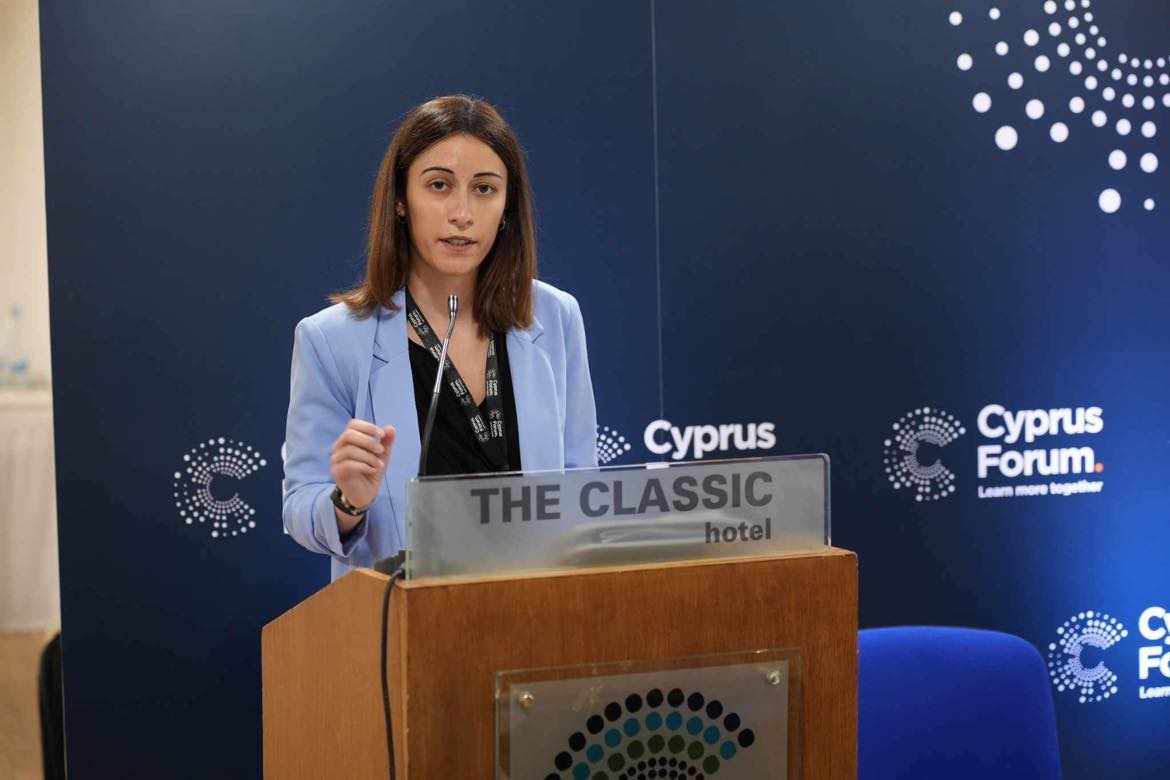
The High-Level Event on the EP Elections took place between October 23-24 in Brussels, organised by the Directorate-General for Justice of the European Commission.
Christiana Xenofontos, vice-president of the European Youth Forum (YFJ) participated in a panel discussion with John Morijn, Fellow in Law and Public Policy at Princeton University and Barbara Prainsack, Professor of Comparative Policy Analysis at the University of Vienna.
The panel discussed the intersections between European values, the people’s voice, and developments in democracy in the European Union. Against a backdrop of evolving political landscapes, societal dynamics and recent crises, the discussion looked into the challenges and opportunities faced by the EU as it heads towards the next EP elections in 2024 and the EU initiatives to tackle those challenges.
During the event, Xenofontos stressed the imperative nature of acknowledging and encouraging the ‘youth vote.’
Her address highlighted the notable increase in the youth turnout in the 2019 European Parliament elections, dispelling the misconception that young people lack political engagement. “Young people can also be seen at the forefront of major protest movements – notably of course Fridays For Future,” she said, citing one of the prominent examples of youth activism.
One of the core themes of her discourse revolved around the development of the ‘Youth Manifesto,’ a comprehensive set of twenty demands across democracy, sustainability, and youth rights.
Xenofontos advocated for the adoption of these demands by political parties for the impending 2024 EU elections, stressing, “If young people do not see their concerns addressed and ideas reflected in political programmes, why should they consider voting as a core way to make their voices heard?” She underscored the need for tangible measures, such as the EU Youth Test, which she described as a vital tool to assess the impact of EU laws on the younger population.
Lowering the voting age to 16 for all elections in Europe emerged as a significant proposition. “There is no reason why you should not be able to have a democratic say,” Xenofontos said, arguing that aligning the age of democratic rights with the responsibility granted to individuals at 16 would instil a habit of political engagement from an earlier age.
She also highlighted the practical obstacles that hindered youth voting, stating, “A staggering 68% of young people didn’t vote because of practical reasons, not ideological ones, with the main sub reason being that ‘they were on holiday or away from home’.”
She advocated for the development and availability of resources to facilitate voter registration, particularly for young voters away from home, such as students or those registering from a new address for the first time.
The under-representation of young people in the European Parliament was another focal point. Xenofontos underscored the need for more young candidates on political party lists, stating, “Young people need to be able to see their demographic represented in political power structures.”
Summing up her suggestions to improve youth voter turnout, Xenofontos urged politicians to address young people’s concerns in political programmes, lower the voting age to 16, support younger people in voter registration, and ensure the representation of young demographics in parliament.
“That would be my advice to those genuinely interested in harnessing that youth vote – and more broadly committed to ensuring that young Europeans are prioritised throughout political mandates,” she concluded.
Read more:

