


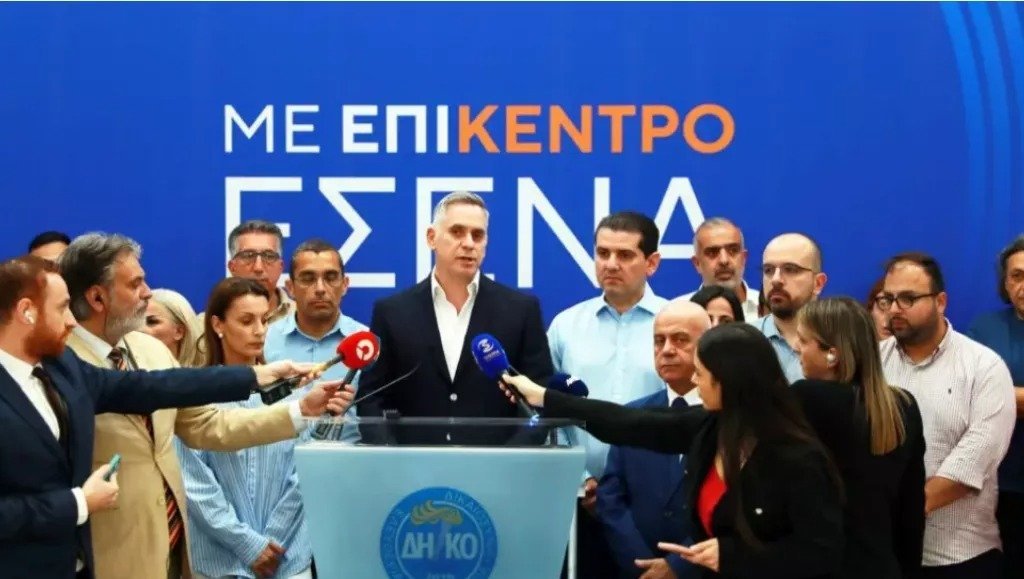
The centrist bloc has all but vanished, suffering significant losses. This is one of the unmistakable conclusions that can be drawn from the results of the European election ballot.
DIKO managed to retain its seat in the European Parliament but with a loss of vote share and failed to meet its target of a double-digit percentage of votes.
One could say that EDEK averted a worse fate, achieving a vote share of around 5%, though this was not enough to secure them a seat or be considered a satisfactory outcome. Beyond this, DEPA suffered a resounding slap in the face, with a significant drop in vote share compared to the 2021 parliamentary elections. With a vote share of just over 2%, the defeat for DEPA is substantial, even being surpassed by the newly established Volt party, which garnered slightly higher votes. There is already deep concern within the party.
Together, these three parties amassed a combined vote share of less than 17%, which is fewer than what Fidias Panayiotou alone achieved yesterday. At different times, DIKO, on its own, could have attained an even higher percentage. In absolute vote numbers, DIKO, EDEK, and DEPA, in the previous European elections, garnered 38,785, 29,715, and 10,673 votes, respectively. Together, they amassed 79,173 votes. Yesterday, the three parties collectively received around 60,000 votes, losing almost 20,000 votes in total.
Analysis of the reasons for this defeat has already commenced, with speculation that developments could unfold even today. The initial interpretation points to the following:
- These three parties support the Christodoulides administration and are part of the governing coalition. The image of the government has been tarnished several times during its first fifteen months, and its popularity has significantly waned. It is logical that this would also impact the parties that support it. Additionally, the lack of coordination observed between the Presidency and these three parties on various occasions has sparked discontent and dissatisfaction within all three parties.
- Another factor is their lack of a clear political compass and their internal problems. It is suggested that DIKO has lost its political identity as a centrist party, which, regardless of whether it was in the government or opposition, would have maintained collaborative bridges with the two major parties. Currently, it occupies a position somewhere between the coalition and the opposition, without a substantive role. EDEK, for its part, has been mired in introspection for years, while DEPA, during the administration of Nicos Anastasiades, had a strong presence in the government, a presence it seems to lack today, despite being part of the current coalition.
- Another perspective attributes the setback to weaknesses in their candidate lists, which may also explain the delay in finalising their processes. Their campaigns are also seen as lacking, failing to effectively communicate their political agenda. In DIKO’s case, one could argue that the motivation of securing third place in the contest with ELAM was a factor, but as it turned out, it did not work as successfully as it did in 2019 with EDEK.
ELAM emerges victorious
On the other hand, ELAM emerged victorious and strengthened, despite the fact that Fidias’ candidacy disrupted their plans for securing third place and potentially achieving even higher vote shares. Nonetheless, the party on the far right of the Cypriot political spectrum managed to significantly increase its vote share and elect a member of the European Parliament for the first time. It is also noteworthy that ELAM surpassed DIKO in vote share, a party that has traditionally been the third-largest in Cyprus and the most prominent in the intermediate political space.
It is also worth mentioning that ELAM is the only parliamentary party to have increased its vote share. In absolute vote numbers, they garnered approximately 16,000 more votes compared to the 2019 European elections and around 15,000 more compared to the 2021 parliamentary elections. Thus, their rise is significant.
The disappearance of the Ecologists
Another notable outcome of yesterday’s ballot is the poor showing of the Ecologist Movement, which suffered tremendous losses. With a vote share of around 1.3%, the Movement recorded its lowest percentage ever. They received fewer than 5,000 votes, whereas, in the previous European elections, in collaboration with Giorgos Lillikas’ Citizens’ Alliance, they had attained a 3.29% vote share and 9,232 votes. It should be clarified, though, that in these European elections, the Ecologists also collaborated with the Aichmi Movement of Demetris Papadakis and the Union of Cypriots, with Oz Karahan on their ballot. Moreover, compared to the 2021 parliamentary elections, the Ecologists lost over 3% and around 10,000 votes.
Volt’s debut
Volt, in its first foray into the political arena, naturally did not replicate Fidias Panayiotou’s impressive performance, but it did manage to secure a vote share of nearly 3% and over 10,000 votes. While this percentage would not have secured them a seat in the House of Representatives, it can still be deemed satisfactory, considering that established parliamentary parties like DEPA and the Ecologists attained lower percentages.
Local elections as a lifeline for traditional parties
When it comes to local elections, the interpretation may differ, as DIKO can celebrate winning the majority of Cyprus’s major municipalities and provincial organisations. Nonetheless, it is essential to recognise that each electoral contest has unique dynamics, and direct comparisons cannot be made.
Read more:

