


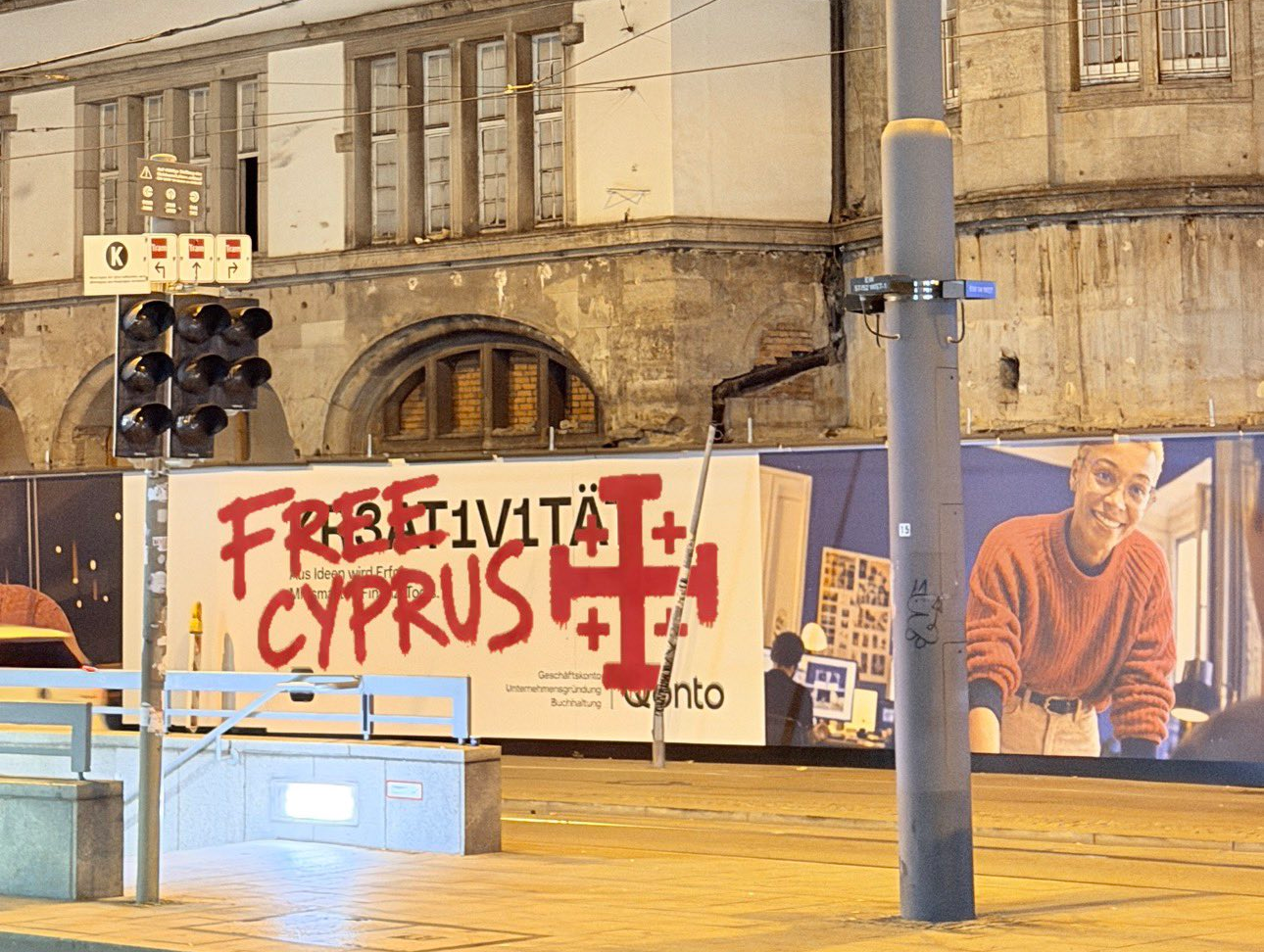
Munich authorities told en.philenews that a viral “Free Cyprus” graffiti photograph shared by Visegrád 24 was “not authentic”, while an investigation by Fact Check Cyprus found signs of digital editing and no exact matches in hundreds of archived webcam images of the site.
The photograph was widely shared as part of a series of posts claiming that “Free Cyprus” graffiti was appearing across Europe. Visegrád 24 presented the Munich slogan as competition for “Free Palestine”. The published photograph appears to show “Free Cyprus” and a red Jerusalem cross painted over a Qonto advert.
All the “Free Palestine” graffiti in the West is now facing competition by “Free Cyprus” More and more Free Cyprus messages have been appearing on walls in cities across Europe in recent weeks. This most recent example is from Munich, Germany https://t.co/t7lRuVuOHE
— Visegrád 24 (@visegrad24) November 10, 2026
In a subsequent video attributed to Edinburgh, it claimed that people were painting over “Free Palestine” graffiti and replacing it with “Free Cyprus”.
People have started covering up “Free Palestine” graffiti in cities across Europe and are replacing it with: “FREE CYPRUS” Here’s the latest example from Edinburgh https://t.co/VdVQl4JcbR
— Visegrád 24 (@visegrad24) November 11, 2026
In correspondence with en.philenews, Visegrád 24 founder Stefan Tompson defended the material and said his source dated the Munich graffiti and photograph to 22 September.
Fact Check Cyprus examined 820 webcam images spanning the period when the advert shown in the photograph was displayed, including images labelled with that date. It found no matching red lettering or cross.
En.philenews and Fact Check Cyprus independently matched the Munich scene to construction hoarding outside the former Hertie department store at Bahnhofplatz 7, opposite Munich Central Station.
What the webcam archive shows
Fact Check Cyprus located a panTerra camera covering Deutsche Bahn’s station construction project whose view includes the advertising surface shown in the photograph. It examined 820 images covering 31 August to 12 October 2026.
According to its investigation, the Qonto advert first appears in the recovered images on 31 August. It remains visible in an image labelled 16:36 on 12 October and has been removed by the image labelled 17:54 that day. The hoarding is uncovered in the November images it examined.
Fact Check Cyprus reported finding no corresponding red “Free Cyprus” lettering or Jerusalem cross in any of the 820 images. It also identified indications of editing around those elements when it examined the published photograph using forensic image-analysis filters. It concluded that the graffiti appears to have been added digitally.
Its published archive includes 19 images labelled 22 September, the date cited by Tompson. The red lettering and cross are absent from the visible advert in those views.
The archive contains individual snapshots with gaps between them. Its documentation states that the provider’s capture timezone has not been independently confirmed and that the recovered files do not establish the completeness of the provider’s internal archive.
What Munich and Tompson told us
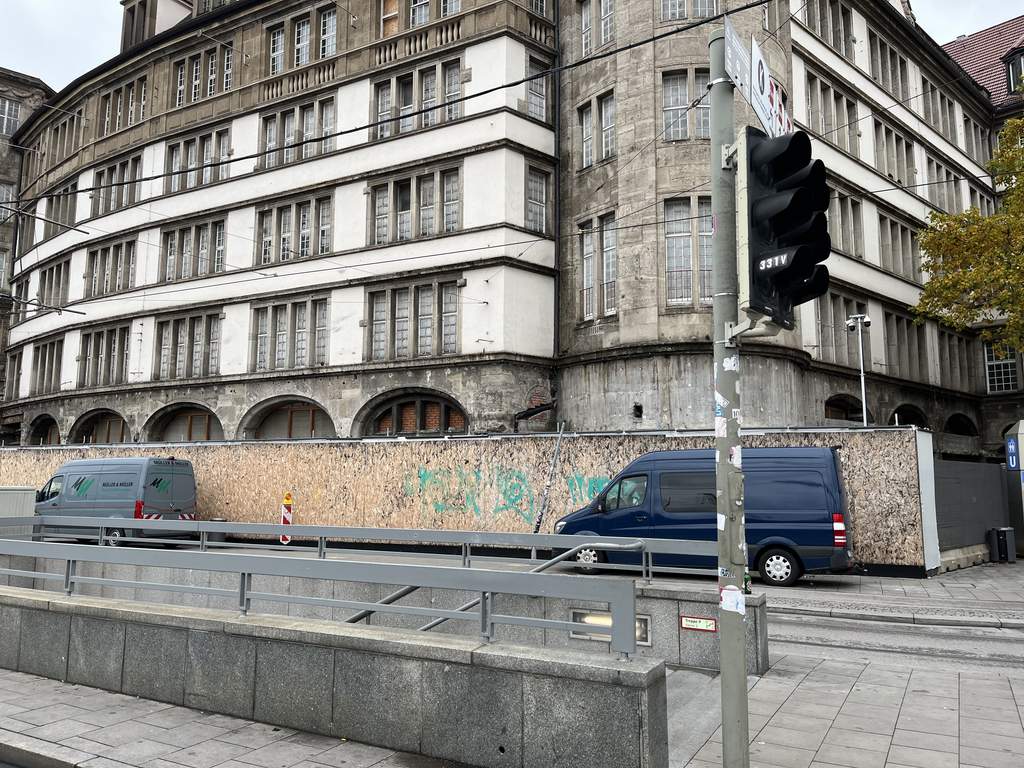
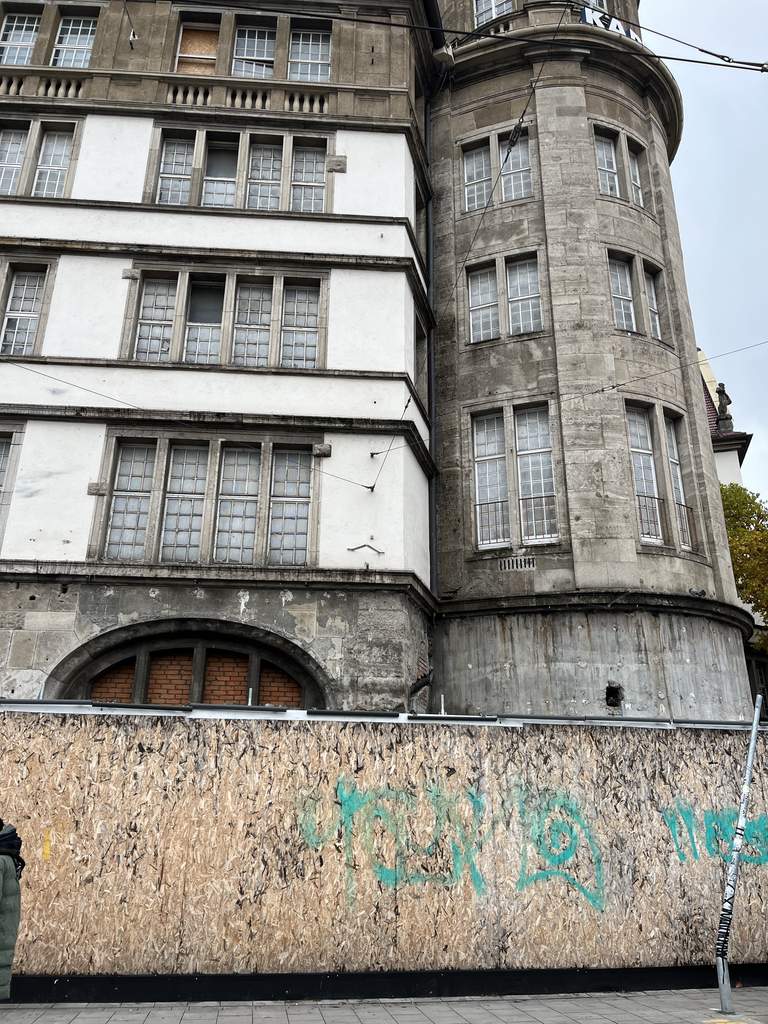
Munich’s municipal construction department told en.philenews that the image was “not authentic”. It said officials had inspected the hoarding on November 11 and found no advertising or lettering.
“We have no records or reports indicating that such lettering was present around 10 November,” the department added.
That initial enquiry concerned the period around 10 November, when Visegrád 24 published the photograph. The department also sent two photographs of the site showing the wooden hoarding without the Qonto advert or the “Free Cyprus” slogan.
Tompson initially told en.philenews that the account received its photographs and video from “a reliable source who knows people in the graffiti subculture around Europe”. He pointed to the Edinburgh clip as “video proof” and said Visegrad 24 planned to publish further videos from other cities.
After being sent Munich’s findings, Tompson said his source dated both the graffiti and the photograph to 22 September.
Paris and Edinburgh remain unverified
The City of Edinburgh Council told en.philenews that its cleansing team could not identify the wall from the short video.
Fact Check Cyprus also said it could not establish where the Edinburgh video or the photograph attributed to Paris had been taken. It reported finding no apparent signs of editing or AI generation in those two items, while leaving their provenance and locations unverified.
The Paris photograph was posted on 9 November, followed by the Munich photograph on 10 November and the Edinburgh video on 11 November.
New graffiti has appeared in Paris with the message: "Free Cyprus" 🇨🇾 https://t.co/L3NBCCIVRd
— Visegrád 24 (@visegrad24) November 9, 2026
en.philenews has reached out to Paris local authorities for comment.
How we checked
En.philenews reviewed the original posts and identified the Munich location by comparing the building’s façade, arched ground-floor windows and nearby tram infrastructure with independently published photographs. Fact Check Cyprus reached the same location independently.
We asked Munich’s construction department about the lettering, requested help identifying the Edinburgh wall and sought Tompson’s response.
Following the publication of Fact Check Cyprus’s investigation, we examined its archive entries for 22 September. The wider examination of 820 images was conducted by Fact Check Cyprus.
We also contacted the Disinformation Analysis Centre at NASK in Poland. NASK expert Olga Wałkuska told en.philenews: “In our monitoring, Visegrád 24 appears primarily as a source cited by other actors or as an outlet whose content is commented on or referenced by accounts engaged in disseminating disinformation narratives”.
What is Visegrád 24?
Visegrád 24 began in 2020 as an English-language account covering Central Europe. It takes its name from the Visegrád Group, which brings together Poland, Hungary, Czechia and Slovakia. The group was founded in the Hungarian town of Visegrád in 1991. The town’s name is of Slavic origin and means “high castle”.
The account has about 2.1 million followers on X. University of Washington researchers ranked it first by total views among seven influential English-language news accounts they examined during the first three days of the Israel-Hamas war in October 2023. Its 399 posts on the conflict drew about 372 million views.
Visegrád 24 became a prominent supporter of Israel after the Hamas attacks of 7 October 2023. The Jerusalem Post reported in 2025 that the outlet had received recognition from Israel’s Ministry of Diaspora Affairs and Combating Antisemitism. “We take sides in war,” Tompson told the newspaper.
Islam and immigration in Europe are also recurring subjects in its coverage, Le Monde reported. Moreover, South Africa’s Daily Maverick documented anti-Muslim content on the account, including a post challenging followers to name something Muslims had invented, discovered or created over the centuries.
Tompson told Le Monde he had carried out projects for Poland’s national-conservative Law and Justice party and rejected suggestions that he was a party propagandist. Investigative outlet VSquare found that his video production firm invoiced a Polish state-funded campaign in 2022, when Law and Justice led the government. Videos from the campaign appeared on Visegrád 24’s social media accounts.
Furthermore, an investigation by WIRED published yesterday reported financial records and internal communications linking donations to wealthy technology investors and pro-Israel supporters. It quoted messages attributed to Tompson discussing fundraising opportunities arising from coverage of Israel and expressing hostility towards Muslims. WIRED said he responded with a blanket denial and an email from a lawyer.


