


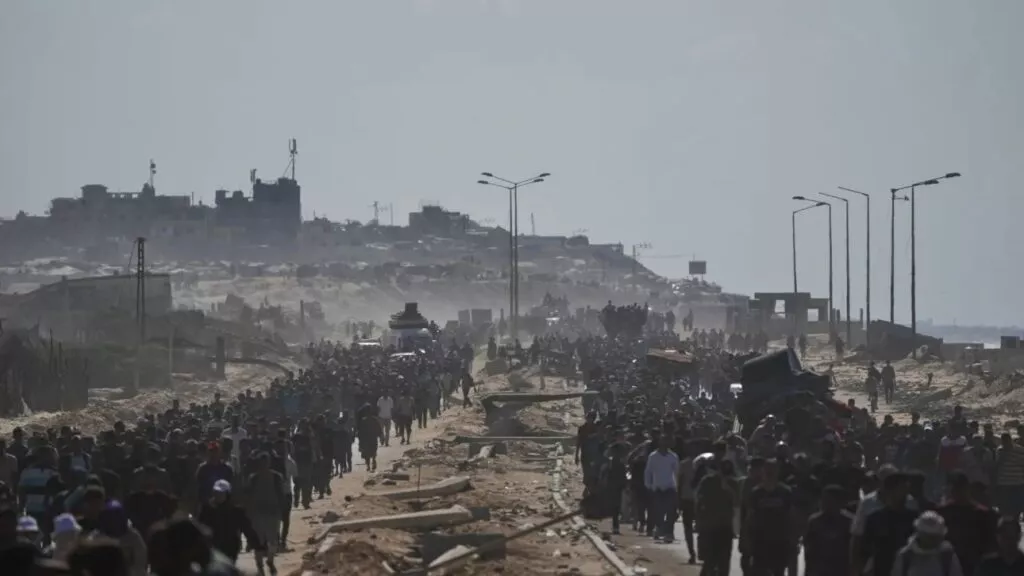
The United States is currently discussing a revised plan for the future status of Gaza, as developments on the ground and geopolitical pressures rapidly alter its initial approaches. The ongoing conflict and the difficulty of finding a viable solution are leading to new scenarios, which, according to The Guardian, reflect a complex and often clumsy planning process.
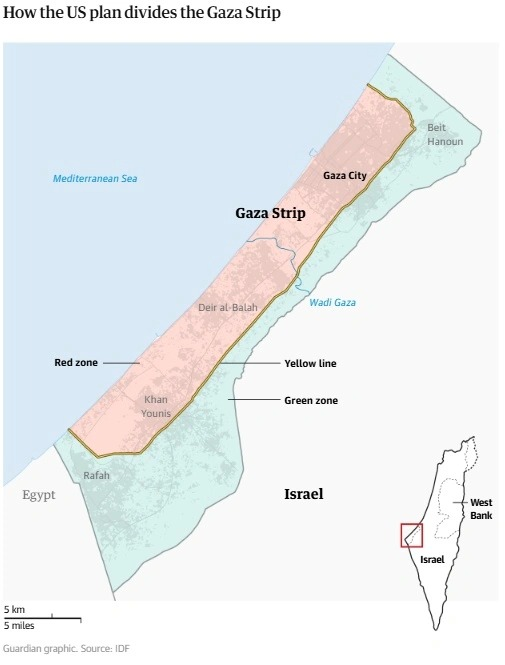
The American discussions now focus on the potential division of Gaza into two zones: a “Green Zone,” which will fall under Israeli and international military control and where reconstruction will begin, and a “Red Zone,” where the ruins of war will remain and where Palestinians will be relocated.
Foreign forces will initially deploy alongside Israeli soldiers in eastern Gaza. The war-damaged area will be separated by a “Yellow Line” that Israel will control, according to US military planning documents and sources seen by The Guardian.
The plan “is ambitious,” stated a US official, adding that it is not an easy undertaking. “It’ll take some time,” the official remarked.
The US initially promoted the reconstruction of Gaza with enclosed, secure communities for Palestinians (ASC), but an official stated those plans were abandoned this week.
“That’s a snapshot of an idea that was pitched at a specific time,” the official said. “They have moved past that already.”
Humanitarian organisations, which have repeatedly expressed serious concerns about the ASC model, stated on Friday that they have not yet been informed of the change in plans.
Without an implementable plan for an international peacekeeping force, the withdrawal of Israeli troops, and large-scale reconstruction, Gaza risks sinking into a deadlock after two years of devastating war, The Guardian reports.
Mediators have warned of a transition to a state that is neither war nor peace in a divided Gaza, characterised by regular Israeli attacks, an entrenched occupation, no Palestinian self-governance, and limited reconstruction of Palestinian homes and communities.
International Force Details
The creation of an International Security Force (ISF) forms the basis of the US 20-point framework, which includes a “peace plan.” The US hopes that a draft UN Security Council resolution formally mandating the force will be approved early next week and expects to finalise the details of troop deployment commitments.
“The first step is getting [the resolution] passed,” the US official said. “Countries aren’t going to make firm commitments until they actually see the language that has been voted on.”
The US has ruled out deploying American soldiers on the ground to pave the way for an Israeli withdrawal or funding reconstruction. “The US has made it very clear they want to destroy the plan and not pay for it,” a diplomatic source commented.
Earlier this month, the US military’s regional command, Centcom, drafted plans to place European forces—including hundreds of British, French, and German soldiers—at the core of the ISF, according to documents obtained by The Guardian. These include up to 1,500 infantry soldiers from the UK, specialising in bomb disposal and military medical personnel, and up to 1,000 French troops to cover clean-up and road security.
The US also wanted troops from Germany, the Netherlands, and Scandinavian countries to manage field hospitals, logistics, and intelligence. Jordan was named as a possible contributor of hundreds of light infantry troops and up to 3,000 police officers, although King Abdullah has explicitly excluded sending troops because his country is “too close politically” to Gaza.
One source called this planning “delusional.” After long missions in Iraq and Afghanistan, very few European leaders would be willing to risk their soldiers’ lives in Gaza, although they have promised other forms of support. Only Italy has spoken of a possible troop contribution.
A US official stated that the figures presented in the documents contained “many inaccuracies” and that Washington did not expect European troops to form the core of the ISF, adding that planning for Gaza is moving fast.
“It’s very dynamic and very fluid,” the US official admitted.
The US plan stipulates that ISF troops will only deploy in the “Green Zone.” The US envisions deploying troops, “starting with a small force” of a few hundred soldiers in a restricted area, and then gradually expanding to a full 20,000-strong force across the entire region. They will not operate on the western side of the “Yellow Line,” where Hamas is regaining control. “You are not going to leave [the Green Zone],” the US official promised.
Another document specifies plans for foreign soldiers to staff the crossings along the control line after “integrating” with the Israeli forces stationed along it—a mission likely to alarm potential troop-contributing nations. They remain wary of being caught in the crossfire between Hamas and Israeli soldiers, as borders are typically likely flashpoints.
The Israeli military will “examine the conditions for withdrawal” at a later stage, once international security has been established, the plan states, without setting any timetable.
Reconstruction in the Green Zone
US military planners also view reconstruction within the “Green Zone” as part of a vague path towards the reunification of Gaza, believing it will persuade Palestinian civilians to move across the line of Israeli control.
“As things progress and the conditions for significant reconstruction progress are created, [you will] see Gaza citizens move there and begin to thrive,” the US official said. “People will say ‘this is what we want’ and this is the direction the situation is evolving in. No one is talking about a military operation to enforce it.”
However, even the delineation of a “Green Zone” in Gaza raises comparisons with Iraq and Afghanistan, which were associated with US military failures. In Baghdad and Kabul, Green Zones were enclaves surrounded by concrete barriers where Western forces and their local allies retreated to escape the violence that their mission had unleashed on the surrounding communities.
The need for reconstruction is urgent, as more than 80% of buildings in Gaza have been damaged or destroyed in the war, including nearly all schools and hospitals, according to UN data.
(information from cnn.gr)

