


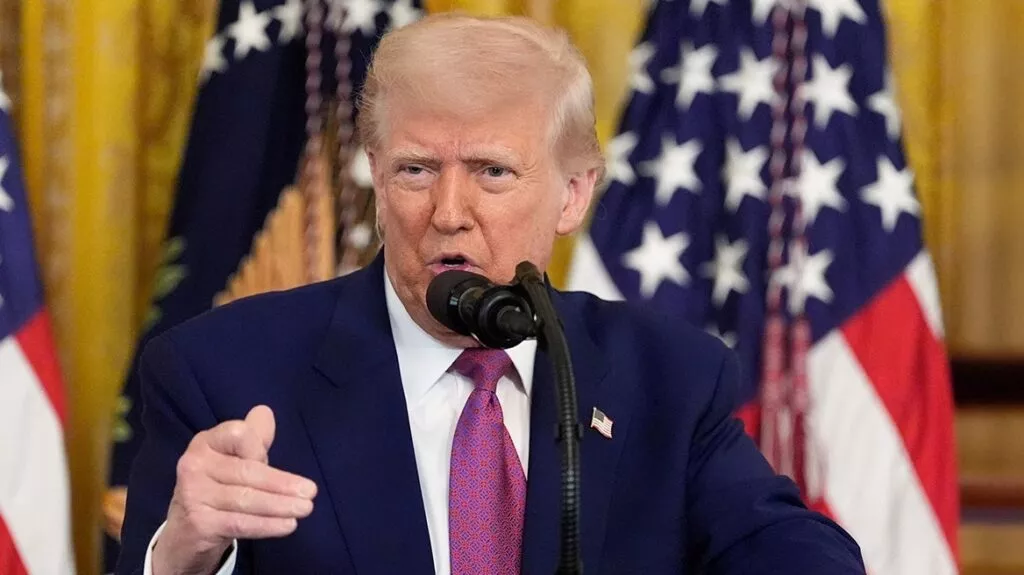
U.S. President Donald Trump reacted furiously to a federal appeals court’s decision that ruled many of the tariffs his administration had imposed were illegal, warning that without them, “America would be destroyed.” Trump, who appeared determined to continue his trade war, announced that he will appeal to the Supreme Court, defending the protectionist policy he implemented during his first term.
Donald Trump responded angrily to the federal appeals court decision that ruled many of his tariffs illegal, arguing that without them, “America would be destroyed.” The U.S. President appeared determined to continue his trade war, announcing that he will appeal to the Supreme Court.
The Court of Appeals for the Federal Circuit, in a 7-4 vote, ruled that Trump’s invocation of the International Emergency Economic Powers Act (IEEPA) to impose extensive tariffs was without a legal basis. According to the verdict, Congress had never granted “unlimited authority” to the president to tax imports.
Despite the decision, the judges postponed its implementation until mid-October, giving the White House the necessary time to file an appeal with the Supreme Court. At the center of the dispute are tariffs affecting a range of countries from China to the European Union, as well as countries like Canada and Mexico.
Trump, who has based a large part of his trade strategy on tariffs, called the decision “wrong” and “partisan.” “If these tariffs are abolished, it will be a total disaster for the country,” he wrote in a post, reiterating that the tariffs will “make America rich again.” The case is of great importance, as the tariffs have been a central leverage point for Washington in trade negotiations, generating billions of dollars in revenue. The administration had warned the court that any limitation on the president’s authority could cause “economic chaos” and undermine agreements reached with international partners.
Even in the event of a final defeat in the Supreme Court, Trump will still have tools to impose tariffs through other provisions, such as Section 232 (for national security reasons), Section 122 (tariffs up to 15% for a limited period), and Section 301 (in response to unfair trade practices).
The appeals court’s decision, however, is considered a landmark, as it brings the constitutional issue of Congress’s authority to determine trade policy back to the forefront. Jake Colvin, president of the National Foreign Trade Council, called it a “wake-up call” for Congress to reclaim its institutional role in regulating tariffs.

