


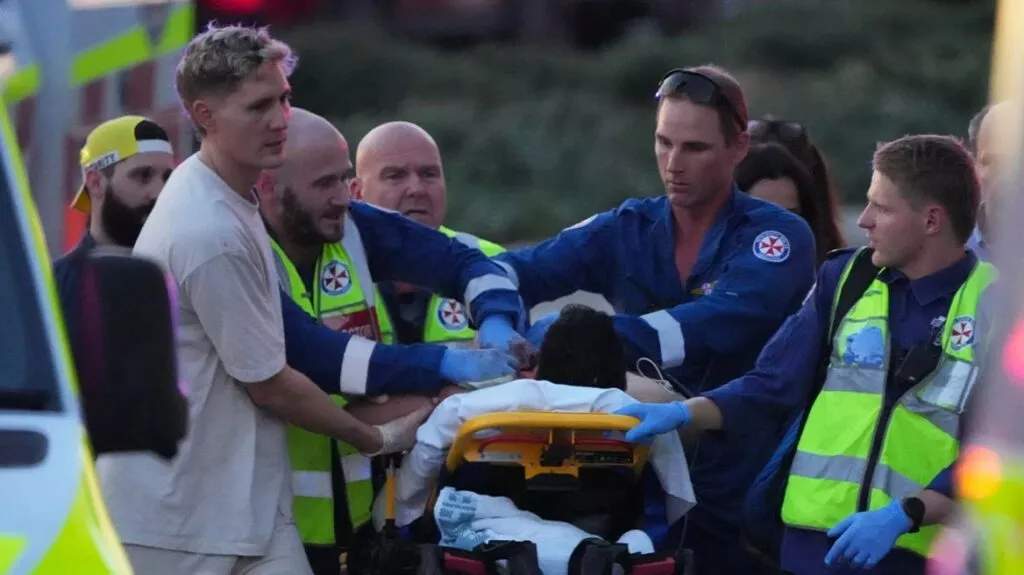
A father and son accused of massacring 15 people at a Sydney beach spent nearly a month in the southern Philippines shortly before the attack, authorities have revealed, as investigators probe possible Islamic State connections.
Naveed Akram, 24, and his father Sajid, 50, flew into the Philippines on 1 November and stayed until 28 November, Philippine immigration officials have confirmed. They told border officers they planned to visit Davao, a major city in the country’s militant-plagued south.
NSW police chief Mal Lanyon said detectives are trying to establish what the pair did during those four weeks. Officers discovered homemade bombs and two crude Islamic State flags in Naveed’s car, which was parked near Sunday’s shooting at the Hanukah festival on Bondi beach.
“The reasons why they went to the Philippines, and the purpose of that, and where they went when they were there, is under investigation at the moment,” Lanyon said.
Prime Minister Anthony Albanese said evidence suggests the rampage was “inspired by a terrorist organisation, by Isis”.
Police shot Sajid dead at the scene. Naveed survived with critical injuries and remains under guard in hospital. Another 25 victims were still receiving treatment on Tuesday.
Investigators are now asking whether warning signs were missed. The elder Akram obtained a firearms licence in 2023 and bought six guns, despite his son previously attracting attention from Australia’s domestic spy agency.
Lanyon corrected media reports claiming Sajid first got a gun licence ten years ago. Records show he applied in 2015 but never submitted a photo, so the application expired. He tried again in 2020 and was finally approved in 2023.
That approval came years after ASIO spent six months in 2019 looking at Naveed over his suspected links to other people of interest. The ABC has reported the investigation involved an alleged Islamic State cell. But spies concluded he posed no threat, Albanese said on Monday, and there’s no evidence authorities tracked him after that probe ended.
Around that time, when Naveed was still a teenager, he appeared in several YouTube videos for a group called the Street Dawah Movement. The organisation set up stalls at Sydney railway stations to talk to passers-by about Islam. In one clip, Naveed tells two teenagers that prayer matters more than “anything else that you have to do. Work, school.”
The group issued a statement on Tuesday distancing itself from him. It said Naveed turned up regularly at its weekend events in 2019 and helped make some videos, but was never a member and they haven’t heard from him since. Separate media reports have tied him to a different preaching group run by hardline cleric Wisam Haddad, though Haddad’s solicitor said his client “vehemently denies any knowledge of or involvement in the shootings”.
After finishing technical college that year, Naveed trained as a bricklayer, according to Guardian Australia. He made the Philippines trip after telling his boss he’d broken his hand boxing and couldn’t work until 2026, then asked to cash out all his leave and entitlements.
Security academics say militant groups including Islamic State and Abu Sayyaf operate in the southern Philippines, though reaching them would be difficult for foreign tourists. Clarke Jones from the Australian National University, who has worked with jailed extremists in the Philippines, said the groups are geographically isolated and dangerous to access. However, he noted commercial military training courses unconnected to terrorism are available there.
His ANU colleague Levi West outlined three possible reasons someone planning an attack might visit the Philippines: to train with jihadist groups in the south, to take part in legitimate tactical courses, or to “indulge themselves in a kind of last hurrah before they came back and switched into preparation mode”.
NSW Premier Chris Minns wants police to have power to block gun licences based on intelligence reports rather than just criminal convictions. “If we can craft a law that the police commissioner can say, ‘I’ve got concerns about this person, I don’t want them having access to a gun’, notwithstanding the fact they don’t have a criminal record, that is the kind of legislation we want to see,” he said.
Albanese flagged possible reforms including caps on how many firearms people can own, restrictions on weapon types, citizenship requirements for gun ownership, and faster completion of a national firearms database.
Australian Federal Police boss Krissy Barrett said investigators believe no one else was involved in what appears to be an Islamic State-inspired attack, but cautioned “this could change given it is early in our investigation”. She said evidence seized has given detectives “a swathe of information that has enabled them to make this initial assessment about the alleged individuals involved and their motivations”.
(Source: The Guardian)
Read more:

