


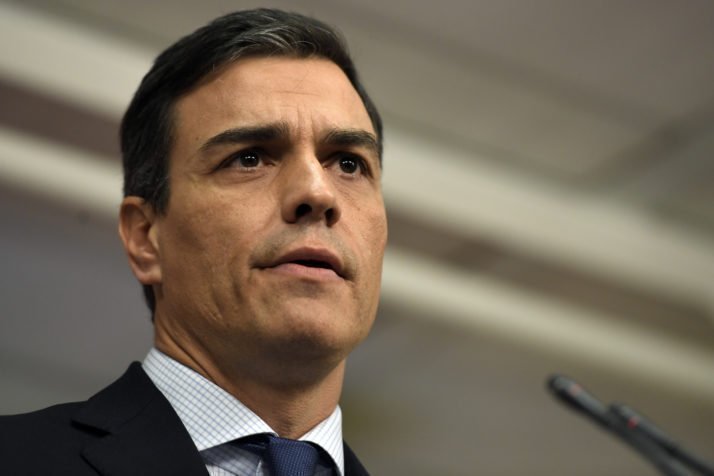
Spaniards go to the polls on Sunday to decide whether to give Socialist Prime Minister Pedro Sanchez another term or return the centre-right People’s Party (PP) to power, potentially bringing the far-right Vox party into national government for the first time since Spain’s return to democracy.
A defeat for Sanchez could bring the far right into Spain’s national government for the first time since the restoration of democracy following the death of dictator Francisco Franco in 1975. It would also reflect the broader rise of far-right parties across Europe amid concerns over immigration.
Polling stations open at 9 am local time and close at 8 pm, when opinion polls conducted during the final week of campaigning will be released. The first results are expected around an hour later.
A party needs 176 seats in Spain’s 350-seat parliament to secure an absolute majority.
Housing crisis dominates election campaign
Sanchez, who has governed with fragile minority coalitions since 2018, called an early election after parliament rejected decrees aimed at addressing the country’s worsening housing crisis. He argued that he needed a parliamentary majority to govern effectively.
The election campaign has been dominated by competing proposals to tackle rising rents and evictions.
Sanchez insisted on Friday that internal party data indicated he could secure a parliamentary majority with smaller left-wing parties, despite opinion polls showing the PP and Vox in a strong combined position.
Some polls indicated that Sanchez’s Socialist Party (PSOE) was closing the gap with the PP, but at the expense of smaller far-left parties whose support he would need to form another government.
Reuters reported that a PP-Vox coalition was widely regarded as a possible outcome, although negotiations over the allocation of ministerial posts could prove difficult.
Analysts said Vox could alternatively choose to support a PP government from outside the cabinet, depending on how many parliamentary seats it secures.
There is no formal deadline for coalition negotiations before the first parliamentary vote to elect a prime minister. However, if no candidate secures parliament’s confidence within two months of that vote, fresh elections are automatically triggered.
Immigration and the cost of living
Sanchez has described the prospect of a PP-Vox coalition as a “regression”. The two parties already govern together in four Spanish regions.
Vox advocates stricter immigration controls, the recentralisation of state powers, lower taxes and the reversal of many progressive social policies.
Sanchez has highlighted his economic record, having overseen one of the European Union’s fastest-growing economies, supported by increases in the minimum wage and a labour reform that has helped bring unemployment to its lowest level in nearly two decades.
However, some Spaniards say they have not experienced the benefits of that economic growth because of rising housing, energy and consumer goods prices.
Immigration has helped fuel Spain’s economic expansion, and economists have warned that restrictive immigration policies under a potential right-wing government could undermine growth.
While much of Europe has sought to tighten border controls, Sanchez has promoted immigration as an economic benefit.
The PP has pledged to prohibit mass regularisation programmes for undocumented migrants, allow returns to third countries and introduce a points-based system for legal immigration.
Vox wants to deport foreign nationals convicted of crimes and give Spanish citizens priority in access to housing.
A defeat for Sanchez would leave Denmark, Lithuania and Malta as the only three EU countries with centre-left leaders, according to Reuters.
Corruption scandals and political pressure
Sanchez’s public image has suffered from a series of corruption scandals involving members of his inner circle and family, as well as crises including two deadly train crashes, a migration crisis in the North African enclave of Ceuta and a nationwide power outage.
While Sanchez faces criticism over his handling of these issues, his main rival, PP leader Alberto Nunez Feijoo, has sought to present himself as a detail-oriented technocrat.
Sanchez has also faced criticism for granting an amnesty to leaders of Catalonia’s independence bid in exchange for their support in securing another term after the 2023 election, when the PP won the most votes but fell short of a parliamentary majority.

