


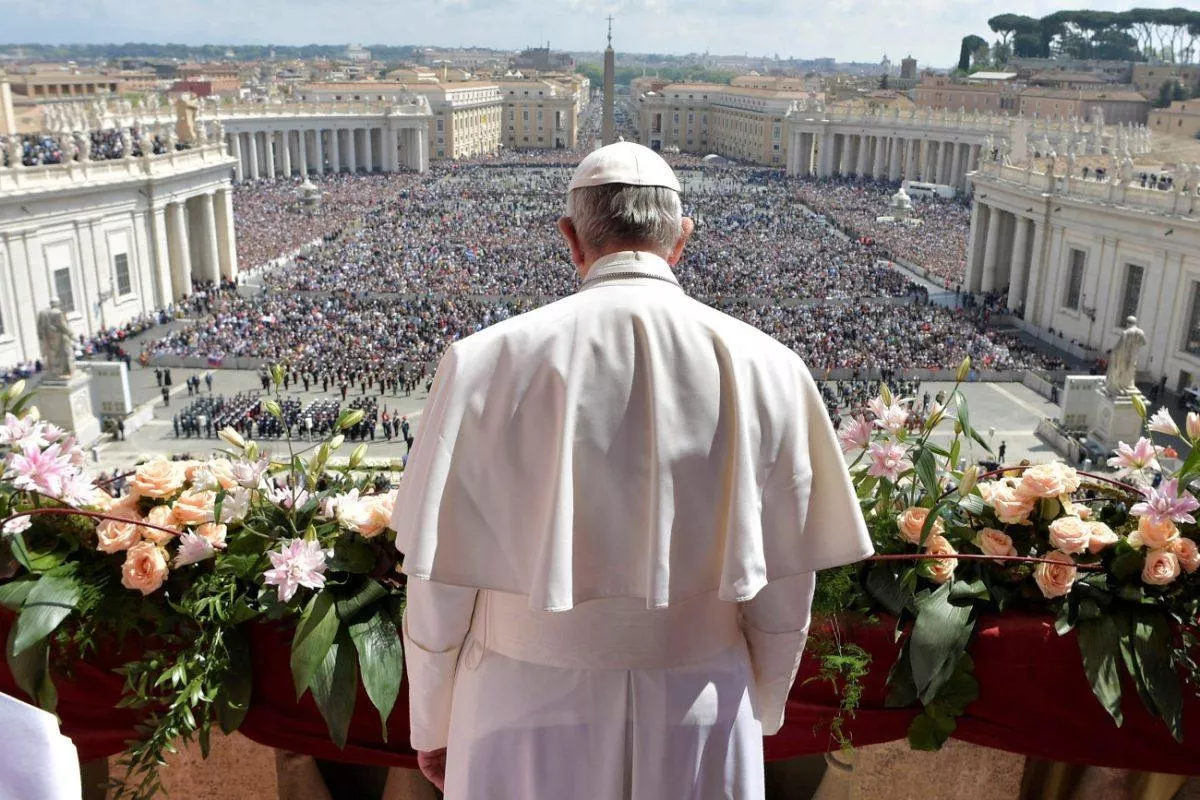
Thousands of faithful from every corner of the world flocked yesterday (April 26th) to St. Peter’s Basilica to bid their final farewell to Pope Francis, who passed away on Easter Monday at the age of 88.
The pilgrimage to the remains of the departed pontiff was accompanied by fervent requests from the faithful to the Roman Catholic Church to launch an immediate process of canonisation.
However, according to a New York Times piece, the canonisation of a Pope is no longer the standard procedure that it was in previous centuries. On the contrary, it requires lengthy investigation and rigorous evaluation before any decision is made by the Vatican.
The Early Years
Of the first 50 Popes – with Saint Peter considered the first – 48 were declared saints following their death. However, this practice has now become more complicated, with only two of the last five Pontiffs before Francis being canonised.
Out of the 266 Popes, 80 have been canonised, (slightly more than a third) while for another 11 the process is underway.

The Process
According to Vatican experts cited by the New York Times, the process now takes a number of years and requires an in depth investigation into the life, virtue, and devotion of the ‘candidates to God’.
Those who meet the criteria are declared “venerable,” and subsequently their “beatification” follows, for which the validity of a miracle, through the intercession of the candidate, is also required from the Dicastery for the Causes of Saints.
Following this process and for the canonisation to go through, the Vatican must recognise the validity of a second miracle, while the final decision is the prerogative of the current Pope.
In recent years, three Popes have been declared saints. In 2014, in a joint ceremony, Popes John XXIII (who died on June 3, 1963) and John Paul II (who died on April 2, 2005) were canonised, while four years later, Pope Paul VI (who died on August 6, 1978) was declared a saint.
According to Harvard University researcher Rachel McCleary, from 1588 to 1978, the average time between an individual’s death and canonisation was 262 years. However, this was reduced dramatically to just five by John Paul II.
Even this waiting period though can be bypassed by papal decree, as happened in the case of John Paul II, with his successor, Pope Benedict XVI, allowing his beatification 9 years after his death.
At the funeral of Pope John Paul II, thousands of faithful lifted banners that read “Santo, subito,” meaning they were asking for the immediate canonisation of the deceased Pope, just as happened earlier this week at the public veneration of the remains of Pope Francis.
Calls for a Longer Waiting Period
However, today there are voices within the Vatican calling for a longer waiting period before the start of a Pope’s canonisation process.
This view gathered pace after a 2020 report by the Roman Catholic Church which stated that Pope John Paul II may have ignored allegations against the former Cardinal Theodore McCarrick regarding sexual abuse.
Thus, it may be necessary for a number of years to pass before launching the canonisation processes for Pope Francis, who stated that the most powerful message of Jesus Christ is mercy towards sinners.

In addition, following the Pontiff’s death and despite the outpouring of love, a number of controversial aspects of his life were made public, albeit prior to taking over at the helm.
They include the time when still known as Jorge Mario Bergolio, he was the head of the Jesuit order during the military dictatorship of Jorge Rafael Vidella.
(PHILENEWS)

