


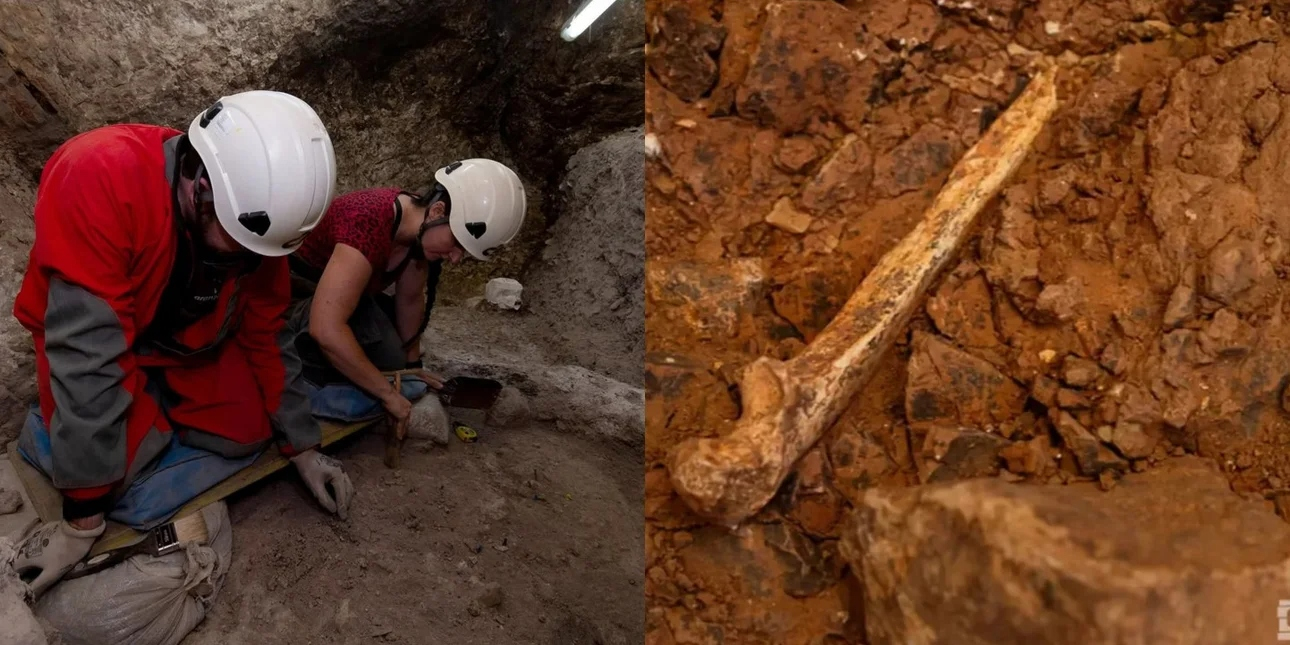
New fossil finds from the Gran Dolina cave in Spain show that Homo antecessor, one of the earliest human species identified in Europe, practised cannibalism on adults as well as children, researchers say.
More than 30 years after Homo antecessor fossils were first identified, excavations at Gran Dolina in northern Spain continue to yield new evidence about the biology, social relationships and practices of these ancient humans, who lived around 850,000 years ago. The new finds include more than 20 fossils, among them skull fragments, vertebrae, hand and foot bones, teeth, and sections of major bones such as the femur, tibia and humerus.
The most significant detail, researchers said, is that several of the bones carry cut marks, which they believe show the bodies were processed after death, most likely as part of cannibalistic practices.
New finds reshape the picture of Homo antecessor
Homo antecessor’s first fossils were discovered at Gran Dolina in 1994, but for years scientists had a limited picture of the group, since most finds involved children and young individuals. The latest excavation season brought to light, for the first time in significant numbers, the remains of adults, allowing researchers to better study the population’s demographics and social structure.
“Each excavation season helps us fill in a puzzle that still has many missing pieces,” said Andreu Ollé, co-director of the excavation and a researcher at the Catalan Institute of Human Palaeoecology and Social Evolution (IPHES). He explained that the growing number of individuals identified, and in particular the presence of more adults, allows scientists to approach the population in a far more complete way.
The bone marks that revealed cannibalism
The cut marks on the bones are among the most striking elements of the discovery. Researchers say the marks were made while the bodies were being processed, in a manner similar to that seen on animals butchered for consumption.
Until now, evidence had pointed to Homo antecessor likely practising cannibalism mainly because cut marks had been found on the bones of younger individuals. The new finds show the practice was not limited to children or adolescents. “The discovery of more adult individuals, some of which also bear cut marks, shows that cannibalism did not involve only younger individuals,” said Palmira Saladié, an IPHES researcher, adding that the new evidence offers a more representative picture of Homo antecessor’s biology, demographics and behaviour.
A window into Europe 850,000 years ago
Gran Dolina is significant not only for its human fossils. The same layers have yielded tools made of flint, quartzite, sandstone and quartz, along with the bones of animals that lived in the area or formed part of the diet of these ancient humans, including remains of deer, horses, cattle, hyenas, beavers and rhinoceroses.
The combination of human fossils, tools and animal remains allows scientists to reconstruct, in exceptional detail, a snapshot of life in Europe almost a million years ago. “The importance of Gran Dolina goes far beyond the human fossils. The relationship between the tools, the animal remains and the Homo antecessor bones allows us to reconstruct a site of human presence from 850,000 years ago,” Ollé said.
Excavations continue
Despite the significant finds, scientists believe the site still has many secrets to reveal. The excavation is ongoing, and researchers expect future work seasons to yield further evidence on the evolution, social organisation and way of life of the first Europeans.
“We have only just begun excavating this new area, and the first results already point to its huge scientific potential,” said Marina Mosquera, director of IPHES.
Gran Dolina is emerging as one of Europe’s most important archaeological sites, offering a rare glimpse into a world hundreds of thousands of years removed from modern humans, one in which survival may have included practices that would shock us today, such as cannibalism.
(information from iefimerida.gr)

