


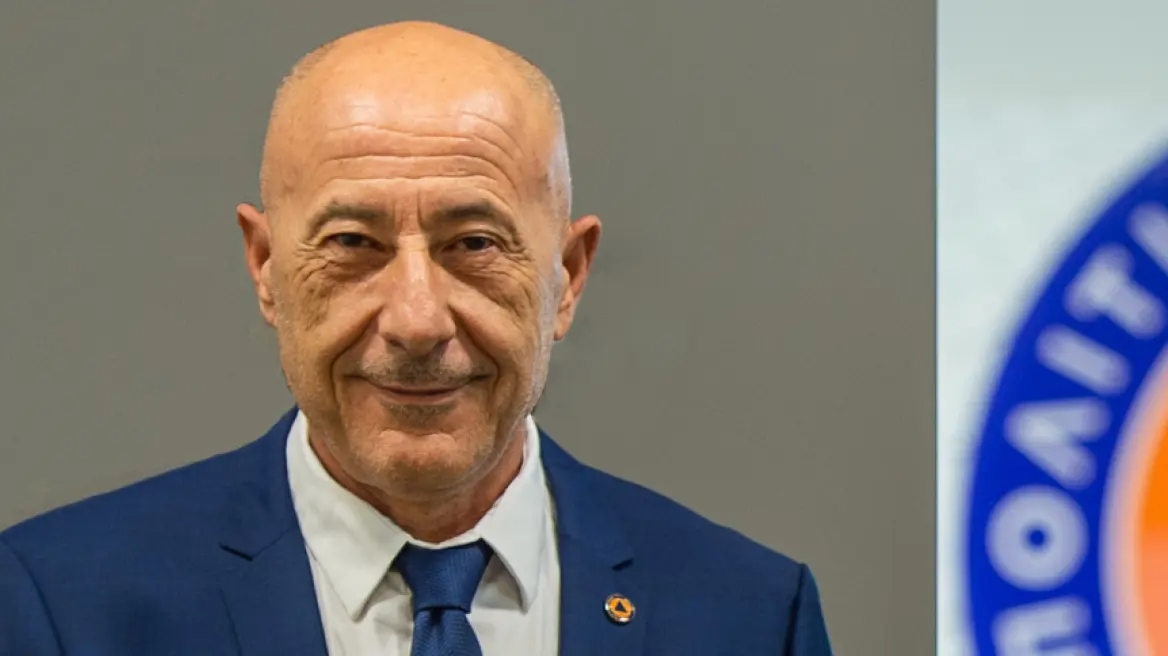
Greece’s Secretary General for Civil Protection Vasilis Papageorgiou has submitted his resignation, citing “political sensitivity” regarding the ongoing investigation into the Tempi railway disaster.
Papageorgiou faces criminal charges related to alleged tampering with the accident site, alongside former Thessaly Regional Governor Kostas Agorastos, Regional Fire Service Chief Ev. Falaras, and Larissa Police Director Ag. Harakopoulos.
The timing of Papageorgiou’s departure appears connected to the recent exit of Christos Triantopoulos from the Greek government, protothema.gr reported.
In his resignation letter addressed to the Prime Minister, Papageorgiou stated: “I hereby submit my resignation from the position of Secretary General for Civil Protection, with the primary purpose of facilitating the work of the Greek Justice system in the Tempi case. I will make every effort to prove that I had no responsibility regarding any operational actions or omissions concerning the disaster site.”
Cover-up allegations
The Tempi disaster has been at the center of corruption and cover-up allegations. The investigation into the railway accident has prompted multiple inquiries into infrastructure safety, emergency response protocols, and post-incident management.
Accusations have emerged regarding the transportation of undeclared hazardous materials on the freight train involved, potentially intensifying the post-collision fire. A technical report by expert investigator Vassilis Kokotsakis suggested that the freight train was likely carrying illegal hydrocarbon cargo, the combustion of which caused the deaths of several passengers inside the train.
Further allegations involve the tampering of evidence at the crash site. Deputy Minister for Civil Protection, Christos Triantopoulos, resigned in February 2025 following claims of unauthorized alterations at the site, though he denied any wrongdoing.
The European Public Prosecutor’s Office (EPPO) has also been involved, charging 23 suspects, including 18 public officials, for crimes linked to the execution of contracts on remote traffic control and signaling systems on the network, co-funded by the EU. Additionally, EPPO prosecutor Popi Papandreou indicated that suspicions have arisen regarding alleged criminal offenses committed by former members of the Greek government.
These allegations have fueled public distrust and led to widespread protests across Greece, with citizens demanding transparency and accountability from the authorities.
The train disaster in Tempi
On February 28, 2023, a train collision occurred near Tempi, Greece, resulting in 57 fatalities and numerous injuries. The incident involved a passenger train traveling from Athens to Thessaloniki and a freight train on the same track, leading to a head-on collision. The majority of the victims were university students returning from a holiday weekend.
Investigations into the disaster identified critical safety lapses within Greece’s railway infrastructure. A report by the Hellenic Air and Rail Accident Investigation Authority (HARSIA) highlighted that the collision was primarily due to human error by the Larissa station master, who manually set the train’s route incorrectly. Additionally, the report pointed to outdated infrastructure, incomplete modernisation projects, and insufficient safety systems as contributing factors. The absence of automated signaling and train protection systems, such as the European Train Control System (ETCS), left the network vulnerable to such tragedies.
Critiques of the Tempi train disaster have primarily focused on the consequences of neoliberal policies, particularly the privatisation of Greece’s railway system. Critics argue that the transfer of public assets to private entities, driven by austerity measures and neoliberal economic reforms, has led to underinvestment in infrastructure and compromised safety standards.
Following the tragedy, progressive groups, including workers’ and student organisations, expressed outrage over the deteriorating state of the country’s railways. Demonstrations highlighted how austerity-driven policies and privatisation had exacerbated systemic issues, leading to negligence and a lack of accountability. Protesters described the incident as a “predetermined crime with causes and culprits,” emphasising the role of neoliberal reforms in undermining public safety.
Mass protests and strikes have been organised, with citizens demanding accountability and comprehensive reforms to prevent future incidents. On the second anniversary of the disaster, widespread demonstrations and a general strike brought the country to a standstill.
Research conducted by Eteron, an institute for research and social change, revealed that a significant portion of the youth population holds neoliberal policies responsible for the disaster. The study found that 38.3% of young respondents favored the re-nationalisation of all passenger services, indicating a lack of confidence in privatized management of essential services.
Read more:

