


During yesterday’s debate in Strasbourg, EU officials called for unrestricted humanitarian access to Gaza, while Irish MEP Lynn Boylan demanded an end to trade with Israel.
The European Parliament warned on Tuesday that Gaza’s humanitarian crisis was deepening despite a year-old ceasefire, as flooding, continuing Israeli military strikes and restrictions on aid deliveries left hundreds of thousands of Palestinians exposed to worsening conditions ahead of winter.
Addressing the European Parliament’s plenary session in Strasbourg, Charlie McConalogue, speaking on behalf of the Council of the European Union, European Commissioner for Equality Hadja Lahbib and Irish MEP Lynn Boylan, among others, called for stronger European action over the situation in Gaza.
The debate exposed growing tensions between the EU’s humanitarian commitments and its political and economic relationship with Israel.
While the Council and Commission called for unrestricted aid access, MEPs such as Boylan demanded that the European Parliament go further and stop trading with Israel.
A ceasefire that has not stopped the killing
McConalogue emphasised that severe flooding had further aggravated an already devastating humanitarian situation. He highlighted that the EU had provided more than €738 million in humanitarian assistance to Palestinians since October 2023, but stressed that funding was meaningless without access. He called on Israel to reopen all Gaza crossings and allow sustained deliveries of aid.
He also condemned the recent airstrike on Nasr Hospital and called for “respect for international humanitarian law, including the protection of civilians and civilian infrastructure.”
Commissioner Lahbib delivered a stark assessment of conditions on the ground.
“An UNRWA staff member had been killed and three others injured following an Israeli strike today,” she said.
“Gaza, has become the deadliest place for a United Nations aid worker since the organisation’s creation,” she added.
As she went on she placed emphasis on the fact that more than 1,600 people had been killed since the ceasefire was declared. Airstrikes continue in populated areas, while hospitals, schools, water systems and electricity services are being destroyed or seriously damaged, while women, children, elderly and people with disabilities are bearing the heaviest burden.
Winter exposes the scale of the crisis
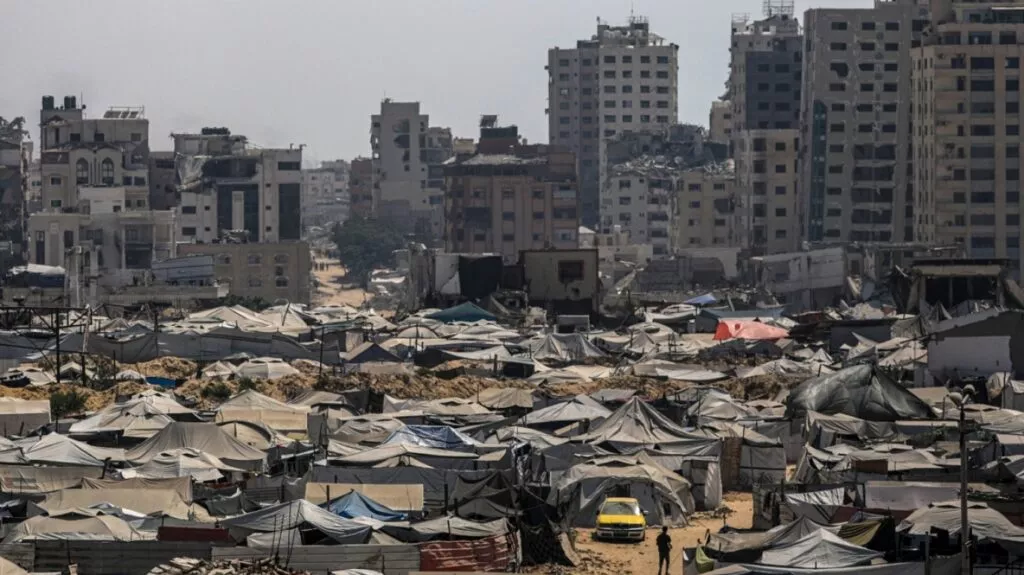
As winter sets in, Gaza’s already displaced population faces a new wave of hardship, with severe flooding, freezing temperatures and restrictions on humanitarian deliveries leaving thousands without adequate shelter or access to essential supplies.
The first storm flooded more than 70,000 tents, damaged shelters and disrupted essential services, affecting over 220,000 people. Some people, including children, had died from hypothermia, according to Lahbib.
“Meanwhile, more than 150,000 tents purchased by humanitarian partners and EU member states were waiting outside Gaza, unable to reach displaced families,” she added.
The Commissioner said critical humanitarian supplies could enter Gaza only one day per week because of restrictions linked to their classification as dual-use items. She described the criteria as arbitrary and demanded clear and predictable rules.
“The world doesn’t lack humanitarian funding or supplies,” she said, “Gaza simply lacks access to them.”
Lahbib argued that the obstacles were political rather than logistical, insisting that a meaningful increase in humanitarian deliveries required a change in Israeli government policy.
She cited a joint demand by 53 states and international organisations, alongside all 27 EU member states, calling for the reopening of crossings, the removal of restrictions on essential supplies and the protection of humanitarian workers and civilians.
Boylan demands an end to trade with Israel
Irish MEP Lynn Boylan, of The Left group, called for the European Union to move beyond expressions of concern and humanitarian assistance, demanding an end to trade with Israel.
“The only thing that can fix this is sanctions, arms embargoes, ending the association agreement, banning settlement trade, and demanding compensation for the EU-funded infrastructure that was deliberately destroyed,” Boylan told Parliament.
Her intervention put the EU’s economic relationship with Israel at the centre of the debate, challenging the gap between European calls for respect for international law and the continuation of commercial ties.
Europe’s response and its limits
Lahbib confirmed that the European Commission had allocated more than €217 million in humanitarian assistance for Palestine in 2026. The EU was also facilitating medical evacuations to member states and helping transport humanitarian supplies through its ReliefEU mechanism.
Her closing remarks returned to the people behind the statistics: a child waiting for food, a mother searching for medical care and a family waiting for a tent stranded just across the border.
“We cannot claim to stand with people while the assistance they desperately need remains beyond their reach,” she told Parliament.
(Sources: European Commission)
Read more:

