


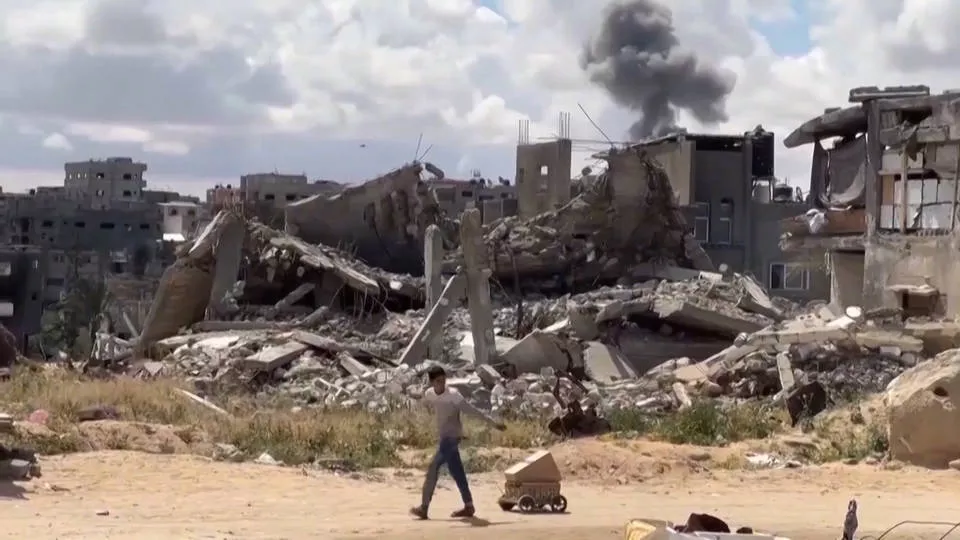
At least 10 Palestinians were killed and over 100 injured on Saturday when Israeli forces opened fire on crowds heading to a US aid distribution facility in the southern Gaza Strip, Gaza’s civil defence agency reported, as a proposed ceasefire deal stalled following Hamas’s response to the US-backed initiative.
Mahmoud Bassal, a spokesperson for Gaza’s civil defence, told Agence France-Presse (AFP) that “at least 10 Palestinians were killed and more than 100 of all ages were injured by fire from Israeli vehicles towards thousands of citizens heading on Saturday morning to an American aid facility west of Rafah.”
Reuters, citing Palestinian and Hamas-affiliated media, reported a higher death toll of 26 in what it described as a “strike on an aid centre” belonging to the newly established Humanitarian Foundation for Gaza (GHF), which is supported by the United States and Israel. The United Nations has previously criticised the GHF, stating it does not adhere to humanitarian principles and that the UN would not cooperate with it.
Ceasefire Talks Hit Snag as Hamas’s Response Deemed ‘Unacceptable’
The deadly incident occurred hours after Hamas announced on Saturday evening that it had submitted its response to a US proposal for a new ceasefire. However, Washington quickly dismissed Hamas’s reply as “completely unacceptable” and a “step backward.”
Hamas stated in a communique released on Saturday that it had “submitted its response to the latest proposal by the American envoy” for the Middle East, Steve Witkoff. Earlier in the week, Washington had assured that the proposal had already received the approval of the Israeli government, and US President Donald Trump had stated on Friday that both sides were “very close” to a new agreement.
On the same day, Israeli Defence Minister Israel Katz warned Hamas that it must either accept the US proposal – which provides for a ceasefire, the release of hostages abducted in the October 7, 2023 attack, and in exchange for Palestinian prisoners – or face “annihilation.”
Humanitarian Crisis Deepens Amid Stalled Negotiations
As Israel continues its war against Hamas in the Gaza Strip, it faces increasing pressure to end its operations, with the humanitarian situation for civilians described as catastrophic. The complete blockade of the enclave since March 2, though partially eased last week, has led to widespread shortages of food, medicine, and other essential supplies.
Hamas explained in its response to the proposal that “ten living captives… held by the resistance will be released, and an additional 18 bodies will be returned, in exchange for (the release of) an agreed number of Palestinian prisoners” from Israel.
Of the 251 people abducted on October 7, 2023, in southern Israel, 57 remain in the Gaza Strip, though at least 34 of them are dead, according to Israeli authorities. Hamas also holds the body of an Israeli soldier killed in 2014, in a previous war in the enclave.
“Hamas’s response is completely unacceptable and only takes us backward,” Witkoff commented on Saturday via X. “Hamas should accept the framework proposal we put forth as a basis for proximity talks we can begin immediately next week,” he added without providing further details.
Israeli Prime Minister Benjamin Netanyahu also called Hamas’s response “unacceptable,” judging that it pushes “the process backward,” according to a statement from his office.
“We did not reject Witkoff’s proposal,” countered Bassem Naim, an exiled member of Hamas’s political bureau, speaking to AFP, stressing that it was the Israeli response to that proposal that “contradicts all the provisions we had agreed upon.”
However, “now we have responded in a positive and responsible manner, in a way that satisfies the demands and minimum wishes of our people,” the Hamas politburo member added. He clarified that the movement seeks a guarantee that the 60-day ceasefire agreement will be respected by Israel and that it will be accompanied by a massive flow of humanitarian aid into the enclave, as well as negotiations for a permanent end to the war. He also accused Washington of bias, rhetorically asking why “one side is always absolutely in favour of another.”
On May 19, Netanyahu stated that he would not rule out a deal that would include an end to the war, but added that it would have to include the “exile” of Hamas and the “complete disarmament” of the Gaza Strip. These demands have been repeatedly rejected by the Palestinian Islamist movement, which has been in power in the enclave since 2007.
According to two informed sources, the American proposal stipulates that the 60-day truce could be extended for another ten days, reaching 70 days, and that Hamas would return 5 living hostages and 9 bodies to Israel in exchange for the release of Palestinian prisoners and an equal number of living and dead in the second phase.
The unprecedented assault by Hamas militants on southern Israel on October 7, 2023, which triggered the war, claimed the lives of 1,218 people on the Israeli side, mostly civilians, according to an AFP count based on official data.
Over 54,321 Palestinians, mostly civilians, have been killed since then in extensive Israeli retaliatory military operations, according to the latest figures from the Hamas-run Health Ministry in Gaza, which are considered reliable by the United Nations.
Indirect negotiations for a new truce and hopefully an end to the war have not yet borne fruit since the Israeli army resumed its operations in mid-March, ending a two-month truce. The Israeli army escalated its offensive in mid-May, with the publicly stated goal of bringing “all” of the Palestinian enclave under its “control.”

