


Rising sea levels could submerge entire cities within 75 years if carbon emissions continue to increase, according to new research from Singapore’s Nanyang Technological University (NTU).
The study predicts global sea levels could rise by 1.9 metres by 2100 under a high-emissions scenario, significantly higher than previous United Nations estimates of 0.6 to 1 metre.
“The high estimate of 1.9 metres highlights the need for decision-makers to prepare appropriate infrastructure”, said Dr Benjamin Grundy, the study’s lead author.
“More importantly, these results emphasise the significance of climate action through reducing greenhouse gas emissions”.

The NTU researchers used a novel “fusion” approach, combining statistical methods with expert estimates, which they argue provides a more reliable projection of future sea level rise.
Under a low-emissions scenario, the fusion model projects sea levels are likely to rise between 0.3 and 1.0 metres by 2100. However, in a high-emissions scenario, the increase could range from 0.5 to 1.9 metres.

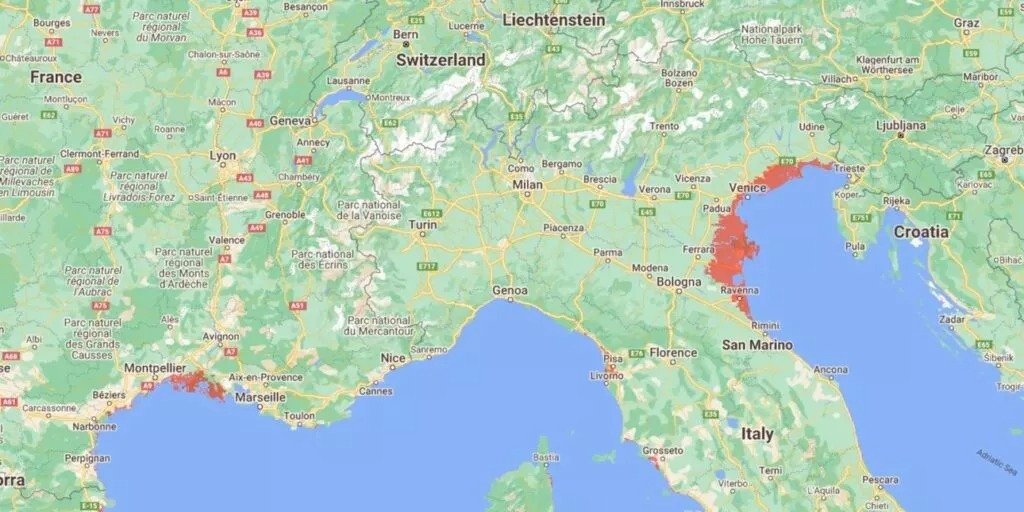
Climate Central’s Coastal Risk Screening Tool identifies numerous vulnerable regions. In the United Kingdom, the eastern coast of England and large parts of London along the Thames, including Bermondsey, Greenwich, Battersea and Chelsea, face significant risks.
Across Europe, the coastline from Calais to southern Denmark could be submerged, including Venice. In the United States, several southern cities including New Orleans, Louisiana, Galveston, Texas, and the Florida Everglades are particularly vulnerable.

Current sea level predictions rely on various climate modelling methods, incorporating well-understood phenomena like glacier melting alongside more uncertain events such as ice shelf collapse, leading to varying projections.

(information from iefimerida.gr)
Read more:

