


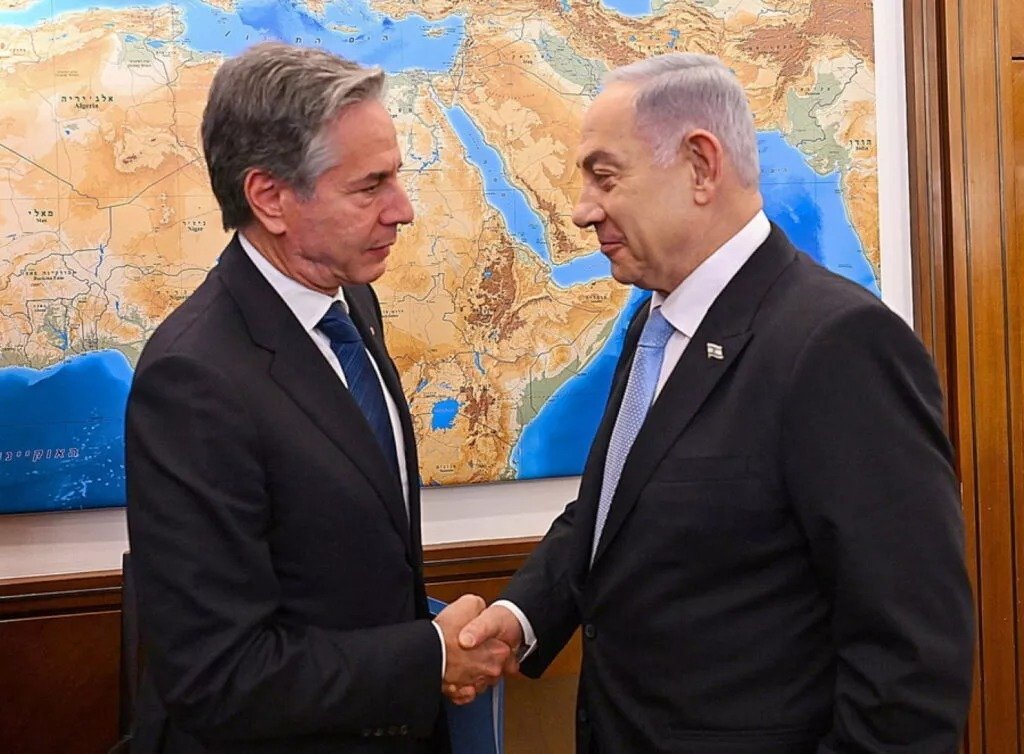
US Secretary of State Antony Blinken urged Hamas on Tuesday to accept the latest American proposal for a ceasefire in the Gaza Strip, though he acknowledged ongoing differences with Israel as he concluded his ninth visit to the region since October 7.
During his visit, Blinken cautioned that the ceasefire proposal could represent the “last chance” to bring an end to the conflict.
As the war enters its 320th day, time is “running out”, Blinken remarked following his stops in Qatar, Egypt – all countries involved in mediation efforts alongside the US.
Both Israel and Hamas have accused each other of hindering progress in truce negotiations, while global concern over the conflict’s potential regional escalation grows.
“Every day that goes by, there’s the prospect of more danger, more violence, more loss of innocent life,” Blinken told reporters before departing Doha, where he met with Qatar’s Foreign Minister, Mohammed bin Abdulrahman bin Jassim Al Thani.
A deal is “necessary”, he said. “It needs to happen, needs to happen now. And we will do everything we can to get there.”
Last Friday, the United States submitted a compromise proposal during the negotiations in Doha between Israel and the mediators. More talks are expected in Egypt this week.
Blinken stated on Monday that Israeli Prime Minister Benjamin Netanyahu had “accepted” the plan and urged Hamas to “do the same”, reiterating the call on Tuesday.
However, Israeli media reported that Netanyahu is insisting the Israeli army retain control over the Philadelphia corridor, a narrow strip of land along Gaza’s border with Egypt.
Blinken stressed that from the start, it had been made “very clear” that the US does not support the long-term occupation of Gaza by Israel.
He added that Israel had agreed on the “locations” and “timing” of the “withdrawal” of its forces.
A US official accompanying Blinken, speaking on condition of anonymity, criticised the Israeli Prime Minister’s “maximalist statements”, describing them as “not helpful” in securing a truce.
While Blinken recognised that differences remain, he urged both Israel and Hamas to demonstrate “maximum flexibility”.
Egypt, which became the first Arab state to sign a peace deal with Israel, is grappling with frustration over Israel’s military takeover of the border crossing in May.
Hamas, meanwhile, emphasised its willingness to reach a ceasefire but rejected the “new conditions” imposed by Israel and included in the latest US proposal.
The group is advocating for the implementation of a previous proposal that was referred to by US President Joe Biden on May 31 and accepted by Hamas in early July. This plan outlined a six-week truce, Israeli military withdrawal from densely populated areas of Gaza, a prisoner exchange, and full Israeli withdrawal in the second phase.
Netanyahu has repeatedly declared his intent to continue the war until Hamas, which has governed Gaza since 2007 and is classified as a terrorist organisation by both the US and the EU, is eradicated.
On October 7, Hamas’s military wing launched a large-scale raid into southern Israel, resulting in the deaths of 1,199 people, mostly civilians, according to figures compiled by Agence France-Presse from official Israeli sources.
Of the 251 individuals abducted that day, 105 are believed to still be held in Gaza, although 34 have been declared dead by the Israeli military.
In retaliation, Israeli military operations have resulted in the deaths of at least 40,173 people in Gaza, according to the Hamas-run health ministry. The UN estimates that most of those killed were women and children.
On Tuesday, the Israeli military reported it had recovered the bodies of six Israeli hostages from an underground tunnel in Khan Yunis, southern Gaza. Five of the hostages had been declared dead previously, with the sixth’s death confirmed yesterday.
In the blockaded and war-ravaged Gaza Strip, where nearly the entire 2.4 million population has been displaced at least once, Israeli airstrikes and ground operations show no signs of abating.
In addition to a recent school strike, six Palestinians were killed in Rafah, southern Gaza, according to medical sources. Four more people died from Israeli fire in an eastern Khan Yunis district, according to a local doctor.
Another seven Palestinians were killed in an Israeli airstrike on Deir al-Balah, central Gaza, civil defence officials reported.
For the US, securing a ceasefire in Gaza is seen as key to averting possible attacks on Israel by Iran and its allies, including Hezbollah in Lebanon, Hamas, and other groups across the region.
Iran and its allies have vowed to retaliate for Israel’s alleged killing of a Hamas leader in Tehran on July 31 and, hours earlier, a Hezbollah commander in southern Beirut during an Israeli airstrike on July 30.
(information from protothema.gr)
Read more:

