Men in Cyprus can expect to spend around 19.8 years in retirement and women more than 22 years, both above the European Union average, according to research by Euronews on how long people across Europe spend retired. Within the EU, the longest retirement period is in Luxembourg, where men are expected to receive a pension for 22 years.
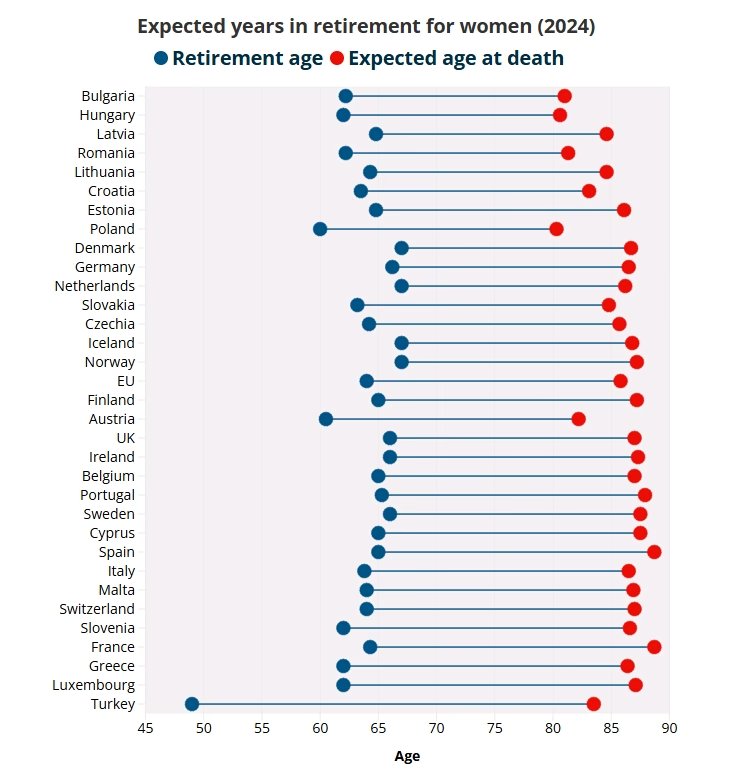
The EU retirement age in 2024 was 64.7 years for men and 64 years for women, according to the Organisation for Economic Co-operation and Development (OECD). Since citizens become entitled to a pension once they reach retirement age, Euronews Business used life expectancy at retirement age in each country to make its comparisons. Citizens can expect to receive a pension for that period provided they meet other conditions, such as the required number of years worked, and some continue working after reaching retirement age.
Years in retirement across Europe
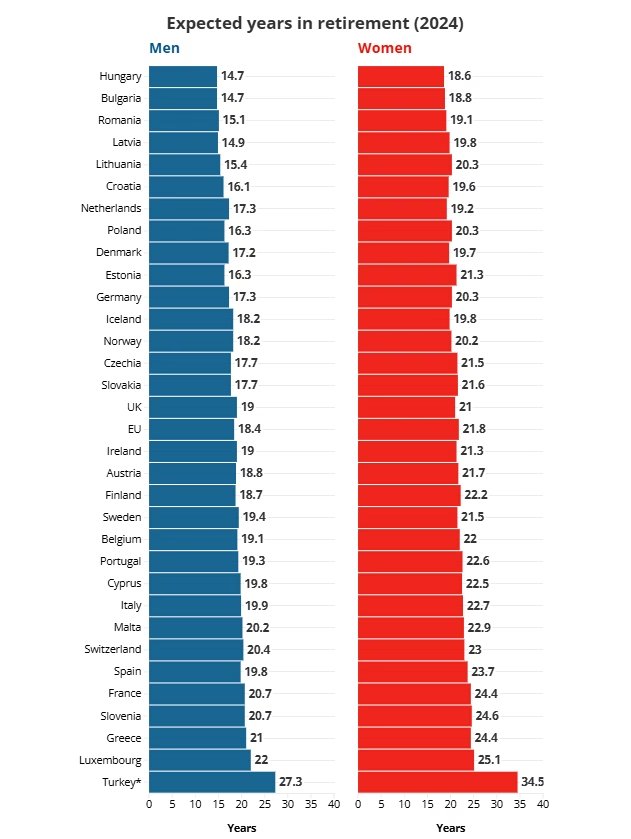
Men in the EU are expected to live an average of 18.4 years after retirement, compared with 21.8 years for women, based on life expectancy at retirement age, according to Eurostat and OECD data for 2024. For men, the expected number of years receiving a pension ranges from 14.7 years in Bulgaria and Hungary to 27.3 years in Turkey. Euronews says this difference is mainly down to two factors: differences in retirement age and in life expectancy.
Male pensioners in Greece (21 years), France (20.7), Slovenia (20.7), Switzerland (20.4) and Malta (20.2) are also expected to spend more than 20 years in retirement. The expected number of retirement years is also higher than the EU average of 18.4 years in Cyprus (19.8), Sweden (19.4), Portugal (19.3), Belgium (19.1), Ireland (19), the United Kingdom (19), Austria (18.8) and Finland (18.7).
For women, the expected number of years in retirement is 21.8 in the EU, ranging from 18.6 years in Hungary to 34.5 years in Turkey, and exceeding 25 years in Luxembourg. Women in Slovenia, Greece, France, Spain, Switzerland, Malta, Italy, Portugal, Cyprus and Finland are also expected to spend more than 22 years in retirement.
Germany’s retirees below average
Euronews notes that, with the exception of Germany, men in the other major European economies are expected to spend more years in retirement than the EU average. In Germany, the figure is 1.1 years below the EU average, a significant gap compared with France, Italy and Spain. Outside Bulgaria and Hungary, male pensioners are expected to spend the fewest years in retirement in Latvia, Romania and Lithuania, where the figure is below 16 years.
Both Germany (20.3) and the United Kingdom (21) are below the EU average for women. Apart from Hungary, several countries see women expected to spend fewer than 20 years in retirement. These include Bulgaria (18.8), Romania (19.1) and the Netherlands (19.2), as well as Croatia (19.6), Denmark (19.7), Latvia (19.8) and Iceland (19.8).
Turkey’s retirement age exception
In 2024, Turkey was an exception among the 32 European countries covered, with a retirement age of 52 for men and 49 for women. Outside Turkey, retirement age ranges from 62 to 67 for men and from 60 to 67 for women across the rest of the countries on the list. Life expectancy is 83.1 years for men, compared with 85.8 years for women.
Gender gap in retirement and pensions
On average in the EU, women are expected to spend 3.4 years longer in retirement than men. This gap ranges from 1.6 years in Iceland to 7.2 years in Turkey, and is also four years or more in Estonia, Lithuania, Latvia, Bulgaria, Romania and Poland, though Euronews notes that labour force participation rates in these countries are comparatively lower.
There is also a gap in pension amounts between men and women. In OECD countries, women receive 23 per cent less in pensions than men on average, a gap that reaches 37 per cent in the United Kingdom.
Actual age of leaving the workforce
The average actual age at which people leave the workforce can differ from the official retirement age. In the EU, for example, the retirement age for men is 64.7 years, while the average exit age is 63.8. For women, the exit age is 62.9, compared with a retirement age of 64.
The most striking difference between retirement age and workforce exit age is in Turkey. Men there can retire at 52, but the average exit age is 60.8; for women, the equivalent figures are 49 and 60.5. Expected years after leaving the workforce in Turkey would be 18.2 for men and 22.6 for women, suggesting that although expected retirement years are highest there, the figure would be significantly lower if workforce exit age, rather than retirement age, were used instead.
Beyond how long people spend in retirement, Euronews notes that pensions are the main source of income for older Europeans, while pension levels vary widely across Europe, both in nominal terms and in terms of purchasing power.