


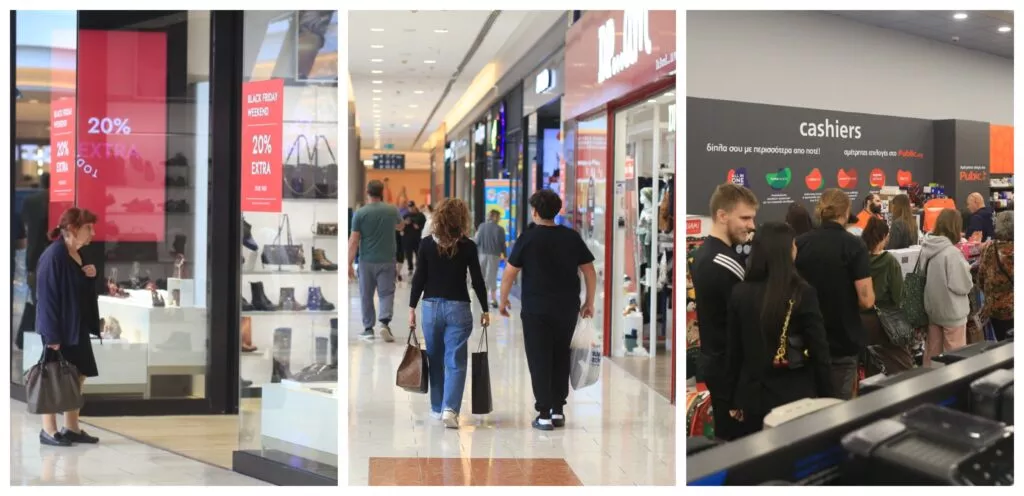
Cypriot consumers are expected to be more cautious with their spending this Black Friday, on 27 November, as rising living costs and pressure on household budgets weigh on shopping decisions, retail and consumer representatives told the Cyprus News Agency (CNA).
Marios Antoniou, secretary-general of the Cyprus Retail Trade Association, said shopping activity remained at normal levels so far, while Virginia Christou, legal adviser to the Cyprus Consumers Association, predicted that consumers would focus on planned purchases rather than impulse buying.
Black Friday traditionally marks the start of the festive shopping season, followed by Cyber Monday and promotional offers on flights and accommodation in early December, ahead of Christmas shopping.
Not all retailers will offer Black Friday discounts
Christou explained that Cyprus does not have a legally fixed sales season, meaning businesses can offer discounts whenever they choose.
As a result, she said, many retailers may decide not to participate in Black Friday promotions.
Some businesses, particularly technology retailers, have already been offering Black Friday discounts since late October.
Antoniou said retailers were hopeful about the shopping period but remained realistic about consumer behaviour.
With inflation and the high cost of living putting pressure on household finances, shoppers are increasingly limiting their spending to essential goods, he said.
Reduced purchasing power has also affected impulse buying, although consumers interested in technology products are more likely to monitor prices in advance and proceed with purchases when they find a worthwhile offer.
Asked whether Black Friday had lost some of its appeal, Antoniou said consumer confidence was an important factor in determining how the shopping period would unfold.
Weather conditions also influence shopping habits, he said, adding that temperatures had not yet encouraged consumers to buy seasonal items.
Retail activity has remained normal so far, but the coming days will provide a clearer indication of Black Friday demand.
Spending on clothing and footwear remains relatively subdued, Antoniou said, as many shoppers are holding off until the January sales.
Consumers are also awaiting government measures aimed at easing financial pressures. The retail association has submitted proposals for relief on products including firewood, toilet paper and gas, which are subject to 19% VAT.
Antoniou added that the payment of public sector salaries, expected on 27 November, could help boost shopping activity on Black Friday.
Despite inflationary pressures, Cyprus’s retail sector continues to perform strongly in both sales value and volume.
According to the latest Statistical Service figures cited by Antoniou, retail trade increased by 10.4% in value and 7.7% in volume in September compared with the same month a year earlier.
He linked the strong performance partly to tourism and the contribution of foreign residents living permanently in Cyprus, whom he said had brought additional momentum to the retail market.
Consumer warnings over misleading discounts
The Cyprus Consumers Association is urging shoppers to research prices carefully before making Black Friday purchases.
Christou advised consumers to start monitoring prices at least a month in advance to determine whether advertised discounts represent genuine savings.
She warned shoppers to be particularly cautious about unusually large discounts.
According to Christou, typical discounts in the Cypriot market range from 20% to 25% for clothing and footwear, rising to 40% for older stock. Technology products generally attract discounts of between 20% and 30%.
Offers advertising reductions of 75% to 90% should raise suspicions, she said, because they could potentially involve online scams designed to take consumers’ money.
Christou also reminded retailers that advertised price reductions must be calculated against the lowest price charged for a product during the preceding 30 days.
She gave the example of a product originally priced at €100, reduced to €50 at the beginning of November and subsequently returned to €100.
If the retailer then decides to offer a Black Friday discount, the reduction must be calculated from €50, the lowest price during the previous 30 days, rather than the restored €100 price.
Christou said this requirement was one reason some businesses might avoid Black Friday promotions and instead wait for the winter sales.
Asked whether businesses were complying with the rule, she said supervisory authorities needed to carry out checks.
With thousands or even millions of products circulating in the market, effective monitoring by the Ministry of Commerce was necessary, she said, adding that information on businesses’ compliance should also be made available.
Online shoppers have 14 days to return purchases
Christou urged consumers to avoid buying from businesses or websites of questionable legitimacy and to check each retailer’s returns policy before placing an order.
She said consumers purchasing goods online generally have the right to return them within 14 days of receipt and obtain a refund, even when the products were bought during Black Friday promotions or at reduced prices.
For purchases made in physical shops, however, the retailer’s own returns policy applies.
Consumers report hidden charges and unavailable products
The Cyprus Consumers Association has already received several complaints connected to this year’s Black Friday promotions.
Christou described a complaint involving a technology retailer whose website advertised a product at a discounted price, only for additional charges to appear when the customer reached the checkout.
Another complaint concerned a technology business advertising Black Friday discounts online, although the product was shown as unavailable when the consumer attempted to complete the purchase.
The association also received a complaint involving a clothing and footwear retailer that advertised discounted products online and accepted payments before informing customers that the items were out of stock.
Christou said such practices could be misleading.
She advised affected consumers to submit a written complaint to the business and request an immediate refund.
If the retailer fails to respond adequately, consumers should report the matter to the Cyprus Consumers Association or the Ministry of Commerce.
Most complaints received by the association each year concern retailers’ returns policies, she said.
Consumers should therefore familiarise themselves with those policies before making purchases, as businesses may refuse refunds in certain circumstances.
Christou also highlighted potential disputes when customers seek to return products purchased before a sales period.
For example, someone who bought an item for €100 in October may wish to return it after its price has fallen to €50.
In such cases, disagreements can arise over the amount to be refunded.
Christou said the amount depended on the retailer’s returns policy, as the specific situation was not regulated by legislation.
Businesses are required to display their returns policies clearly, she added.
Flight and accommodation deals require careful checks
Black Friday-style promotions have also expanded into travel, with airlines and accommodation providers offering discounted fares and bookings.
Christou said the practice began internationally in 2017 and had become more noticeable in Cyprus over the past two years.
Discounts may be offered directly by airlines and accommodation providers or through booking platforms.
However, she warned that consumers should read the terms and conditions carefully before making reservations.
Discounted flights may only be available for travel during specific periods, and bookings outside those dates could result in additional charges.
Christou also noted that Cyber Monday, traditionally associated with technology products, was less established in Cyprus because Black Friday promotions frequently extend beyond one or two days.
She concluded that consumers who choose not to shop during Black Friday should not feel pressured to make purchases, as Cyprus has no fixed sales season and businesses can offer further discounts later.

