More shipping companies in the Eastern Mediterranean are setting climate targets, but more of them are also reporting obstacles to meeting those targets, according to a survey by the Hellenic Marine Environment Protection Association (HELMEPA).
In the second wave of the METAVASEA survey, 22 per cent of shipping company representatives said their company had a net-zero strategy in line with the International Maritime Organization’s (IMO) 2050 target, up from 14 per cent in the first wave. A further nine per cent reported a more ambitious strategy. Over the same period, the share citing financial constraints rose from 46 to 59 per cent. The share citing limited ability to implement changes rose from 29 to 50 per cent, and the share citing lack of awareness of available solutions rose from 27 to 50 per cent.
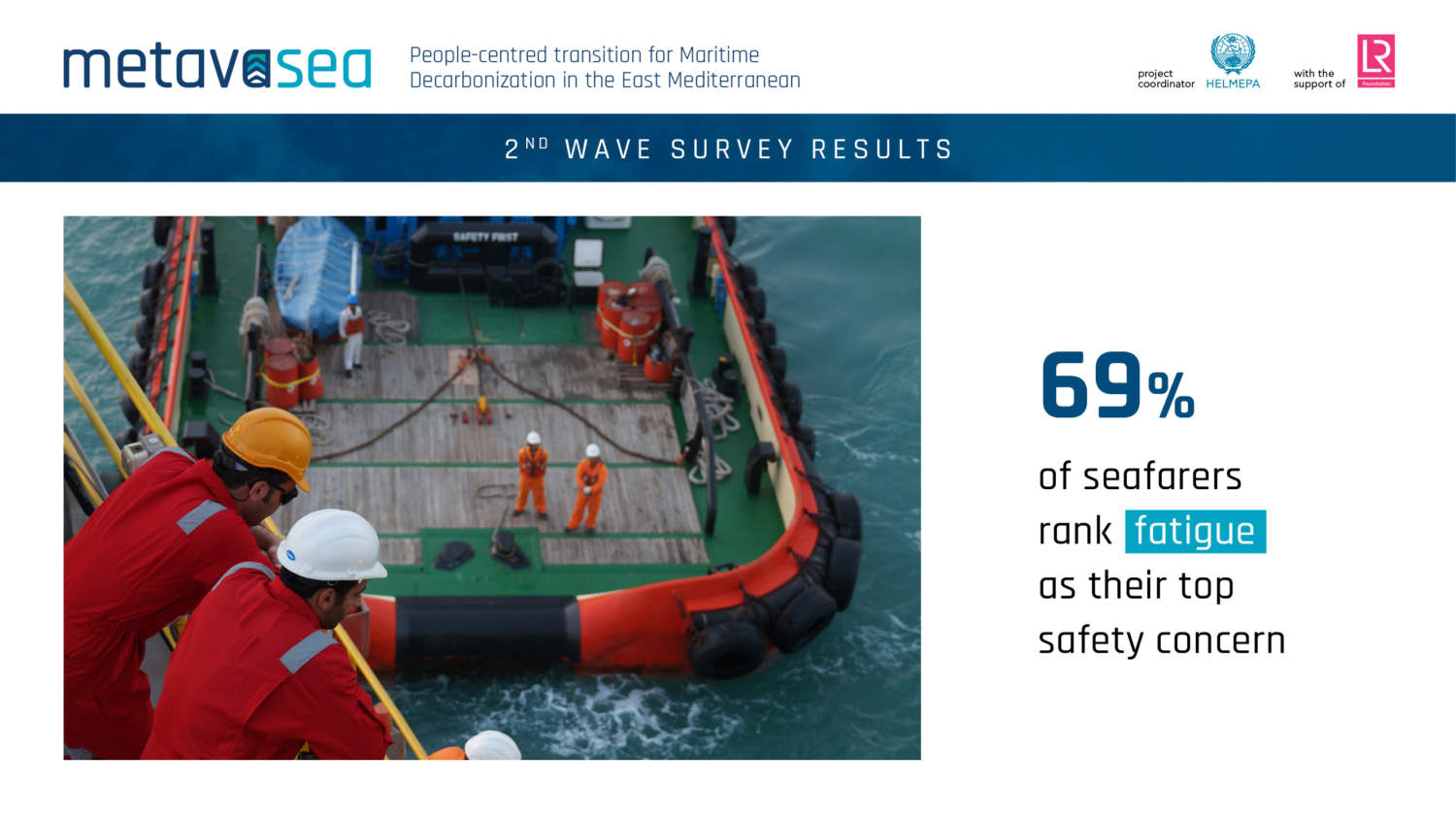
Crew fatigue remained seafarers’ biggest safety concern. Sixty-nine per cent named fatigue linked to extra responsibilities and workload from new regulations, almost unchanged from 70 per cent in the first wave. Lack of adequate training (25 per cent), lack of communication (24 per cent), handling unfamiliar equipment (24 per cent) and the use of new alternative fuels (22 per cent) completed the top five.
The findings, released on September 25 to mark World Maritime Day, are based on 1,182 responses. They came from seafarers, shipping companies, port administrations, service providers and suppliers, and civil society and port cities, bringing the total across both waves to 2,080. Data were collected between December 2024 and November 2025, around the time of the initial adoption of the IMO Net-Zero Framework at MEPC 83 in April 2025.
Seafarers
Seafarers’ familiarity with climate frameworks rose on every topic measured. Familiarity with the EU Emissions Trading System (ETS) rose from 34 to 47 per cent, with FuelEU from 33 to 45 per cent and with EU MRV from 30 to 41 per cent. For the first time, more than half were familiar with the IMO GHG Strategy, with familiarity up from 45 to 56 per cent. Familiarity with ESG indicators rose from 22 to 34 per cent, and with the EU’s Fit for 55 package from 20 to 29 per cent.
Forty-five per cent said they had received decarbonisation training in the past two years, up from 36 per cent. However, 55 per cent still reported none, down from 64 per cent. Among those trained, the share who were very or extremely satisfied rose from 56 to 65 per cent. Training focused mainly on alternative fuels (66 per cent), the EU ETS (36 per cent), MRV (25 per cent) and FuelEU (24 per cent).
Companies and seafarers increasingly disagree on which skills matter most. Shipping companies gave more weight to the following seafarer skills than in the first wave:
- leadership, from 40 to 50 per cent
- teamwork, from 36 to 50 per cent
- resilience, from 18 to 30 per cent
- adaptability, from 27 to 37 per cent
Seafarers’ own priorities held steady or moved the other way. Resilience fell from 15 to nine per cent, while adaptability held at 12 per cent and leadership at 44 per cent.
Fuels and digitalisation
Biofuels were the most widely used or planned alternative fuel among shipping companies, at 59 per cent. The share using or planning LNG fell from 25 to nine per cent, methanol from 19 to 11 per cent and ammonia from 14 to seven per cent. For long-term potential, biofuels also led at 46 per cent, followed by green hydrogen (20 per cent), green methanol (17 per cent) and green ammonia (15 per cent).
Seventy per cent of company representatives said they used performance monitoring tools, and 79 per cent of seafarers rated basic digital training as very or extremely necessary, up from 73 per cent. Yet digital and cybersecurity skills were ranked as a core seafarer competency by only a minority of each group:
- shipping companies: 17 per cent, up from 12 per cent
- seafarers: 16 per cent, up from 10 per cent
- service providers: 11 per cent, up from six per cent
Cybersecurity as a safety concern among seafarers rose from eight to 11 per cent.
Public views and ports
Among civil society respondents, 73 per cent rated maritime decarbonisation as highly or very highly important, down from 78 per cent. Seventy-eight per cent were very or extremely concerned about local environmental impacts, down from 87 per cent. Fifty-five per cent rated shipping’s contribution to global greenhouse gas emissions as very or extremely significant. HELMEPA noted that this rating was not an estimate of the sector’s share, which it put at about three per cent of global CO₂ emissions. Forty-one per cent were unaware of any efforts to cut shipping emissions, and 35 per cent were unsure which alternative fuel held most promise.
Only one port administration, the Port of Tripoli in Lebanon, responded to the second wave. Port findings were therefore based on the 11 ports across both waves. Of these, 73 per cent had no low-carbon fuel infrastructure, 45 per cent could not monitor ship emissions and 36 per cent had no planned decarbonisation measures.
AI in shipping
The survey has produced its first youth-led spin-off, ‘Can We Trust the Machine?’, on artificial intelligence and autonomous systems in shipping. A 16-year-old HELMEPA Youth Ambassador Leader designed and carried out the survey under the academic supervision of Professor Dimitris Lyridis of the National Technical University of Athens. It drew responses from 236 maritime professionals between June 28 and July 31, 2026.
Fifty-seven per cent of respondents wanted a human to supervise every AI decision, and only nine per cent were willing to accept a reduced human role. Forty-eight per cent said a clear explanation of how the AI reached a recommendation would increase their trust. Support for human oversight rose with experience, from 43 per cent among those with fewer than five years in the industry to 60 per cent among those with more than 30 years.
A second spin-off, ‘Is Training an Investment or a Cost’, has been launched by another HELMEPA Youth Ambassador Leader. It is under the academic supervision of Christopher Wiernicki, MIT NAVSEA Professor of the Practice in Mechanical Engineering.
The project
METAVASEA, Greek for “transition”, is a five-year project running until 2027. It is coordinated by HELMEPA with strategic and financial support from Lloyd’s Register Foundation, and takes a people-centred approach to maritime decarbonisation in the Eastern Mediterranean. Its partners include:
- Lloyd’s Register
- the World Maritime University
- the Cyprus Marine and Maritime Institute
- Premium Consulting
- MIO-ECSDE
- CYMEPA
It also involves 12 associate partners and more than 90 HELMEPA member companies and other stakeholders across the region.
The findings were presented for expert discussion at the 3rd European Conference on Shipping, Intermodalism and Ports (ECONSHIP) in Chios on September 25. They will also be discussed at a METAVASEA workshop on people-centred maritime decarbonisation at the World Maritime University in Malmö on October 2. The third wave of the survey runs from December 2025 to April 2027.