


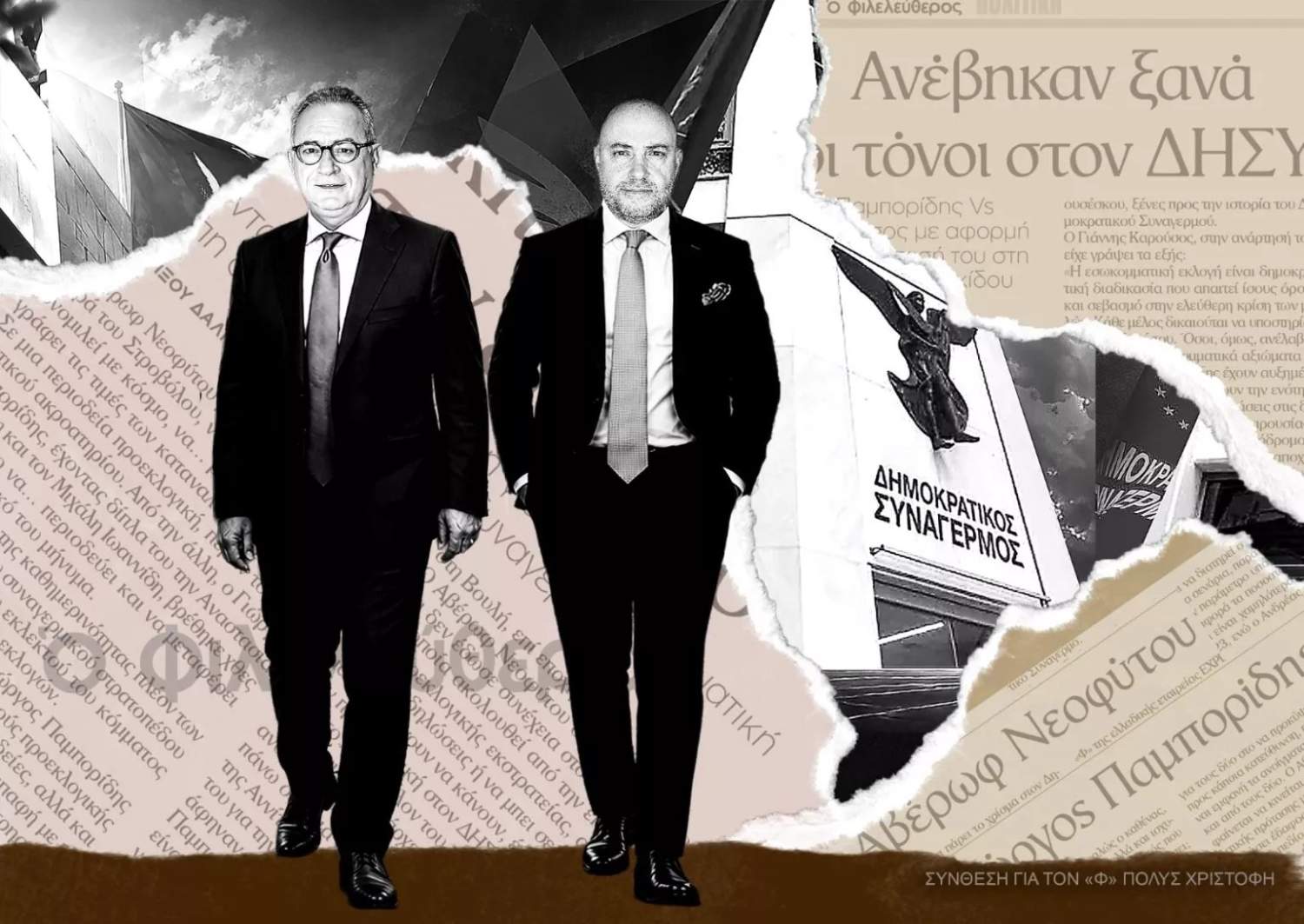
Giorgos Pamborides has stepped up his challenge to Averof Neofytou ahead of Saturday’s vote, in which Democratic Rally (DISY) members will for the first time directly choose the party’s candidate for the 2028 presidential election.
With the last rallies held and the final messages sent, the two camps’ phone banks have been running flat out. In the closing stage of the campaign, each contender is sticking to his own tactics.
Pamborides raised the temperature with a video on his personal social media account, effectively throwing down the gauntlet to his rival. Neofytou did not take up the challenge.
Neofytou continues to avoid public statements. He is focusing his campaign on gatherings at the clubs of local party committees and on talks with members. For some time he has posted daily photos and videos from well-attended gatherings, which show him talking to those present.
In his video, Pamborides told members that Saturday was a very important day for DISY, because for the first time they would choose the party’s presidential candidate themselves. Each member’s vote carried as much weight as his own, or that of Neofytou, party leader Annita Demetriou or former President Nicos Anastasiades, he said, and their choice would shape the future of the party and the country.
He said some people had made huge efforts in recent days to convince members that the election had already been decided and that voting was not worth the trouble. He assured them it was anything but decided.
“Very close”
Pamborides struck the same note on ANT1’s midday programme, hinting at efforts to discourage members from voting by creating the impression that the result was a foregone conclusion.
“Nothing has been decided, things are very close,” he said. He urged the party’s roughly 49,000 members to turn out and decide the party’s future themselves, arguing that every ordinary member’s vote counted exactly as much as those of DISY’s veteran figures.
He said he had found strong disappointment and anger in his contacts with the grassroots. In his view, DISY supporters gave the party another chance at the last parliamentary elections, only to be confronted again with infighting.
His aim, he said, was to put internal feuding behind the party and lead it away from the dead ends of the 2023 presidential election. He said turnout of around 50 per cent would be particularly satisfying, noting that about 20,000 members voted in the previous internal election for the DISY leadership.
Pamborides said he had the backing of prominent DISY veterans, naming Ioannis Kasoulides, Stella Kyriakides, Anastasia Anthousi and Michalis Ioannides.
He regretted that the two candidates had not held a public debate, saying it would have allowed members to compare their positions. He also acknowledged that the short campaign had been a serious handicap, noting that his rival had the advantage of years in the party’s leadership.
His remarks on possible alliances, should he win the nomination, drew particular interest. He said he would first draw up a preliminary programme, discuss it with DISY’s collective bodies and leadership, and then seek common ground with other political forces.
He made clear, however, that he would not seek cooperation with AKEL. He also ruled out ELAM, which he said lay outside the democratic arc. He said he was willing to talk to DIKO, DIPA, EDEK and even ALMA, if they were interested.
Pamborides described the contest as pivotal for DISY. What was at stake, he said, was not just the choice of a candidate but the party’s political direction. He framed it as a choice between continuing a transactional approach to politics and turning towards reform, to bring change to the country and better prospects for young people.
He confirmed he would be present when the results are announced on Saturday evening, whatever the outcome.
Prodromou questions the process
Also drawing attention was a social media post by Prodromos Prodromou, who raised a series of questions about how DISY is choosing its candidate.
Prodromou wrote that the debate, which he described as probably premature, had been dominated by the question of who would run for president. Once a candidacy by the party leader had been ruled out by what he called the “known (?)” incidents, he wrote, the party moved to a process to select another candidate. With several figures interested in the nomination, the idea took hold that some kind of primary was needed.
He questioned whether the US-style primary was the fair and effective model it is taken to be. Historically, he wrote, the method was meant to curb the once all-powerful party bosses in the United States, so they could not hand-pick candidates at will. But US parties are not the strictly hierarchical organisations that Cypriot parties are, he argued.
In DISY, he noted, all members already take part in electing the party’s leadership. With such a party hierarchy of president, deputy leader and vice-presidents, he asked whether a separate election could be held at the critical moment of a presidential race. “There seems to be a serious mismatch,” he wrote.
He asked what position and standing the party leader would have if someone else won such a primary, and whether they could still lead once members had judged another person better placed to run. He also questioned whether the ability to lead the party into a contest for power was not among the qualities expected of its leader.

