


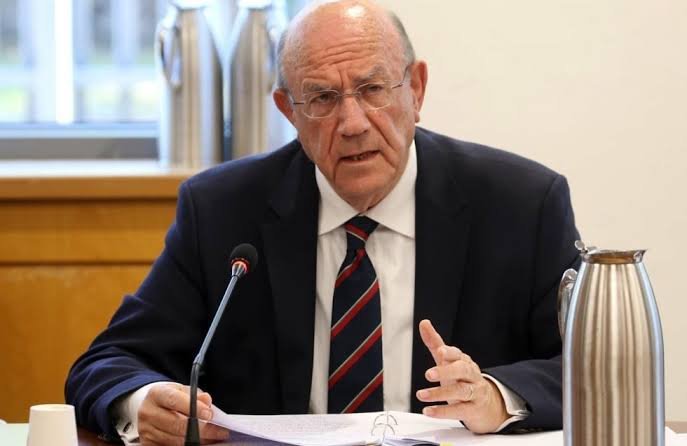
Finance Minister Makis Keravnos on Thursday defended the 100,000-euro income ceiling in the government’s 65-million-euro support package, saying it was based on analysis by the Cyprus Statistical Service (Cystat).
Responding to criticism of the 12 measures announced by President Nikos Christodoulides on Wednesday, Keravnos said the government aimed to move gradually towards more targeted support, alongside permanent infrastructure and institutional policies.
He was speaking at a news conference on the 225-million-euro amending budget for 2026, which he said was fiscally neutral. A large part of the support package is included in the amending budget, with the rest already provided for in the 2026 state budget, he noted.
Middle-class threshold
Cystat’s analysis uses international criteria, such as those of the Organisation for Economic Co-operation and Development (OECD), and puts the upper income level of the middle class at 100,000 euros, Keravnos said.
Asked about criticism that the definition covers too wide a range of incomes, he argued that policy and decisions should, as far as possible, rest on objective criteria and statistics that are also used by other European countries and allow comparisons.
He stressed that the measure was not the government’s only support for households, pointing to tax reform provisions that include benefits for families scaled by the number of children, and an interest rate subsidy on loans for first homes.
“Someone has to look at the overall picture, the forest, as the saying goes, and not each person at their own tree,” he said.
Permanent policies take time
Asked whether one-off payments to families were effective and helped tackle social inequality, Keravnos acknowledged that permanent infrastructure was preferable to temporary measures, but said comprehensive policies took time.
“I will agree that building permanent infrastructure that serves citizens is much better than any temporary measures. But it takes time,” he said.
For many years, policies on both infrastructure and institutions had not been pursued adequately in Cyprus, he said, and the government was now recognising and addressing those problems. “You cannot solve all the problems overnight. You cannot make all schools compulsory all-day schools overnight,” he added.
He noted that the Cypriot economy was now able to meet these needs, allowing institutional processes and infrastructure to be put in place. Responding to the point that the measures were temporary and tied to Christmas, he said a comprehensive policy required time, study, the drafting of bills and their approval by parliament.
“We respond to each case with the appropriate measures, while we plan institutional policies and infrastructure,” he said.
Low-income pensioners
Responding to complaints from low-income pensioners that the measures did not cover all of them, Keravnos said the government was tackling the problem through both support measures and pension reform. Dialogue on the pension reform is under way, and improving low pensions is a main aim of the first-pillar reform, he said.
“This government recognises the problem, and we are doing what we can and taking measures, always of course within the bounds of responsibility and our capabilities,” he said.
Asked whether the extra support was limited to Christmas, he said these measures covered the festive period, but other support measures taken earlier remained in force. He pointed to the lowest tax rates permitted on motor and heating fuels, saying Cyprus had applied for a further reduction and expected an answer soon. He also cited the zero VAT rate on a range of everyday products, including bread and milk.
Better targeting through the CY ONE CARD
Asked whether longer-term measures were needed, given that high prices are not limited to the festive season, Keravnos stressed the need to stay flexible in responding to needs as they arise and to gradually improve targeting.
He said developing the technology behind the CY ONE CARD would allow the government to intervene more directly and in a more targeted way, where and when needed. Asked whether the card could be used to give low-income pensioners targeted support for longer, he said it first had to be tested.
“It is an important step. If we can have this digital capability, a great many things can be improved and changed,” he said.
He also linked the pressures facing the public to ongoing armed conflicts, saying peace would allow more permanent policies aimed at the long-term prosperity of citizens and businesses.
Amending budget
The amending budget has been approved by the cabinet and tabled in parliament, where debate began on 23 November. Keravnos stressed that it was an amending budget and not a supplementary one, as some reports had suggested.
“A supplementary budget increases net primary expenditure, and this government consciously and responsibly does not table supplementary budgets,” he said.
He explained that the amending budget reallocates spending between projects, schemes and ministries, using savings in the state budget. “The amending budget is fiscally neutral and at the same time, through the reallocation of spending, strengthens specific categories of spending relating mainly to social benefits,” he said.
Besides social benefits, it is aimed at strengthening the defence shield and local government, with small infrastructure projects in every district as part of efforts towards balanced development.
Main additional funds
According to figures presented by the minister, the largest additional funds go to EU-funded and energy projects: about 57 million euros for co-financed projects, 37 million euros to complete Recovery and Resilience Plan projects and a 23-million-euro grant to the Renewable Energy Sources Fund to complete projects.
For defence and local government, the amending budget provides 20.3 million euros for the defence shield, 11.7 million euros in grants to municipalities to cover revenue lost after responsibility for planning permits was transferred to the District Local Government Organisations (DLGOs), and an extra 1.2 million euros in grants to local authorities for various projects.
Social spending includes an 8-million-euro government contribution to the Social Insurance Fund and 6 million euros for additional needs under the low-income pensioner allowance. Keravnos singled out 3 million euros to create three social reintegration hostels for people without a home, with 1 million euros going to each of the municipalities of Nicosia, Limassol and Larnaca.
Other funds include an extra 9 million euros for the Research and Innovation Foundation with an emphasis on artificial intelligence, 7 million euros for contractual obligations on computer equipment, software and services, 4.5 million euros for improvements to school buildings, 3.6 million euros in support for farming and livestock, and an extra 3.5 million euros for the Payment Fund of the Cyprus Agricultural Payments Organisation (CAPO).
(Information from Cyprus News Agency)

