


Cyprus and seven other European Union member states are calling on Brussels to take action against the malicious use of artificial intelligence. Phileleftheros understands that an informal policy paper, known as a non-paper, circulated by the eight countries calls for stricter oversight and greater transparency in platform algorithms, measures against the misuse of the technology and protection against impersonation.
At home, time is running out. Cyprus is heading towards the 2028 presidential election without an adequate protective framework or a body responsible for responding to such attacks and warning voters while the campaign is under way.
The 2028 election will take place in an environment unlike anything Cypriot voters have experienced before. Fake videos and audio recordings that can be produced in minutes, anonymous networks of paid advertising and chatbots offering voting advice are now part of the landscape of European elections.
Europe has already learnt some costly lessons. In Slovakia, a fabricated audio recording circulated during the pre-election silence period. In Romania, the first round of the presidential election was annulled. In Ireland, a fake news bulletin falsely announced that a candidate was withdrawing from the race. Countries such as France and Sweden have responded by establishing permanent mechanisms, while the EU has introduced legislation.
Cyprus had its first taste of the threat last January. An eight-minute video posted on X reached every major news outlet and thousands of viewers within hours. It took six months for an official body to conclude that it had been a hybrid attack.
That delay exposes the absence of mechanisms capable of responding quickly and effectively if something similar happens immediately before the presidential election or, worse, between the first and second rounds.
Under the current arrangements, there is no way to ensure that voters can be warned and protected in time, or that the integrity of the election result can be safeguarded against such an attack.
Concerns raised in Dublin
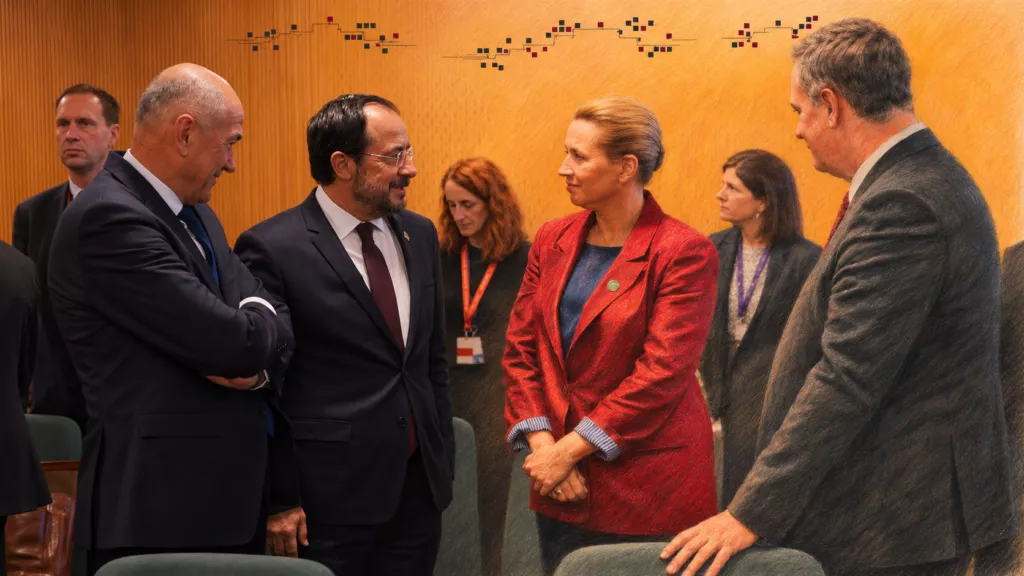
President Nikos Christodoulides now acknowledges the danger himself.
Arriving at the informal European Council summit in Dublin, he expressed concern that malicious actors were exploiting technology to influence election results in EU member states.
He pointed out that 2027 would be a year of elections across Europe and warned that “we are certainly all vulnerable to this technological threat”, including Cyprus.
The summit took place a week after a wave of cyberattacks and false bomb threats targeting airports, schools, supermarkets and newspapers across Europe.
Europol is investigating whether artificial intelligence was used, while the summit’s preparatory document warned of potentially systemic consequences for critical infrastructure.
The main agenda focused on Europe’s competitiveness and technological autonomy, but security and trust formed the second major strand of the discussions.
Nicosia also raised the issue of election security. With presidential elections scheduled for early 2028, Cyprus is placing particular emphasis on tackling foreign information manipulation and interference online.
This is the context in which the eight countries circulated their non-paper.
The concern is justified, and pressing Brussels to act is worthwhile.
Christodoulides himself identified the right test. It is not enough, he said, to “analyse afterwards” what malicious actors have done, because “as governments, we have an obligation to have the framework in place”.
Judged against that standard, the question for 2028 is not whether a deepfake will appear, but whether someone will have the authority, tools and credibility to tell voters, within hours, what is real.
The measures that could close this gap are already known and have been tested elsewhere. The challenge is to adopt them in time.
Who could interfere, and how?
Russia is the most extensively documented potential source of interference.
Cyprus has been a target of pro-Russian propaganda for years. Its shift towards the West since 2023, including support for Ukraine and the implementation of sanctions, has made it an even more attractive target.
In the Videogate affair, analysts identified similarities with the Russian Doppelganger disinformation campaign.
In October, a Lithuanian MEP called for an investigation into the activities of the Russian House in Cyprus in the context of hybrid threats.
Turkey and the structures operating in the occupied north represent a second possible source.
Last year, a European embassy advised Nicosia to prepare for Turkish and Russian disinformation. It subsequently clarified, however, that it was not attributing responsibility to the Turkish state.
There has so far been no publicly documented attribution of responsibility.
Russia is no longer the only potential source of such operations. Regarding recent cyberattacks targeting European shops, Belgium’s interior minister said Iran was “very likely” responsible, a development of direct relevance to a country on the edge of the Middle East.
The final category is the least discussed: hired private operators and domestic actors.
In the Videogate affair, investigators identified the involvement of a private intelligence company, but not who had paid it.
The anonymous paid advertising networks that appeared during May’s parliamentary elections were not attributed to foreign actors.
The methods are familiar: hacking and strategically timed leaks, fabricated videos and audio recordings, fake news bulletins designed to resemble those of established Cypriot media, anonymous paid promotion and networks of accounts amplifying divisive issues such as migration, the Cyprus problem and corruption.
The ultimate aim may not even be to help someone win. It may be to undermine confidence in the result itself, with potentially more serious consequences.
Such challenges to an election result extend far beyond the choice of a president or parliament. They can trigger a chain of reactions that could lead to social unrest, with all the implications that would have for the country.
Why 2028 will be the toughest test
Presidential elections bring together all the major risk factors.
They are contests between individual candidates, making it easier to target a single person. Opinion polls point to an open race, and with an electorate of roughly half a million, just a few thousand votes could determine who reaches the second round.
The week between the two rounds is the most vulnerable period.
In less than seven days, political alliances are formed, party supporters shift their allegiance and turnout becomes decisive.
A convincing fake video released during that week might not be debunked in time.
Cypriots are among the EU’s most active users of social media for news, particularly younger people. Political culture has already changed: a YouTuber was elected to the European Parliament in 2024.
Cyprus also ranks highly in the use of generative artificial intelligence.
According to Eurostat, 44.2% of people in Cyprus had used such a tool during the preceding three months in 2025, compared with an EU average of 32.7%. That placed Cyprus seventh among the bloc’s 27 member states.
The more voters turn to chatbots for information, the more important the answers they receive become.
Cyprus also sits at the intersection of Turkish, Russian and other interests, with actors who, as Videogate demonstrated, are willing to pay for influence.
The Chief Returning Officer is not an independent institution but a senior government official.
Until now, Cyprus has not experienced serious challenges to the conduct of elections or their results.
The changing environment will test another aspect of the system: how quickly and effectively the authorities can respond, and how willing the opposition will be to accept that a hybrid attack has taken place.
During Videogate, the opposition openly rejected the suggestion of foreign interference.
Cyprus: A 20th-century system facing 21st-century threats
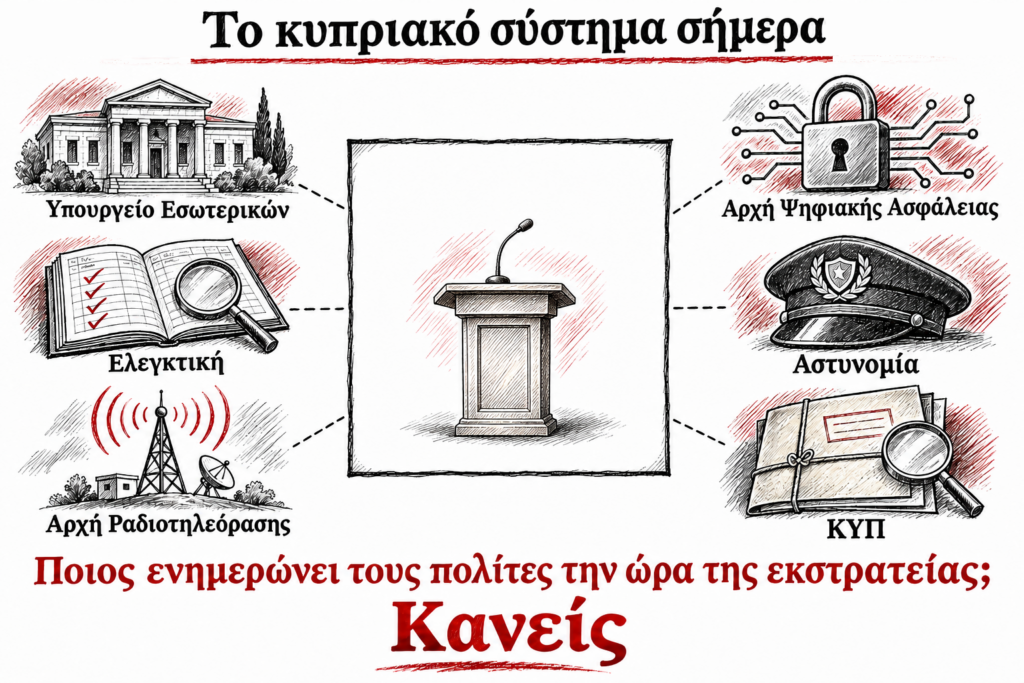
Cyprus follows what is known as the government model of election administration.
The Interior Ministry organises elections, with a Chief Returning Officer appointed three to four months before each vote.
Political finances are scrutinised retrospectively by the Audit Office. Its 2025 report on political parties covered the period from 2016 to 2021 and identified irregularities in all seven parliamentary parties.
Oversight of online platforms falls to the Cyprus Radio Television Authority, which received the necessary powers only after the European Commission referred Cyprus to the Court of Justice of the EU.
Cyprus has yet to pass legislation implementing the EU AI Act, while Greece adopted its own law in July.
Cyprus is not alone in missing deadlines. Sixteen member states failed to meet the August 2025 deadline for designating a national authority responsible for implementing the legislation.
On 10 November, the Council of Ministers approved the National Artificial Intelligence Strategy 2026–2032, which aims to turn Cyprus into an AI hub in the Eastern Mediterranean.
But this is a strategy for development, not defence.
One positive step came last March, when Cyprus passed legislation criminalising the publication of deepfakes without permission, following a proposal by AKEL MP Christos Christofides.
The problem is that enforcement depends on the courts, meaning action comes after the damage has already been done.
The situation is better in cybersecurity.
Cyprus has a Digital Security Authority, and the NIS2 Directive has been transposed into national law with strict requirements.
However, attacks are now a daily occurrence, according to the authority’s director, and the National Cyber Crisis Management Plan has not yet been adopted.
Nor is it clear whether the electoral register and the transmission of election results are treated as critical infrastructure.
Manual vote counting helps protect the result itself. But an attack on the transmission of results on election night could be enough to fuel doubts about the outcome.
The central gap remains: no institution has been given responsibility for dealing with hybrid attacks during an election campaign.
What Cyprus can do before voters go to the polls
Cyprus does not need to invent anything. There is already a European precedent for addressing each of these shortcomings.
What is needed is a political decision, and that decision must be taken in the coming months.
The first and most important measure is a permanent, independent mechanism to protect elections.
It would not require a large agency. A small core team accountable to parliament rather than the government would be sufficient, following the example of Ireland’s Electoral Commission.
That team would coordinate the Elections Service, the Cyprus Radio Television Authority, the Digital Security Authority, the police and the Cyprus Intelligence Service, along the lines of the Swedish model.
The second measure is a protocol specifically designed for the week between the two rounds of a presidential election.
It should include an agreed communication channel with major online platforms and a system for notifying candidates within hours when a deepfake is detected.
Third, Cyprus needs to pass the legislation implementing the AI Act, with clear penalties for failing to label AI-generated content.
Fourth, political advertising must be monitored while the campaign is taking place, rather than relying solely on spending audits conducted years later.
The fifth measure is the cheapest: a public commitment from candidates not to use deepfakes of their opponents, following the example set by Danish political parties in 2024.
Timing is crucial.
If decisions on the new mechanism and legislation are not taken by March 2027, there will not be enough time to test them before the election.
There is an understandable objection: the fear of censorship. Who gets to decide what is fake?
The answer is that such a body should not judge political opinions.
Its role would be limited to cases in which voters are deceived about the electoral process itself or about what a candidate actually said.
A video falsely showing a candidate announcing their withdrawal is not an opinion. It is deception.
The discussion about the 2028 presidential election has already begun.
Candidates will talk about the economy, housing and the Cyprus problem.
They should also be asked a simple question: what would they do if, on the Wednesday between the two rounds, a convincing fake video appeared featuring themselves or their opponent?
If their answer is that they would report it to the police, Cyprus is clearly not ready.
And the country would end up doing precisely what President Nikos Christodoulides said in Dublin was not enough: analysing the attack after the event.
Europe faces the same threat
What EU elections have revealed, what Brussels has decided and how countries voting in 2027 are preparing.
In Slovakia in 2023, a fabricated audio recording purportedly featuring liberal leader Michal Šimečka discussing electoral fraud circulated two days before the vote, during the pre-election silence period, when media outlets were unable to respond.
In Romania in 2024, the Constitutional Court annulled the first round of the presidential election just days before the second, following coordinated manipulation on TikTok in favour of Călin Georgescu, who had declared zero campaign spending.
Even when the election was rerun in 2025, observers from the OSCE Office for Democratic Institutions and Human Rights (ODIHR) found that oversight of online advertising and campaign financing remained ineffective.
In Ireland in 2025, a deepfake presented as an RTÉ news bulletin falsely announced that Catherine Connolly was withdrawing from the presidential race.
Connolly went on to win, but the incident demonstrated the next stage of the threat: it is no longer just politicians who are being impersonated. The news organisations that would normally challenge false claims can also be impersonated.
In Hungary in 2026, the largest source of AI-generated political content was not Moscow but the governing party itself.
European tools designed to combat foreign interference had little to offer in response.
The common pattern is clear.
In almost every case, the response came from platforms, journalists and researchers. Very few countries had a state body specifically tasked with detecting such operations and warning the public during an election campaign.
What Europe has decided – and where its protection ends
The EU now has four binding instruments: the Digital Services Act (DSA), the Code of Conduct on Disinformation incorporated into its framework, the Regulation on political advertising and Article 50 of the AI Act, which has required deepfakes to be labelled since 2 August 2026.
None of these measures prohibits political deepfakes outright. They require labelling.
In Hungary, many government-produced videos were clearly labelled as AI-generated, yet still achieved their intended effect because they appealed to emotions rather than relying on deception.
Russia, of course, is unlikely to label its content.
The political advertising regulation also produced an unintended consequence.
Meta and Google stopped carrying political advertising in the EU, while paid propaganda moved towards anonymous pages and influencers.
The European Democracy Shield and the European Centre for Democratic Resilience, which has been operating since February 2026, rely on voluntary cooperation.
In September, the European Parliament called for the centre to become a binding mechanism with a legal mandate and its own budget.
For now, responsibility remains with individual member states.
Three models facing three electoral tests in 2027
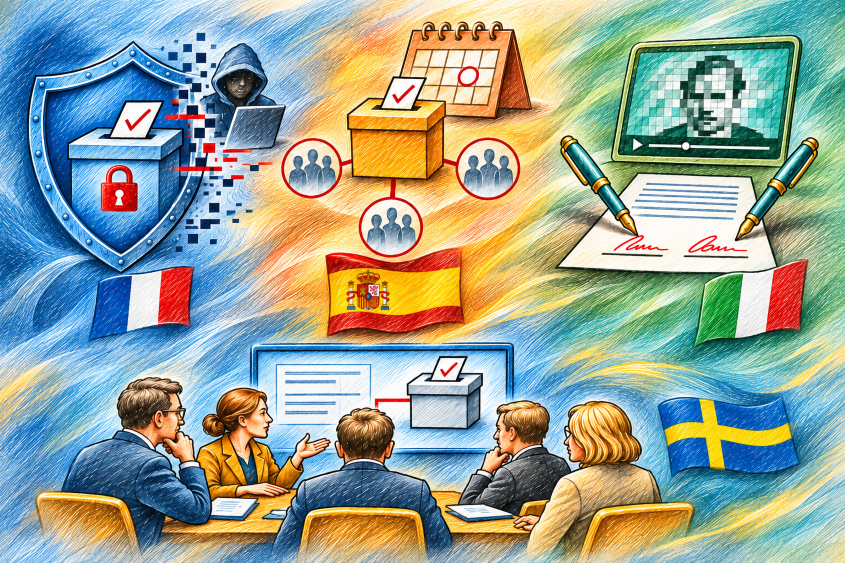
Three major European countries will hold elections in 2027, each testing a different response to the threat.
France has the most mature mechanism: VIGINUM, which operates under the General Secretariat for Defence and National Security.
According to its figures, more than 100 digital interference operations have already targeted April’s presidential election, compared with 25 during the 2024 elections.
Even there, however, French senators have pointed out that no equivalent tool exists to address manipulation originating within the country.
Spain establishes a coordination network under the Interior Ministry for each election.
This is the model most closely resembling Cyprus’s arrangements, but it is activated only when an election is called, while manipulation campaigns can begin months earlier.
Italy is taking a political approach, with a cross-party moratorium on deepfakes and proposals to give the communications regulator AGCOM powers to secure their rapid removal.
MP Anna Ascani put the problem clearly: criminalising the practice is not enough because the justice system operates on timescales far longer than those of an election campaign.
The model that deserves the closest attention is Sweden.
There, the Election Authority coordinates a permanent network involving the police, security services and the Psychological Defence Agency. Party leaders receive joint briefings on the threats.
Sweden went through its September election without a major coordinated attack.
Perhaps it was not Moscow’s primary target. But it was prepared.

