


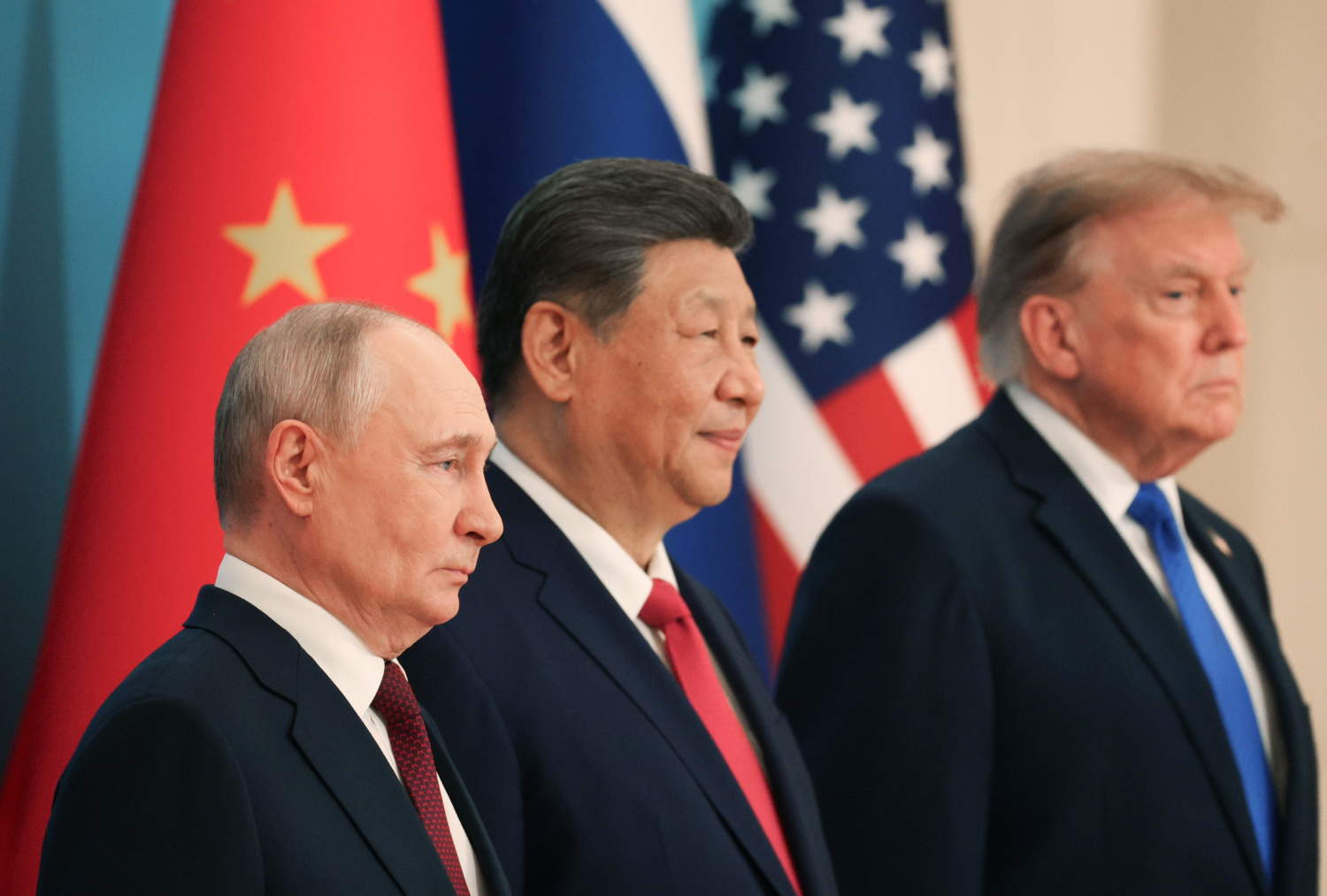
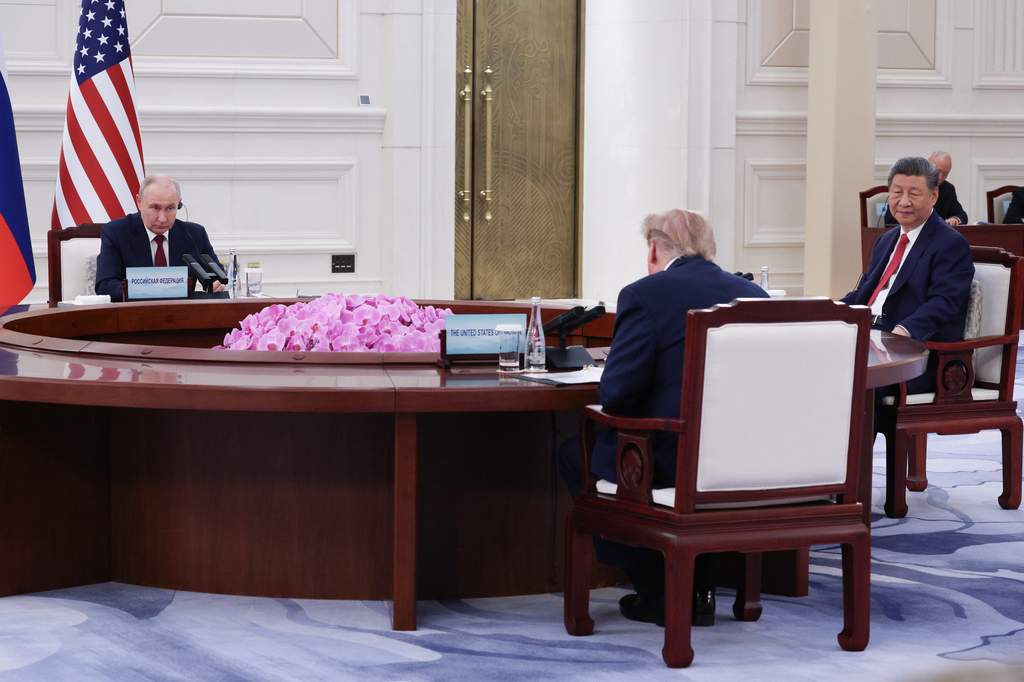
“We made history,” Donald Trump declared, appearing almost moved, shortly before meeting Vladimir Putin and Xi Jinping in China last Thursday, on the sidelines of the Asia-Pacific Economic Cooperation (APEC) summit.
The sight of the three leaders together was certainly unusual. Yet at a time of profound geopolitical change, with China and the United States competing for economic, military and technological supremacy, the talks produced no positive results. Instead, they exposed the divisions between Washington and Beijing and their fundamentally different interpretations of global developments.
As the first meeting of its kind, the summit in Shenzhen could reasonably be described as “historic”. But its tangible achievements hardly seem to justify Vladimir Putin’s claim that a “new chapter in the history of diplomacy” had been written.
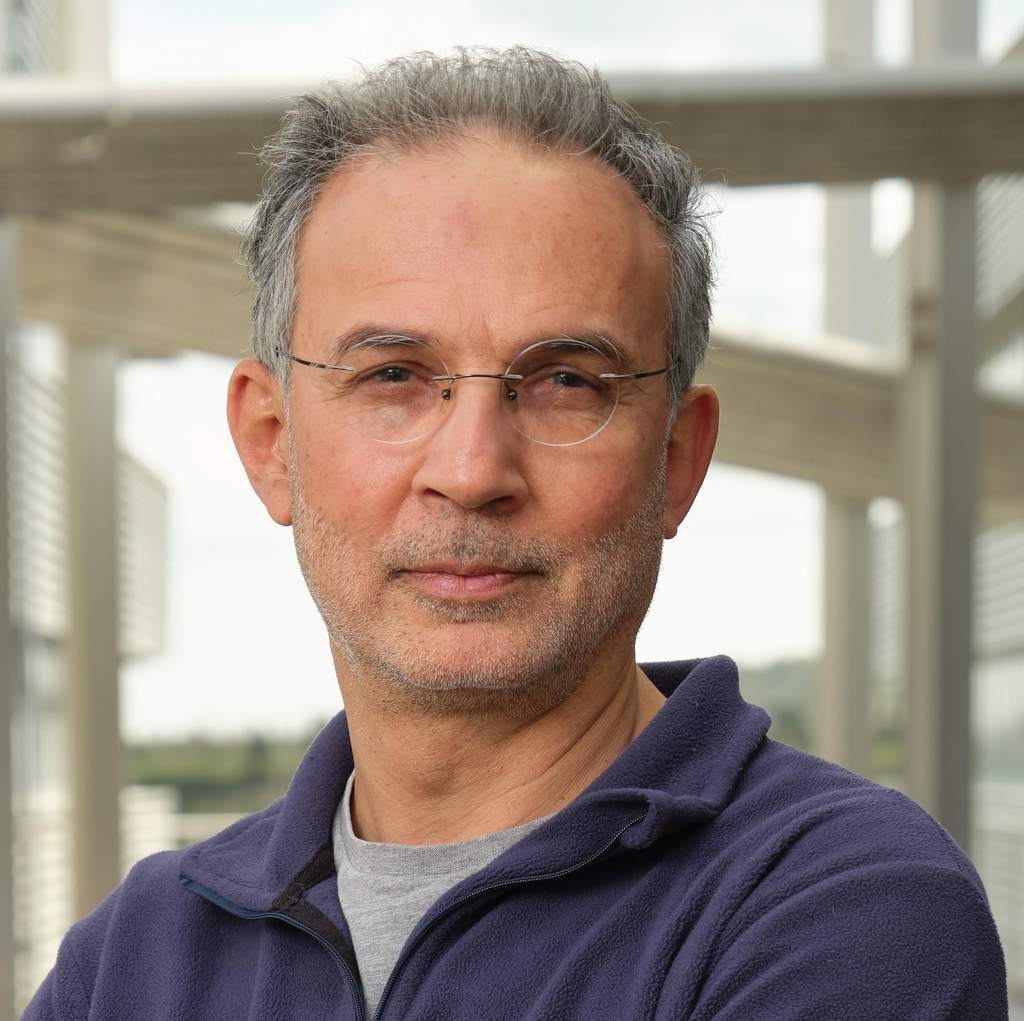
Speaking to Phileleftheros about the summit, Costas Constantinou, Professor of International Relations at the University of Cyprus, argues that the meeting primarily served the three leaders’ public relations interests rather than offering meaningful solutions.
“Most importantly, it contains no clear commitments or mechanisms for implementation that would allow progress to be assessed in the future. It sidesteps urgent issues, including the war in Ukraine and the geopolitical rivalries between the three powers,” he says.
Each leader sought to project power while pursuing his own personal gains, with other major international players excluded from the discussions.
“The real question is not which of the three gained the most, but what, if anything, was gained by societies suffering from crises and wars, as well as by those excluded from negotiations on matters that affect them,” Constantinou says.
How do you assess the objectives announced at the trilateral meeting between Trump, Xi and Putin? Do they offer meaningful solutions to the problems they were intended to address, or are they unlikely to have any significant impact?
The joint peace declaration issued by the three leaders does not, in itself, help address serious international problems. It makes broad references to international security, UN reform, energy stability and reducing nuclear risks, but offers no concrete solutions.
Most importantly, it contains no clear commitments or mechanisms for implementation that would allow progress to be assessed in the future. It sidesteps urgent issues, including the war in Ukraine and the geopolitical rivalries between the three powers.
Essentially, the declaration serves the public relations interests of all three leaders, allowing each to portray it as a diplomatic success for different reasons.
Nevertheless, the declaration raises serious questions, particularly about the kind of “strategic stability” the three leaders are seeking. What sort of stability are they talking about? Which threats do they consider important, and which are they choosing to ignore?
What appears to matter most to them is stability where their own strategic interests are concerned.
Even more troubling is the statement that the International Criminal Court and similar institutions should not “abuse their jurisdiction”. Such wording effectively whitewashes leaders such as Vladimir Putin and Benjamin Netanyahu, against whom arrest warrants have been issued.
Ironically, on the very day of the Shenzhen meeting, the International Court of Justice in The Hague found Myanmar responsible for genocide against the Rohingya, underscoring the importance of justice in maintaining international peace and security.
The fundamental problem, therefore, is the risk of an international order in which stability is defined by the interests of the powerful, while accountability for international crimes takes a back seat to political expediency.
What does the fact that the wars in Ukraine and Iran received so little attention tell us?
The absence of explicit references to the wars in Ukraine and Iran does not mean they were not discussed. Rather, it suggests that the three leaders avoided adopting common positions on them.
Instead, they opted for a form of constructive ambiguity, using indirect references that allow for different interpretations.
In Ukraine’s case, the reference to “strategic stability and international security” could be interpreted as an acknowledgement of Russia’s geostrategic concerns. At the same time, the declaration carefully avoids mentioning territorial integrity as a prerequisite for stability and lasting peace.
In Iran’s case, the references to reducing nuclear risks and preventing nuclear proliferation indirectly allude to the conflict with the United States and Israel. However, they frame the problem solely in terms of nuclear security, overlooking the war itself and its human consequences.
This selective approach allows the three leaders to project an image of agreement without addressing the deeper causes of the conflicts.
The problem with the joint declaration is that it treats peace primarily as a matter of managing power and the concerns of major powers, rather than upholding rules and ensuring justice.
Did the United States and China move closer following the meeting between their leaders? And what about the issues that continue to divide them, including trade, artificial intelligence and Taiwan?
Trump’s meeting with Xi, and the lavish welcome the American president received in China, appear to have helped keep dialogue open and ease tensions. But they have done little to bridge the deeper strategic differences between the United States and China.
Trade, artificial intelligence and, above all, Taiwan remain areas of intense competition. Beyond their disagreements over these specific issues, the two countries have fundamentally different views of power and the international order.
In his book On China, Henry Kissinger illustrates this distinction through an analogy involving two strategy games: Western chess and the Chinese game of weiqi.
In chess, the aim is a decisive, often dramatic victory over an opponent. In weiqi, the objective is to gain a strategic advantage gradually, through encirclement and control of territory.
In practice, the United States, particularly under Trump, places greater emphasis on tariffs, technological restrictions and immediate negotiating victories.
China, by contrast, takes a longer-term approach, seeking to strengthen its position in markets, technology and international institutions.
The difference is even clearer over Taiwan. The United States focuses primarily on deterring any military attempt to overturn the status quo, while China seeks gradually to restrict Taiwan’s strategic options and shift the balance of power in its favour.
A better personal relationship between Trump and Xi could undoubtedly help them reach agreements on individual issues. But it does not remove the deeper strategic rivalry between the two powers, which often approach the strategic landscape in fundamentally different ways.
What did Trump, Putin and Xi each gain from the meeting? Although this is not a competition, which of the three emerged as the winner?
All three leaders gained politically and symbolically from the meeting, but it produced no significant agreements.
A joint declaration of this kind amounts to soft law and serves primarily as a public relations exercise.
Trump bolstered his image as a master negotiator following the disappointing midterm election results. Putin gained political legitimacy, while Xi strengthened his standing as a mediator.
But you are right to point out that this is not a competition, despite the simplistic way international relations are often portrayed.
From a critical perspective, the dominant discourse in international relations is often framed and understood in phallocentric terms – as a game played by “great men”.
In this case, leadership becomes a display of personal prowess through rivalry, coercion and deals between individuals, supposedly for the benefit of nations and peoples, while their fundamental principles and needs are pushed aside.
I would like to believe that the real question is not which of the three gained the most, but what, if anything, was gained by societies suffering from crises and wars, as well as by those excluded from negotiations on matters that affect them.
There is an old, cynical saying in international diplomacy: “If you’re not at the table, you’re on the menu.” Neither the European Union nor other countries more powerful than Russia, such as India, had a seat at the table. Did those left out lose anything, and if so, what?
If this agreement is followed through and implemented consistently, those excluded from the table will have lost, above all, the opportunity to influence priorities and decisions affecting their future.
But we should not focus solely on states. We must also consider nations and peoples who are either unrepresented or under-represented in international diplomacy.
It is telling that the three leaders announced plans to increase the production and supply of petroleum products for the benefit of all nations, without explaining how this can be reconciled with efforts to tackle climate change.
For communities most severely affected by the climate crisis, particularly in small island states, greater dependence on fossil fuels could bring increased environmental insecurity rather than benefits.
The same applies to Indigenous peoples whose lands contain minerals and rare earth elements needed to maintain the “stable energy flows” referred to in the joint declaration.
The three leaders also committed themselves to reforming the United Nations so that it can respond more effectively to global challenges.
But how can this be achieved without broad collective consultation and participation?
Reforming a global organisation – something that, incidentally, has been called for and debated for decades – cannot be left exclusively to the great powers.
When states and nations affected by decisions are excluded from the process, both the legitimacy and effectiveness of those decisions are undermined.
Problems that require collective responsibility and action cannot be solved unilaterally, through manipulation of the United Nations, or through repeated threats and coercion.
The idea of a new Yalta is more symbolic than substantive
Before the meeting, many commentators spoke of a new Yalta. What are the similarities and differences between 1945 and today when it comes to the balance of power among the major powers?
There were indeed comparisons with the Yalta Conference, evoking the idea that great powers can determine the international order and carve out spheres of influence.
For Ukraine and its European allies, the prospect of such a trilateral meeting raised concerns that the future of European security might be decided without their involvement.
In Russian circles, the idea of a new Yalta was portrayed as a boost to Putin’s and Russia’s standing, drawing parallels with the Soviet Union’s participation as a victorious power in 1945.
For Trump, the image of three powerful leaders negotiating the future of the world fitted perfectly with the self-driven, theatrical style of diplomacy he favours.
Today’s circumstances, however, are very different from those at the end of the Second World War. The United States, Russia and China have different interests and face challenges that are both different and more complex.
It is not simply that Russia lacks the power the Soviet Union possessed in that historical context, or that China has now become a central geopolitical player.
Europe and the wider Global South also have greater scope to assert themselves than the historical analogy suggests.
The idea of a new Yalta is therefore more about projecting power and prestige than the realistic prospect of a straightforward deal to reshape and redistribute the international order.
The meeting took place at a time of profound shifts in the international balance of power. Could the talks in Shenzhen improve relations between the three countries and lead to closer cooperation on major shared challenges, such as artificial intelligence and climate change?
The meeting in Shenzhen could help reduce tensions and improve communication and relations between three major powers. That, in itself, is important.
But a patriarchal understanding reached by three men seeking to balance their power and legitimise their policies is not enough.
Global challenges such as climate change and artificial intelligence require diplomacy that is multilateral, operates at different levels and allows for meaningful participation. This means involving both state and non-state actors affected by the decisions being made.
They also demand critical reflection and an ethic of care that translates into practical action: genuinely listening to the needs of the most vulnerable, building trust, upholding fundamental rights, distributing resources fairly and accepting shared responsibilities.
At the very least, this means supporting societies most severely affected by climate change and working together to ensure that artificial intelligence is used safely and fairly.
What is needed is not simply a new balance of power, but diplomacy that translates interdependence and the commitments made by states into sustained, practical expressions of care.

