


By Katerina Nicolaou
Shenzhen, China, is in the global headlines this week. On Thursday, 19 November, Xi Jinping, Donald Trump and Vladimir Putin are set to sit down together, and the twenty-one economies gathered for APEC will find their trade forum sharing the spotlight with the most famous guest list.
From Palestine to Ukraine, from the war in Iran to the run-up to the US elections, the world is short of rooms where anything gets settled. Shenzhen may be one of the few. Phileleftheros is here this week, one of the media outlets invited under China’s public diplomacy programme for journalists, and no one in the world is spared the consequences of what is decided here.
Shenzhen
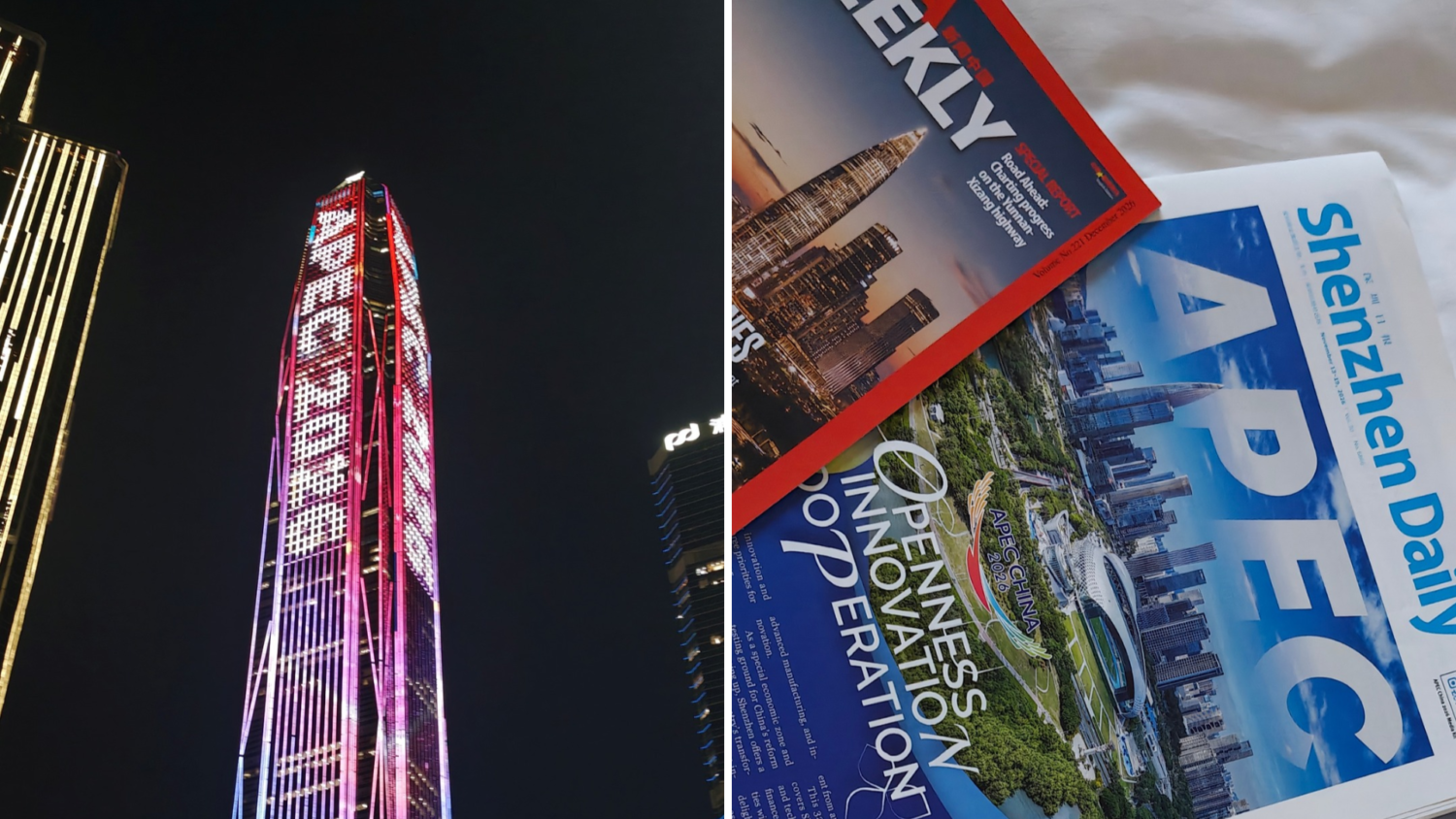
The APEC leaders’ meeting opens on Wednesday 18 November, the first day of the forum, and it is China’s third time hosting it. Shenzhen, in south China’s Guangdong Province, is dressed for the occasion. Summit flags and banners line the main roads, 25 dedicated lanes are open for visiting delegates and the media at border crossings, more than 7,000 smart translation devices are deployed across the city, and subway turnstiles now accept foreign bank cards. All of this is for APEC, CGTN reports.
Between them, the economies account for close to half of world trade. Yesterday the visiting journalists toured one of the world’s biggest LED industries, a company also operating in Cyprus. In its lab and showroom they watched stages and screens the size of FIFA stadiums. The company is one of the main sponsors of APEC and one of modern China’s most innovative corporations. APEC 2026 is about cooperation, under a theme Beijing has chosen: “Building an Asia-Pacific Community to Prosper Together.”
The three leaders’ meeting, however, is the biggest story. Beijing has confirmed the three-way meeting, which will take place on the forum’s sidelines. It would be the first time the three leaders have met together. International media report that the agenda could include nuclear arms, the war in Iran and artificial intelligence, while Ukraine is expected to be left out. The chances of a grand bargain look slim.
On nuclear weapons, Beijing has long argued that the main responsibility for reducing arsenals lies with the United States and Russia, which hold the two largest. It rejects limiting its own stockpile under such commitments, pointing to the far smaller size of its arsenal. That disagreement is likely to be the sticking point.
Chinese sources told Phileleftheros that Beijing is not seeking to divide the world into spheres of influence. Rather, China seeks to play a constructive role as a mediator and facilitator of dialogue. “In fact, the very possibility of bringing President Putin and President Trump to the same table in China demonstrates the unique role China can play in promoting dialogue and easing international tensions,” they said.
Decisions of this size are rarely made by many. They are made by a few, in rooms like this one, and they reach everyone: the price of fuel, the routes of ships, the security of nations that were never at the table. Small states rarely sit at such a table, yet its people feel every decision made there.
Analysts warn that a three-way summit could reinforce European fears that their security is negotiable. For a small state, that fear is not abstract.
Big decisions are not made by the size of the table. They are made by the people who sit at it, and small countries, like Cyprus, learn early to read the room, build alliances and keep their own interests in view.

