


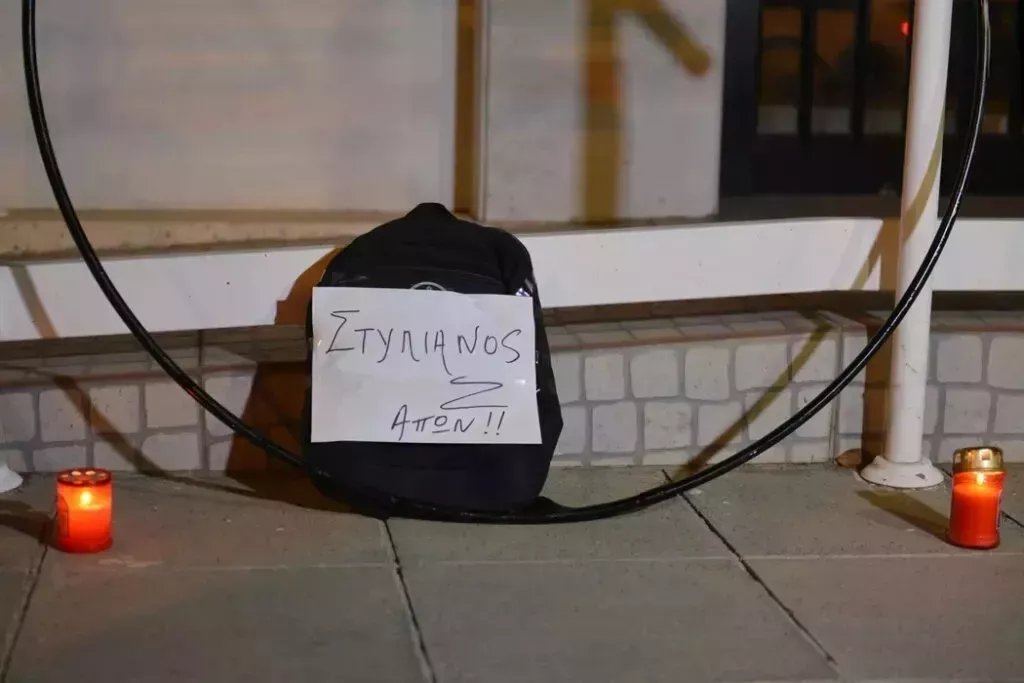
Stylianos’s speech therapist told the court on Monday that she believed the boy’s accounts of what he allegedly suffered at home, and that for a child to disclose such things was “the tip of the iceberg”.
She was being cross-examined by Konstantinos Kazantzis, lawyer for the first defendant, in the trial over the 14-year-old’s death. His questioning focused on the reliability of Stylianos’s accounts of what he allegedly experienced in his family environment and on the steps taken to protect him.
Kazantzis put it to the witness that she had not made a written complaint to Social Welfare Services or the police because she did not believe the child. She firmly disagreed, saying the written reports had been made by the liaison officer and that she had followed all the procedures then in place for informing the relevant people.
Asked about an incident in which, according to what Stylianos told her, he left home after being beaten by his father and walked all night to reach his school, she said she had been disappointed when his mother decided a week later to return with her children to the marital home, where the father may even have become angry.
Kazantzis described her view as personal speculation, which she disputed.
The defence also challenged her descriptions of neglect, suggesting the boy had no problems with his appearance or weight. “Did you see him?” the speech therapist replied, insisting he was an underweight child who always appeared dirty and exhausted. When Kazantzis suggested Stylianos always went to school clean, she maintained that he always arrived dirty, saying she had seen this herself. Asked why she had not washed him, she said the 40-minute sessions were for speech therapy, not for the hygiene that should have been provided at home.
The witness said Stylianos had told her about an incident in which he was beaten with a belt, and that she later saw diagonal bruise marks on his back. Asked whether the marks could have been caused by other children or by a fall in the school yard, she asked whether he meant they had hit him with a belt, and maintained that what Stylianos told her was consistent with the bruises she saw.
Kazantzis also challenged the link she drew between the boy’s learning difficulties and the environment he grew up in. “So his parents should have been Harvard graduates?” he asked. She said no, explaining that a linguistically limited environment affects a child’s development. She also pointed to the importance of proper nutrition, sleep, safety and everyday experiences, and of the attention a child is given, such as being read a fairy tale.
Asked how she knew Stylianos had been deprived of these things, she said the information had come from the child himself. “I believed and I believe Stylianos,” she said, arguing that children of his age do not have the cognitive ability to keep up a lie over time, especially against their father.
Children generally idealise their parents and, when they suffer violence, consider themselves responsible, she said. “For a child to get to the point of telling is the tip of the iceberg.”

