


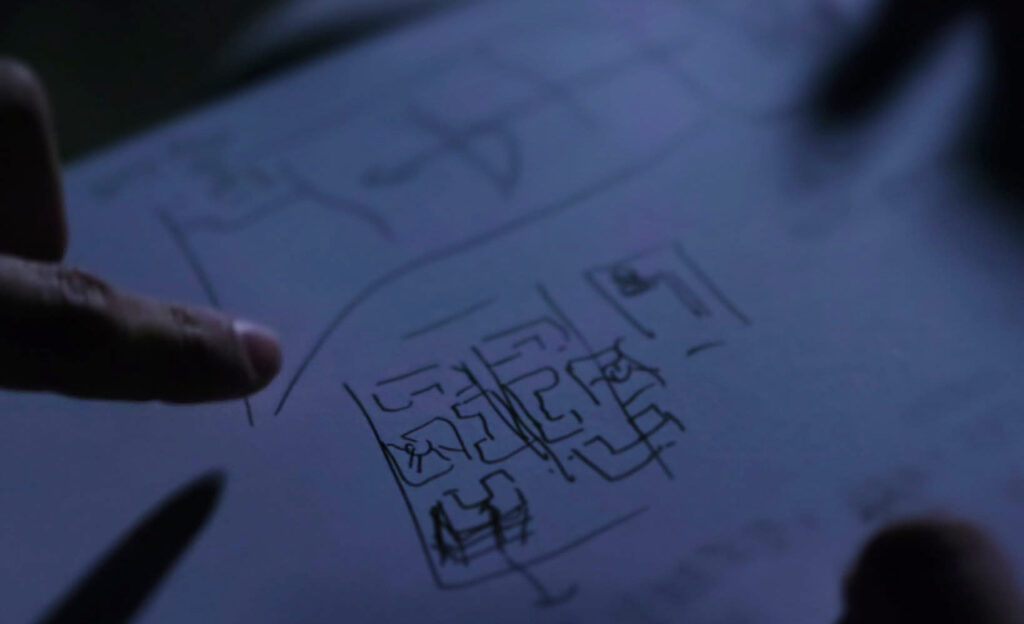
The documentary NAZA is one of the most important works of art and journalism of our time. It lays bare the machinery behind the mass killing of civilians, and at the same time it sheds light on the human, political and moral dimensions of complicity.
Watching the closing credits at the screening, I could not spot a single Arab name among the crew. What I did find was a string of Jewish names, headed by the two directors, Yuval Abraham and Rachel Szor. It is a secondary observation, but hardly a trivial one, for a film that charts the machinery behind the deaths of thousands of Arab civilians through the testimony of people who took part in an extermination run on industrial lines.
The film grips the viewer through the sheer weight of its revelations and the way they unfold. Abraham and Szor, who already have an Oscar to their name, gather 24 testimonies from Israeli soldiers and intelligence officers. They speak anonymously, their faces in shadow and their voices digitally altered. Produced by the Guardian, the film rests on extensive investigative journalism.
What impresses most is the skill with which the testimonies are knitted together. They are more than a succession of statements or a simple patchwork of information. Gradually and masterfully, they piece together a system, illuminating its individual functions, its connections and its procedures. Above all, they show how responsibility is diluted until it seems almost not to exist.
One describes his own remit. Another explains his small contribution. A third refers to decisions taken by others. A fourth says: “If it hadn’t been me, it would have been someone else.” The chain of actions is revealed piece by piece, until the viewer grasps the full scale of the killing machine.
Here, once again, we encounter the political and philosophical dimension of the banality of evil, as analysed by Hannah Arendt. You do not need to be a monster to take part in a monstrous process. It is enough to accept your role, confine your responsibility to the narrow limits of your official remit and convince yourself that you are simply doing a job. The logic of self-absolution keeps resurfacing, exposing how horror is normalised through the daily running of a well-oiled system.
The link with Jonathan Glazer’s The Zone of Interest (2023) is unavoidable, all the more so since Glazer is credited as an executive producer on NAZA. In his Oscar-winning film, Glazer captured the family life of Auschwitz commandant Rudolf Höss. The extermination camp stays out of shot, yet it is ever present through industrial sounds, silences and smoking chimneys in the background. The horror could coexist with gardening, family meals and the small pleasures of bourgeois life.
NAZA approaches a related question from a different angle. Rather than drawing a historical equivalence between events, it sheds light on a similar mechanism of dehumanisation and fragmented responsibility.
The film’s narrative architecture and cinematic language find an equally powerful counterpart in its visual construction. This creates a second, parallel layer of storytelling that is every bit as revealing as the testimonies.
The interviews take place mostly on Tel Aviv rooftops at night. The interviewees remain faceless in the shadows, while the camera roams the city: its illuminated avenues, its skyscrapers, its apartment windows. We watch, almost voyeuristically, as residents eat, lounge about, watch television and carry on with their daily lives. On the screens, politicians and officials defend the military operations. The scene of the devastation is only a few dozen kilometres away, yet the gulf between the two realities seems immeasurable.
Tel Aviv is one of the film’s protagonists. It is a city that keeps functioning and prospering while, within a stone’s throw, a humanitarian catastrophe unfolds. The nod to Claude Lanzmann, in a shot of an illuminated sign at the Tel Aviv Cinematheque, is extremely apt and anything but accidental. His documentary Shoah (1985) was a landmark, detailing the Holocaust through interviews with survivors, historians and perpetrators. Like Lanzmann, Abraham and Szor treat testimony as an act of moral weight. The editing ties the accounts to the place, and personal testimony to historical and political reality. The aesthetic choice becomes part of the political stance.
The title NAZA, an abbreviation of the Hebrew phrase “nezek agavi” (collateral damage), has the ring of grim antiphrasis. It turns mass death into a calculated figure, built into the cold planning of a lethal campaign. Here, language helps shape reality. The irreversible fact of death acquires an official designation and is squeezed into tables, algorithms and patterns, while the victim’s humanity is pushed out of the field of conscience.
Turning casualties into a measurable military quantity is a constant in the history of warfare. We need not go as far back as the Holocaust. In the Vietnam War, the US military doctrine of the “body count”, the tally of enemy dead, became a key indicator of military progress. It often led even to dead civilians being counted as combatants. The circumstances differ, but the logic is disturbingly similar: human life is reduced to statistics, and extermination becomes a barometer of operational efficiency.
The contrast between the cynicism of some interviewees and the unease of others, who seem to be only now grasping the enormity of what they describe, carries particular weight. Some speak with unfathomable coldness. Others appear awkward, guilt-ridden or frightened.
The fact that all these people agreed to talk at all is significant in itself. These are not heroes stepping forward after the event to claim a place on the right side of history. Their testimonies keep the contradictions, the discomfort and the moments of self-justification of the narrators themselves. And precisely because they are not free of these things, they are especially valuable as accounts of a suffocating reality in which the speakers themselves took part.
It takes exceptional courage for someone involved to agree to speak in a film like this, and far more to make one. Inevitably, Abraham and Szor faced threats. The intimidation extended to their families, and the campaign against them took on an institutional dimension. In keeping with the maxim that “what is true is national”, the film-makers’ stance can be read as an act of profound responsibility towards their own society. The truth is rarely convenient.
This is not a film that soothes the viewer’s gaze, offers the relief of catharsis or seeks to reconcile us with what we are watching. Its power lies precisely in its insistence on connecting the individual with the collective, the technical with the moral, the everyday with the catastrophe. It draws us in inescapably. It shatters the sense of sheltered normality, closes the comfortable distance from events and brings us uncomfortably face to face with the raw materiality of a genocide.
INFO: NAZA is showing at the Pantheon in Nicosia until 25 November. Tickets: pantheon-theatre.com. Running time: 80 minutes.

