


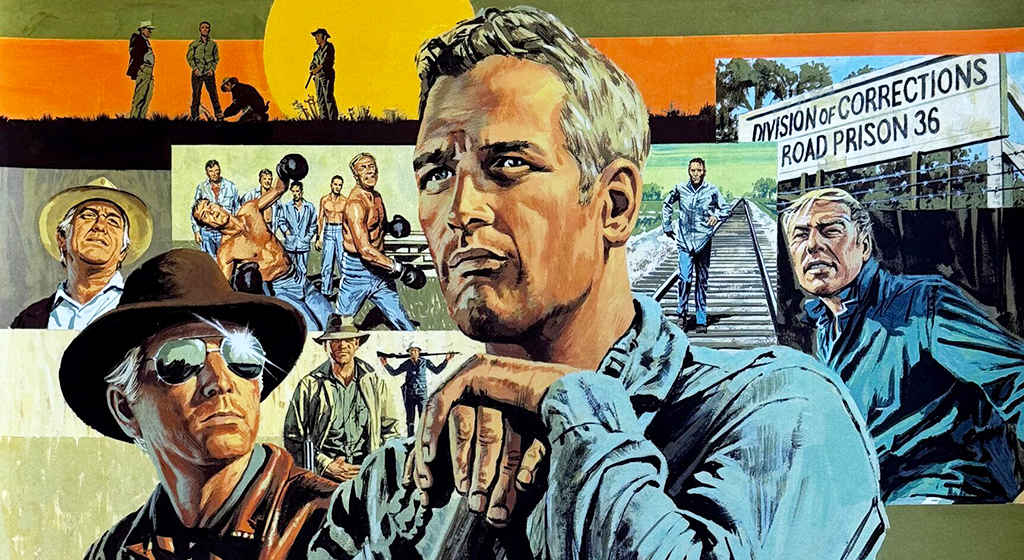
You may have seen Cool Hand Luke, the 1967 film starring Paul Newman. For quite a few years now, as I follow developments in the Cyprus problem, one scene keeps coming back to me. It is the one where the prison warden tells Luke, in that unmistakable Texan drawl: “What we’ve got here is… failure to communicate.” (In 1991, Guns N’ Roses used a recording of the line to open Civil War.)
Luke tried to escape again and again, always with the same result: he was caught and thrown back into solitary. The fellow inmates who egged him on did so mostly for their own reasons. It let them feel that someone like them was defying the rules, while they took comfort in knowing that, as long as they kept their heads down and broke no rules themselves, they were safe. As safe as anyone in their position can be.
And here we are, it seems, playing the same game over and over on the Cyprus problem, believing it is safe to be “good boys” inside our “prison”. We cling to the illusion that we will get a pat on the back (from foreigners, the UN and the rest), while at the same time believing (do we, really?) that we are pursuing a clever strategy which, sooner or later, will pay off. So we hail every new step as progress, even when it is marching on the spot, and even when, worse still, it smacks of Lenin’s “One step forward, two steps back”.
“The definition of insanity is doing the same thing over and over again and expecting a different result.” Einstein may never have said it, and it was most likely coined at some Alcoholics Anonymous meeting. But it sums up perfectly the way we have been “negotiating” for years on end, like a bunch of… Alcoholics Not-So-Anonymous, hooked on failure.
To return to Cool Hand Luke and the warden: when the UN Secretary-General’s personal envoy threatens to throw in the towel and walk away, saying “Nothing was achieved. Goodbye everyone. Goodbye to me, goodbye to Guterres,” that is nothing but… “failure to communicate”. The good lady has plainly understood nothing, neither what her job is nor what is going on in Cyprus. But how hard can it be to explain the glaringly obvious: a Turkish occupation army present since the invasion, de facto partition and Turkey’s demand for two states?
So it seems the fault does not lie with whichever lady or gentleman turns up to… set us straight, like a marriage counsellor trying to help a troubled couple patch things up. The failure to communicate is ours, and that of every government since 1974. It is as if we were preaching to deaf ears in an unintelligible sign language, and in Braille to boot.
The Cyprus Archaeological Museum is currently hosting an art exhibition entitled With What Remains. Its exhibits are relics of ancient civilisations that lived on Cyprus and left their mark on it, and the works of the two artists, Leontios Toumbouris and Andreas Mallouris, are in “conversation” with them. Looking around, I found myself wondering what will remain of us. Apart from concrete, what cultural footprint will we leave to future generations to give them some idea of who we were and how we lived, assuming there are any future generations, given the world’s apparent drive towards self-destruction? What remnants will survive, not only material ones but those of our intangible culture too? And what will they make of our inability to talk to one another like rational human beings?
I imagine the bafflement of the future historian who sets out to study our era. What will he make of reading about “confidence-building measures” that were supposed to lead to a “solution of the Cyprus problem”? Perhaps he will wonder what the word “barricades” stood for. He may try to work out how opening ever more crossing points from one side to the other was meant to build trust between the people of this land, and how this practice could (so we believed) prevent partition rather than legitimise it and set it in stone. How can you reach an understanding with the other side when a third party dictates what they do and what they say? Who is meant to “trust” whom, and about what?
One of the most baffling features of our age, and of the way we understand negotiation, is the notion of the “opportunity”. It comes, goes and comes round again, billed each time as “the last”, with windows flapping open and shut and assorted voices urging us to climb through (or escape?) before they close for ever. That is, until the next time, with each window a little smaller than the last, until not even a crack remains.
I suspect the historian of the future, if there is one, will be unable to grasp either the logic or the purpose of this supposed strategy of ours. I picture him searching in vain, perhaps with the help of artificial intelligence, for some hidden motive that might explain the absurdity. Then again, you might say, we cannot understand ourselves here and now, whatever tool we use, natural or artificial…

