


President Nikos Christodoulides and the European Commission’s envoy on the Cyprus problem, Raffaele Fitto, agreed on Thursday that the key to further progress in EU-Turkey relations is resuming Cyprus talks from where they broke off at Crans-Montana in 2017, Phileleftheros understands. Fitto is due to meet Hakan Fidan in Ankara on 20 November.
Sources with close knowledge of the phone call told Phileleftheros that the two men agreed on the framework within which Fitto will operate during his visit. He is expected to discuss both EU-Turkey relations and the Cyprus problem.
Customs union in play
The assessment is that if Turkey agrees to resume Cyprus talks, the EU will make a parallel move on issues of interest to Ankara. Turkey is particularly interested in three areas of its relations with the EU: the customs union, visa liberalisation and SAFE.
Several EU member states have serious objections to visa liberalisation. There are also objections to SAFE, particularly from Greece, because of Turkey’s continuing casus belli and its recent actions over the GSI.
The issue on which unanimity could be reached is the customs union, where Cyprus has been the main obstacle. Turkey continues to refuse a customs union that covers all EU member states.
If Turkey agrees to resume Cyprus talks, the EU and the Republic of Cyprus will be positive about reopening dialogue on the customs union. Diplomatic circles believe that Nicosia wants talks on the Cyprus problem to resume and Turkey wants customs union talks to begin, which means a deal could be reached.
Nicosia has also made clear that a positive response from Turkey is not enough on its own. Turkey must also accept that negotiations start from where they stopped at Crans-Montana, a position the EU shares.
Signs, but no guarantees
From Christodoulides’s three conversations, with UN Secretary-General Antonio Guterres, Ursula von der Leyen and Fitto, Nicosia has taken away their view that there are some signs the effort could succeed. Diplomatic sources point out that Fitto is very careful in his moves, and that his decision to go to Ankara at this time may mean something.
They also point to what Guterres told von der Leyen: that he wants to bring the Cyprus problem to the point where negotiations resume before his term ends.
However, the same sources say nobody can guarantee a positive outcome from the meeting between Fitto and Fidan.
Schengen by mid-2027
During the phone call, Christodoulides also discussed Cyprus’s accession to the Schengen area with Fitto, who is a European Commission vice-president. Nicosia is certain that Cyprus will join in 2027, most likely on 1 July.
The President discussed with both Fitto and von der Leyen the work that the European Commission now needs to do. Both said an effort would be made to move the Commission’s work forward quickly. Cyprus has already completed its own technical preparations.
Warning on hybrid threats
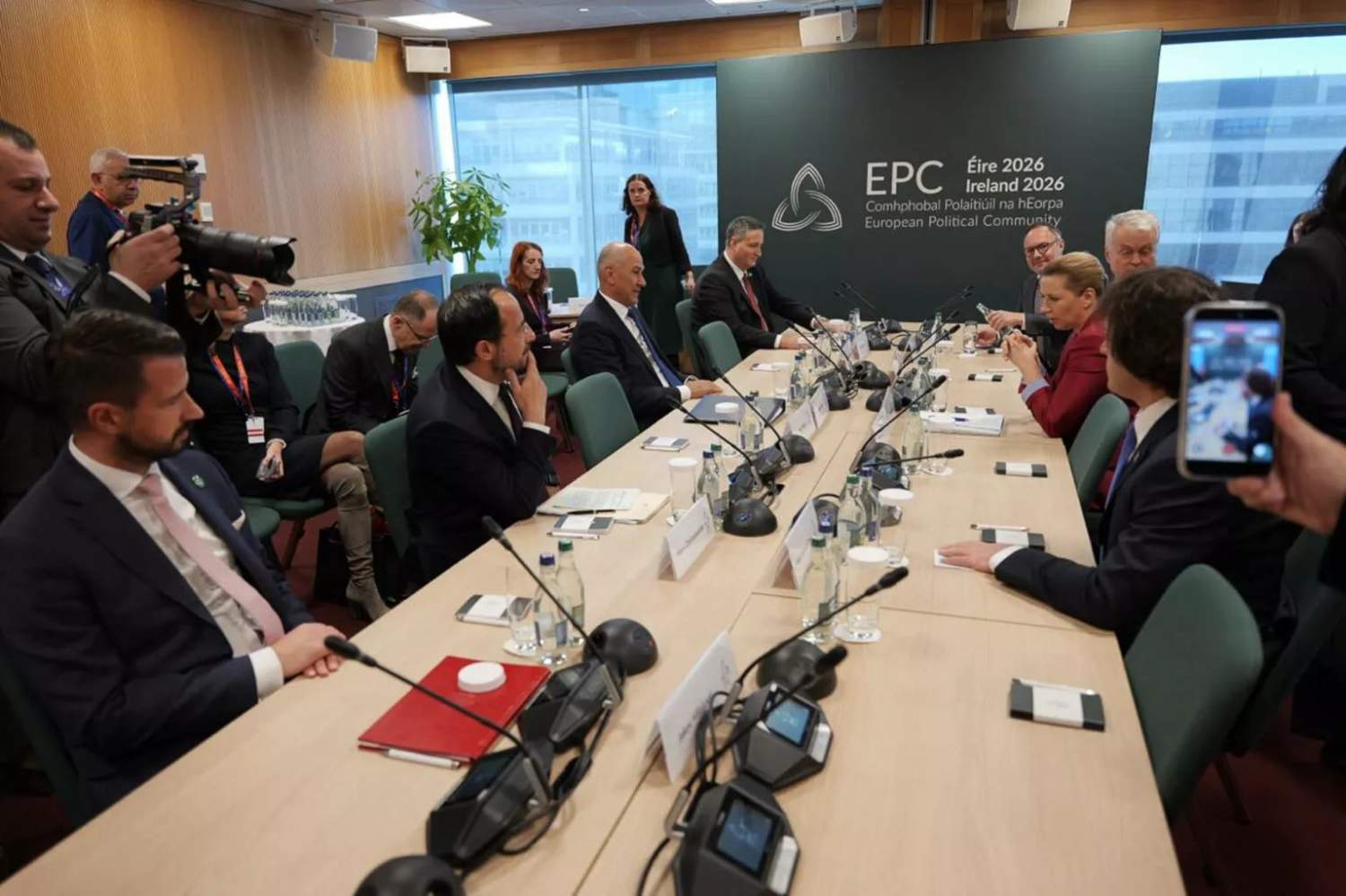
In Dublin, Christodoulides took part in a thematic discussion on “Security and the defence of a democratic Europe” during the ninth summit of the European Political Community.
He said hybrid threats were becoming increasingly frequent and, perhaps more worryingly, were starting to be treated as normal. Cyberattacks, drone incidents, disinformation and foreign interference, once considered rare, were now becoming part of daily life. “We cannot allow these threats to become the new normal,” he said.
He said Europe’s response had to be comprehensive, coordinated and based on principles, and that governments needed to inform and protect citizens better. With the rapid development of artificial intelligence, he said, raising awareness and strengthening the resilience of society were the first line of defence, and Cyprus was actively pursuing this.
He called for stronger EU oversight of digital platforms and technology companies. He said greater transparency, accountability and effective safeguards against the malicious use of artificial intelligence were essential to protect democratic societies.
He also called for full and effective use of collective European tools. These include mechanisms to counter hybrid threats, cyber diplomacy and foreign information manipulation, as well as targeted sanctions against those responsible.
Defending Europe, he concluded, is not only about protecting borders and critical infrastructure. It is also about protecting citizens, democratic institutions and the trust on which societies are built.
Meeting with Carney
Christodoulides also met Canadian Prime Minister Mark Carney. The meeting was requested by the Canadian side and was the first high-level meeting between the two countries in eight years.
The two leaders discussed the Cyprus problem and regional security. Canada has traditionally taken a principled position and supports a solution within the framework of UN Security Council resolutions.
Canada attaches great importance to strengthening its relations with the EU, including through EU-Canada strategic cooperation. It is the first non-EU country to take part in SAFE. Ratification of CETA, the EU-Canada trade agreement, is still pending in nine member states, including Cyprus.
Cyprus also sees prospects for attracting Canadian investment and strengthening trade, particularly in energy and technology. Canada is the world’s 11th largest economy and a major producer of energy and critical minerals.

