


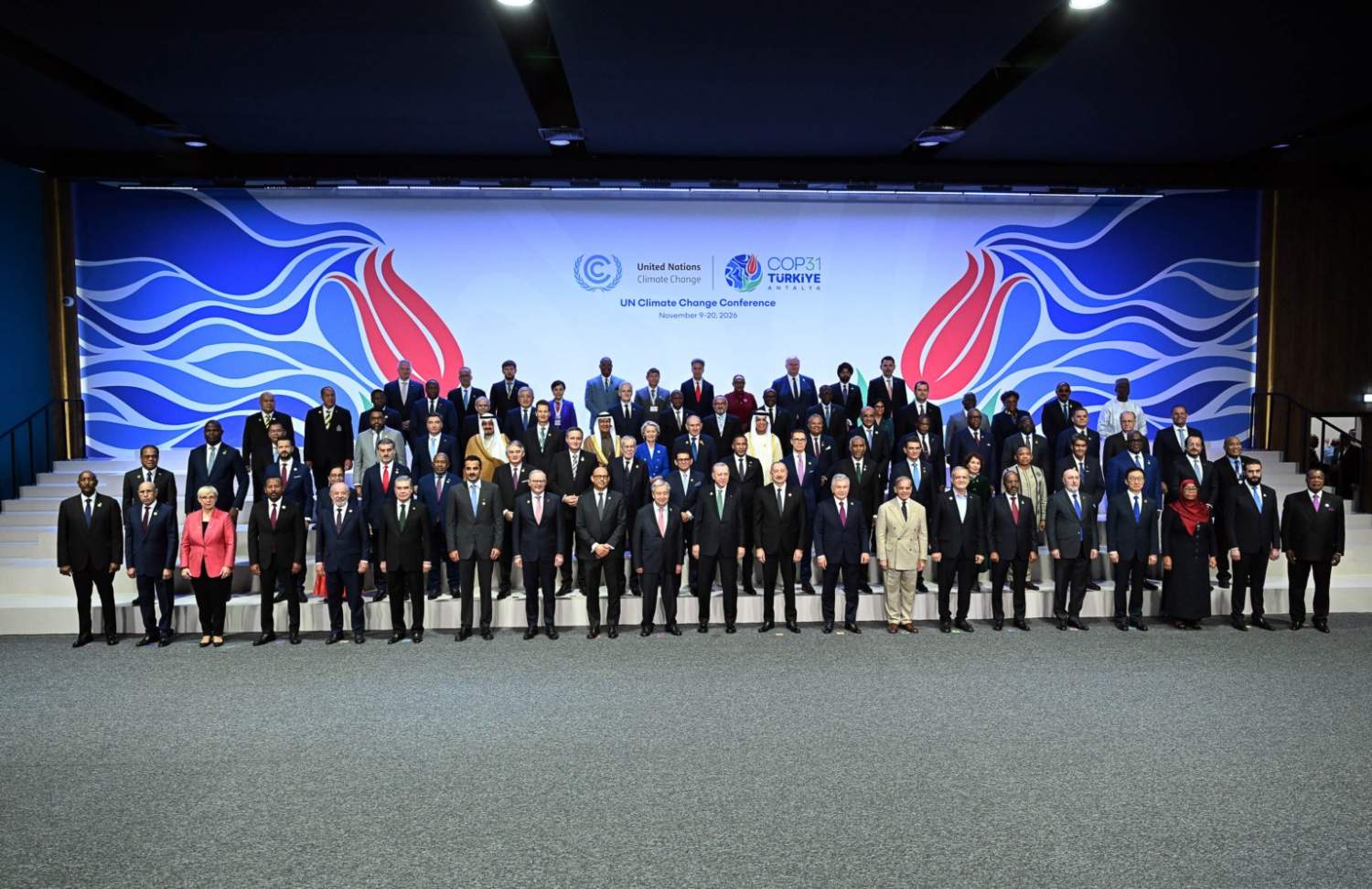
Turkish President Recep Tayyip Erdogan left the welcome line at the UN COP31 summit in Antalya on Wednesday as President Nikos Christodoulides arrived, leaving UN Secretary-General Antonio Guterres to greet him alone.
Turkish television stopped broadcasting from the entrance at that moment and showed general shots of the conference centre. Erdogan then returned and carried on welcoming other heads of state and government.
Diplomatic sources described Erdogan’s departure as “a sign of contempt for the United Nations”, under whose auspices the summit is being held.
Erdogan and Guterres had taken up position at the entrance to welcome foreign leaders and government representatives arriving for the summit. Erdogan had arrived early to welcome Turkish Cypriot leader Tufan Erhurman and pose for photographs with him. Erhurman was welcomed before Guterres arrived, because he does not represent a state or government.
The Turkish government had tried to avoid sending an invitation to the Cypriot president for the Antalya summit, while Erdogan sent Erhurman a personal letter inviting him.
Talks with von der Leyen and Guterres
Christodoulides told European Commission President Ursula von der Leyen about the incident when they met on the sidelines of the summit. He also briefed her on developments in the Cyprus problem, and the two discussed EU-Turkey relations, Turkey’s conduct and Cyprus’s bid to join the Schengen area.
In a brief conversation with Christodoulides, Guterres said he intends to convene the trilateral meeting on the Cyprus problem as soon as possible, Phileleftheros understands. The dates will be finalised once Guterres returns to New York from the Philippines, where he is travelling straight after the Antalya summit.
The speech
Christodoulides opened his address to the summit by describing the Republic of Cyprus as “a sovereign, equal and independent member state of the UN” that had come to Antalya with the message that the climate crisis demands political leadership, collective responsibility and decisive action.
He said collective efforts were still not enough to meet the Paris Agreement goals, and called for faster emissions cuts, a move away from fossil fuels, a tripling of renewable energy capacity and a doubling of energy efficiency improvements by 2030. Countries, he said, must move beyond declarations to implementation, investment, adequate climate finance and a just transition.
For Cyprus, water shortages, extreme heat, desertification and devastating wildfires are already a reality, he said. He also pointed to the Eastern Mediterranean and Middle East Climate Change Initiative, which brings together ten partner countries and more than 200 scientific experts, and to the Cyprus Regional Aerial Firefighting Station (CRAFS), set up earlier this year with Jordan and backed by the European Commission.
Read more:

