


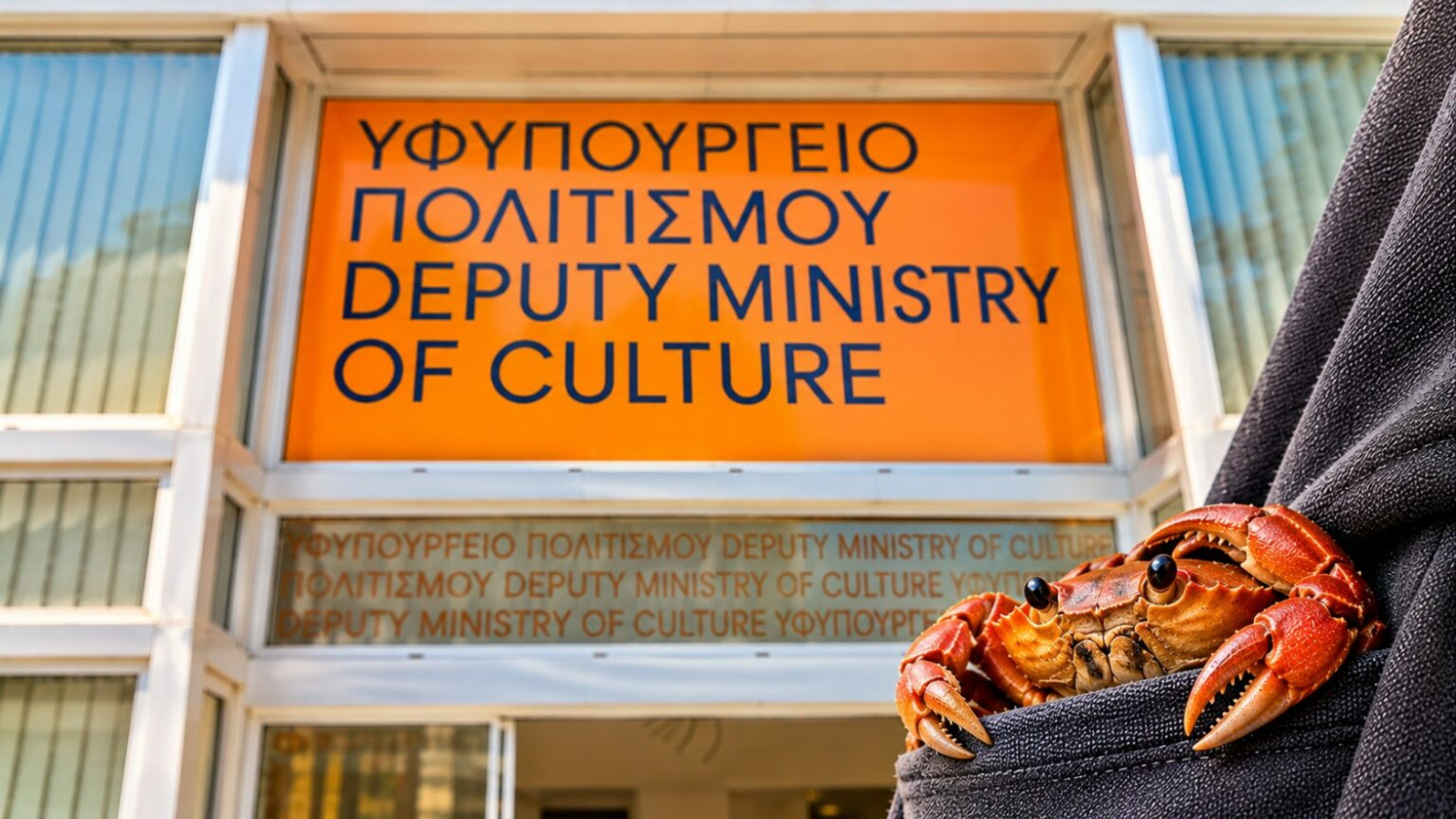
From the promise of zero fiscal cost to today’s underfunding and bureaucratic dysfunction. Four years on, culture still rests on the passion and personal endurance of its creators
Back in the bad old days, when culture was merely a sub-department of the Ministry of Education, the annual budget for the sector barely reached two per cent of the ministry’s total budget — not, of course, the state budget, but that of the ministry under which it fell. Admittedly, that figure did not include the budget of the Department of Antiquities, which was itself an obscure branch of another ministry — first the old Ministry of Communications and Works and later the Ministry of Transport, Communications and Works.
I was reminded of that striking figure in recent days, as the people of the cultural sector are once again in uproar, rallying around the figure of 0.45 per cent following the parliamentary Finance Committee’s discussion of the Deputy Ministry’s budget for 2027.
Let us leave aside, for a moment, the 0.45 per cent and the 0.62 per cent, the millions added to or cut from budgets, Eurostat and comparisons with other European Union countries, and the endless arguments over what exactly is included under each spending line. Numbers have their uses, but in culture especially they can very easily become an exercise in optics.
One time you use one denominator, another time a different one. Infrastructure is included or excluded. Antiquities are bundled together with contemporary creation. Then there is the operating cost of the Deputy Ministry itself and of the organisations it oversees. And after all that, good luck working out what actually reaches the people who produce culture.
Beyond percentages, statistics and accounting gymnastics, there is an entire world of people who, despite the entrenched and inherent obstacles, continue to keep the cultural edifice standing. Perhaps their patience and stamina really are limitless; I do not know. Either way, I do not think we should keep testing how far they can be pushed.
Because they are the ones who matter. The creators, the artists, the workers, the small groups, the independent venues, the people who keep putting on performances, publishing books, organising exhibitions, rehearsing and rehearsing and rehearsing, researching, dancing, writing, deleting, rewriting, composing.
The whole structure rests, in effect, on their backs. On their goodwill, their passion, their obsession, their stubbornness and a level of dedication that often goes far beyond what economic, employment and social conditions reasonably allow.
That personal overextension has become a prerequisite for the entire structure to function. And someone might say: surely that is how it should be.
Yes, but the problem is that it has become almost the only prerequisite — and sometimes even IN SPITE OF the very policies supposedly designed to support it.
People fill the gaps with their time, their labour, their contacts, their persistence and, occasionally, their own money, covering what the state cannot or will not provide. At some point, even passion runs out. Creators leave, give up or simply lose the will to keep rowing. And no figure, no percentage in any budget, will ever be able to capture that haemorrhage.
The roots of the problem did not appear with this year’s budget, or last year’s. They go back ten or fifteen years, to the debates over giving culture institutional autonomy and creating an independent body that could finally formulate and implement policy.
As far back as 2012, even in his election promises, Nicos Anastasiades laid down zero fiscal cost as an inviolable principle. Over the years, as consultations on setting up the Deputy Ministry limped forward, the central and much-advertised condition of the government’s approach became “fiscal neutrality”.
The new structure would emerge by merging the responsibilities and budgets of existing departments and organisations, without any meaningful increase in operating costs. What was never part of the plan was a properly staffed and financially strengthened Deputy Ministry. They did not even consider it useful as an empty campaign promise. Quite the opposite.
The shadow of that constraint has followed the project from the moment it was conceived. As though culture were some secondary administrative responsibility that could simply be transferred from one organisational chart to another, given a new sign and logo, and suddenly acquire substance.
And the people? The infrastructure? The tools? The resources? Administrative capacity? A political understanding of what, exactly, we are trying to achieve?
More than four years after the Deputy Ministry was established, expectations have not been fulfilled to the extent one might reasonably have hoped. No one disputes that steps have been taken, that people are working and trying, that initiatives are being implemented and projects promoted.
But have we really created a functioning mechanism for cultural policy? Or have we simply added another top-heavy layer of administration, complete with all the familiar dysfunctions that come with it?
The worst — perhaps even the most alarming — part is that many people in the sector feel the Deputy Ministry makes things harder rather than easier, to the point where they have begun to look back nostalgically on those unforgettable days when culture was the second watermelon tucked under education’s arm.
They feel that procedures, delays, overlapping responsibilities and administrative management consume time and energy instead of freeing up creative possibilities. That appearances, announcements, presentations and events come before substance, while real needs continue to be crammed into drawers.
Can we really afford to place even more obstacles in the way of people who are already at breaking point, struggling with uncertainty, underfunding and precarity?
Did we create a Deputy Ministry simply to add another maze to an already labyrinthine path towards a cultural strategy?
If that question is not to remain rhetorical, and if the answer is genuinely to be “no”, then we need an environment in which people can work with dignity, plan for the long term, be paid for their work and stop having every next step depend on the goodwill of whichever administration happens to be in office or on their own personal endurance.
Increasing resources is imperative, but it must go hand in hand with the development of useful policies. One depends on the other.
As for the people of the cultural sector currently “boiling over”, they should think carefully about where to hold their next protest: Ifigeneias Street in Strovolos — or perhaps the heroic junction of Afxentiou Avenue and Karaoli Street?

