


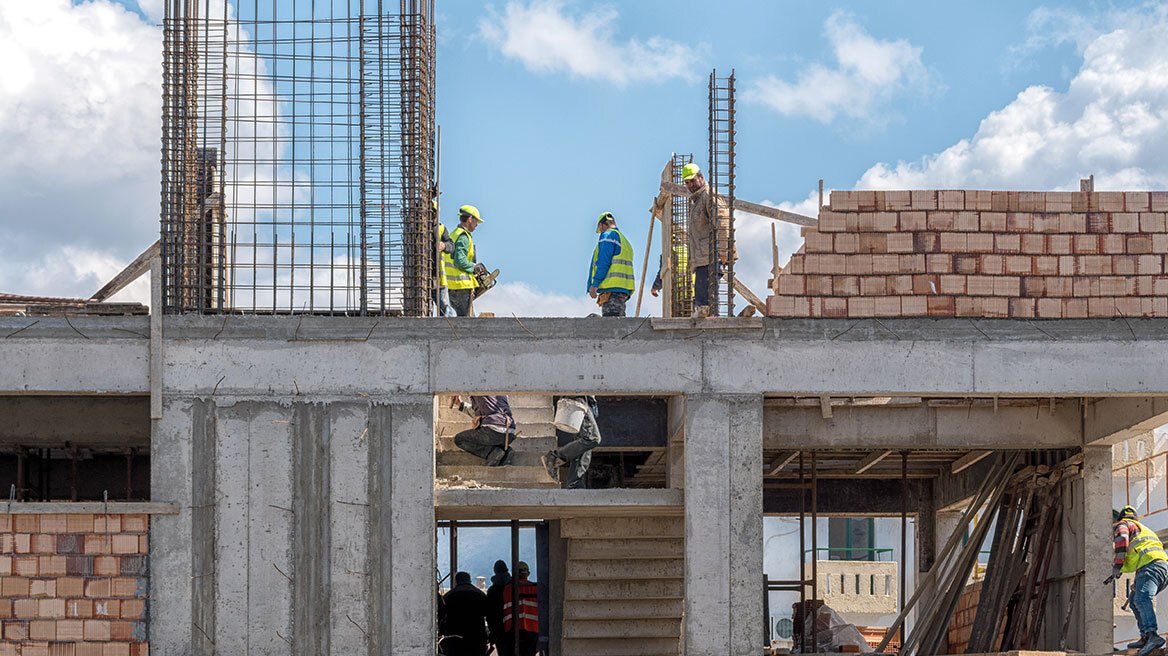
Contractors in Cyprus are finding it ever harder to hire construction workers and are paying more for those they can find, after many Syrians went home and Turkish Cypriot labourers moved to jobs in the occupied north.
The Cyprus Property Developers Association warned a few days ago that the labour shortage is a major obstacle to increasing the supply of housing. Even once a project is licensed, it said, it must be possible to complete it within a reasonable time. In the association’s view, housing policy therefore cannot be considered separately from what the construction sector can actually build.
Construction firms, and small contractors in particular, now struggle to recruit Cypriots, so foreign workers fill a large share of jobs. A significant number of Syrians have returned home following the change of regime there. Several Turkish Cypriots have also left to work in the occupied north, where a construction boom means they may be able to earn better daily wages.
The government tried to bring in workers from Egypt through an intergovernmental agreement, but the effort did not produce the results it wanted. Phileleftheros understands that the conditions set for employing Egyptian workers were ones that many contractors, mainly small ones, could not meet.
Higher rates, fewer workers
Although many Syrians have left, a significant number remain. They have years of experience in Cyprus, know how both the work and the system operate, and make up an important part of the construction industry.
In recent years, several have moved up from labourers to subcontractors. When a firm needs subcontractors to take a project forward, it turns to them, and they in turn hire their former fellow labourers.
Seeing the demand, those labourers have raised their prices. Many no longer work for a daily wage but charge by the job. As a result, contractors are paying more for labour, and workers have become extremely hard to find.
The permit process
Even when a firm does find a worker, the permit system has flaws that cause problems of their own. Phileleftheros understands that a contractor can legally obtain a permit to employ a foreign worker, only for that permit later to become illegal.
The process has two stages. The contractor first applies to the Department of Labour at the Ministry of Labour, which assesses whether there is a genuine labour shortage and issues an ‘approval in principle’. The contract then goes to the Civil Registry and Migration Department at the ‘Ministry of Interior and Civil Protection’, which issues the final Temporary Residence and Employment Permit.
The migration department can reject the application or revoke the permit if it identifies a problem, such as a deportation history or a criminal record, or if it considers the worker a risk to public security. The worker’s employment then automatically becomes illegal.
Even with all permits in place, Labour Ministry inspectors or the police Aliens and Immigration Unit can inspect a building site. The permit is cancelled and the employment becomes illegal if they find that the worker is employed by a different employer or in a different trade from the one approved, or that the contractor is breaching the terms of the collective agreement.
The inspection stage is not one of the system’s flaws, particularly where the employer is at fault. But it shows how many services are involved in the process, and how easily a legal permit can become illegal.
Government bodies and industry professionals have said several times that a number of factors are holding back the smooth development of the property market, and labour is one of them.

