


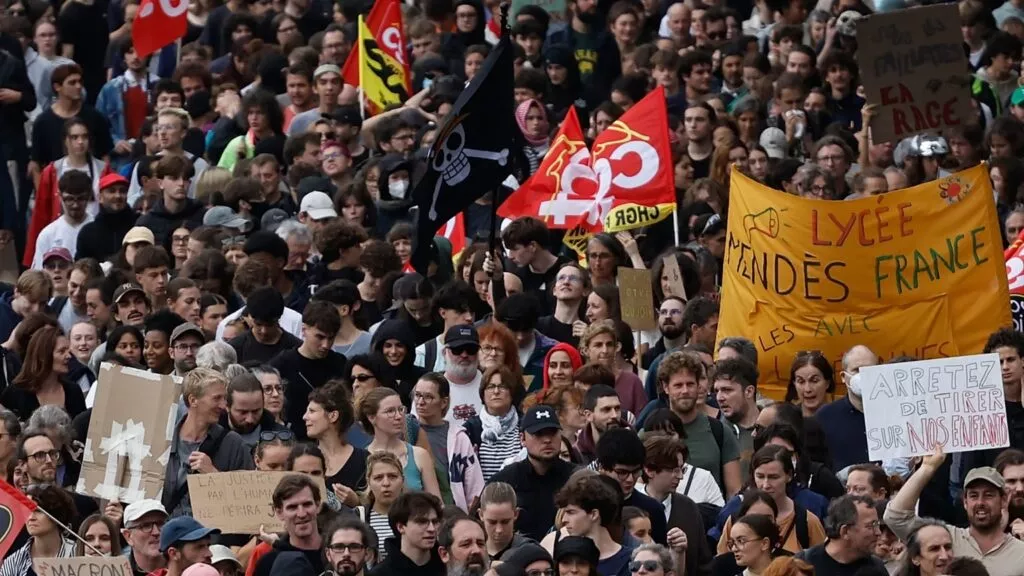
The protests in France are not as simple as some readings would have them. They cannot be written off wholesale as outbursts of cynicism or nihilism, or as the work of a generation of young people who have lost all their values.
That reading turns a complex social phenomenon into a moral failing. It also dodges the real question: what has driven an entire generation to question so profoundly the society it is growing up in?
These are not immigrants struggling to fit in. Most of the young people at the heart of the unrest are third-generation French, born and raised in France, and not only in Saint-Denis. Yet they face social exclusion and the lived experience of not being recognised as equal members of that society.
Nor is the crisis confined to poor neighbourhoods. Insecurity, frustration and doubt about the future run through very different social settings, even if they surface in unequal ways.
The veteran journalist Edwy Plenel, who has spoken up for the school students protesting in France, sheds light on a crucial side of this reality: education as a field of social inequality. When there are schools without enough teachers, unequal facilities, overloaded curricula and guidance systems that breed injustice, equality stops being a promise anyone can take for granted. Tellingly, Plenel contrasts conditions in schools on the outskirts of Paris with those in the centre, showing just how deep the educational divide runs.
This is the heart of the problem, or at least what has set off the wider unrest. When education no longer guarantees real opportunity, when work no longer pays for a decent life, and when society treats some young people as unwanted, the promise of a future loses its credibility. That is especially true when artificial intelligence entrenches inequality rather than doing away with it. For a generation that feels it has nothing to lose, anger can become a way of voicing a deeper rejection.
This is not a new May ‘68, with all its good and bad. It is not demanding power to the imagination or love on the barricades. But the problem cannot be solved by shunning a Left that is itself confused and, understandably, sidelined. Nor can it be solved through analysis of the Palestinian question and the contradictions of modern society.
The issue is probably a European one, or even a global one. It concerns a system that shuts people out not only economically but culturally. It denies them the sense that they belong to a community and have a say in shaping its future.
The people themselves share some of the blame. But before we brand a generation nihilistic, we should ask whether the nihilism we pin on it is not, in part, the reflection of a society that has broken its own promises of equality, liberty and fraternity.

