


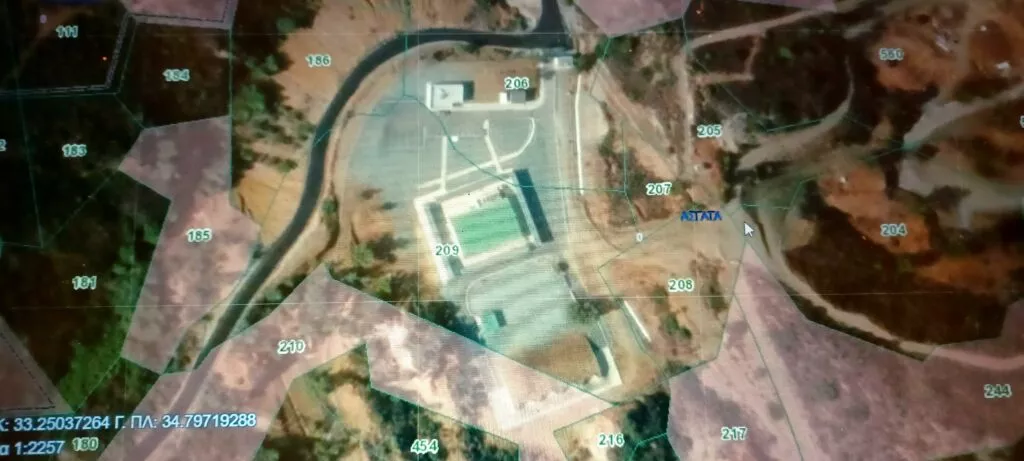
The Archbishopric has secured ownership of tens of thousands of square metres of land following a court ruling on 5 October 2026 that enforced an agreement dating back to 21 June 1948.
The agreement was signed between Hellenic Mining Public Company Limited and the Greek company Anonymos Elliniki Etaireia Chimikon Proionton kai Lipasmaton AE, which was subsequently placed into liquidation under the National Bank of Greece SA.
An indication of the property’s value can be found in the price paid 78 years ago: 150,000 Cyprus pounds. Some of the dozens of individual plots cover more than 30,000 square metres each.
The unusual history surrounding ownership of the properties was highlighted when the Archbishopric approached the National Bank of Greece and asked it to transfer the land it was claiming. The bank was not even aware that the property claimed by the Church existed.
Hellenic Mining Public Company Limited, later known as the Hellenic Mining Company (EME), was incorporated in Cyprus on 22 May 1948 with the aim of acquiring the business of Anonymos Elliniki Etaireia Chimikων Proionton kai Lipasmaton AE.
The acquisition went ahead, but the company’s property was not transferred to Hellenic Mining. Some properties in Nicosia district were transferred several years ago, while the transfer of land in Limassol remained outstanding.
According to the Limassol District Court ruling, in 1948 the Greek company agreed to sell and transfer to Hellenic Mining its mining and quarrying business in Cyprus, including all of its immovable property, mining leases, licences, quarrying privileges, factories, facilities, tools, railway lines, air lines, pylons, furniture, book debts, contractual rights and all its other assets.
In return, Hellenic Mining transferred 149,993 of its shares to the Greek company. Each share was worth one pound, putting the total value at about 150,000 pounds.
At the time, monthly earnings ranged from three to six Cyprus pounds, depending on a person’s occupation, an indication of the scale of the transaction.
Neither the Archbishopric nor the National Bank of Greece was a party to the original agreement. They became involved later, when the Archbishopric acquired Hellenic Mining Public Company Limited and the National Bank of Greece became liquidator of the Greek company that had signed the 1948 agreement.
In carrying out the 21 June 1948 agreement, the Greek company transferred most of its properties in Cyprus. However, the transfer of 47 Limassol title deeds remained outstanding, including titles for trees, which at the time could have their own separate ownership titles.
Decades later, on 27 January 2012 – 64 years after the agreement – Hellenic Mining deposited the agreement with the Limassol District Lands Office.
On 8 September 2015, it informed the Greek company that transfers of several plots remained outstanding. The company was asked to attend the Lands Office on 12 January 2016 but did not do so, prompting legal proceedings aimed at completing the transfers.
Under the 1948 agreement, the Greek company handed over and transferred all of its mining facilities and leases to Hellenic Mining, including those in the Asgata-Kalavasos area.
Hellenic Mining’s lawyers, Leonidas Georgiou and Chloe Tofaridou, argued that mining operations continued uninterrupted without the need to transfer the Greek company’s properties into Hellenic Mining’s name, on the basis that it had acquired the company.
They told the court that property transfers were carried out only when necessary. This, they said, explained why properties in the village of Asgata had still not been transferred to Hellenic Mining.
They also argued that transferring the properties had not been necessary because the terms of the agreement gave Hellenic Mining possession of all the Greek company’s properties, allowing it to continue operating without interruption. The mining leases had also been transferred to it.
A witness for Hellenic Mining, whom the court found credible, testified that properties containing ore-processing facilities at Vasiliko were among those transferred under the agreement.
Plots forming part of the railway line running from the Asgata-Kalavasos mines to Vasiliko and subsequently included in the Kalavasos land consolidation scheme were also transferred.
During 1979 and 1980, plots belonging to the Asgata-Kalavasos mine and administratively falling within Ora village were transferred to Hellenic Mining. The witness submitted a collection of documents, including copies of 23 title deeds transferred by the Greek company to Hellenic Mining.
Another Hellenic Mining witness testified that he had met the chairwoman of the defendant’s board, Louka Katseli, in Athens to discuss the matter. Officials from the defendant, the late Archbishop Chrysostomos II of Cyprus and lawyer Leonidas Georgiou were also present.
According to the testimony, those at the meeting were told that the Greek company had no assets in Cyprus and that no property transfer could therefore take place.
Katseli suggested that Hellenic Mining pursue the matter through the courts and gave assurances that the defendant would not object to the transfer of the properties.
However, when a date was subsequently set for the property transfers, representatives of the National Bank of Greece did not attend the Lands Office.
The court ruling states that Hellenic Mining has possessed and never relinquished possession of the 33 properties at issue since 1948.
Six mines were located within the mining lease it operated. The properties covered by the lease, including the 33 disputed properties, were used by Hellenic Mining for activities including excavation, exploration surveys, depositing mining waste, installing equipment and machinery, building and maintaining housing for miners and constructing roads.
All expenditure relating to the mining lease and all investment in it was undertaken by Hellenic Mining.
The ruling also states that if Hellenic Mining decided to reactivate the Kalavasos-Asgata mining lease, the 33 properties would be essential to its operations. It would be unable to obtain a new mining lease in the area if the properties remained registered in the name of the Greek company.
The court concluded that it had the power to issue a specific performance order under Section 7 of the law and that, in light of the evidence, the action should succeed.
The relevant orders were therefore issued.
The court also awarded the costs of the proceedings to Hellenic Mining and against the defendant, with the amount to be calculated by the Registrar and approved by the court.

