


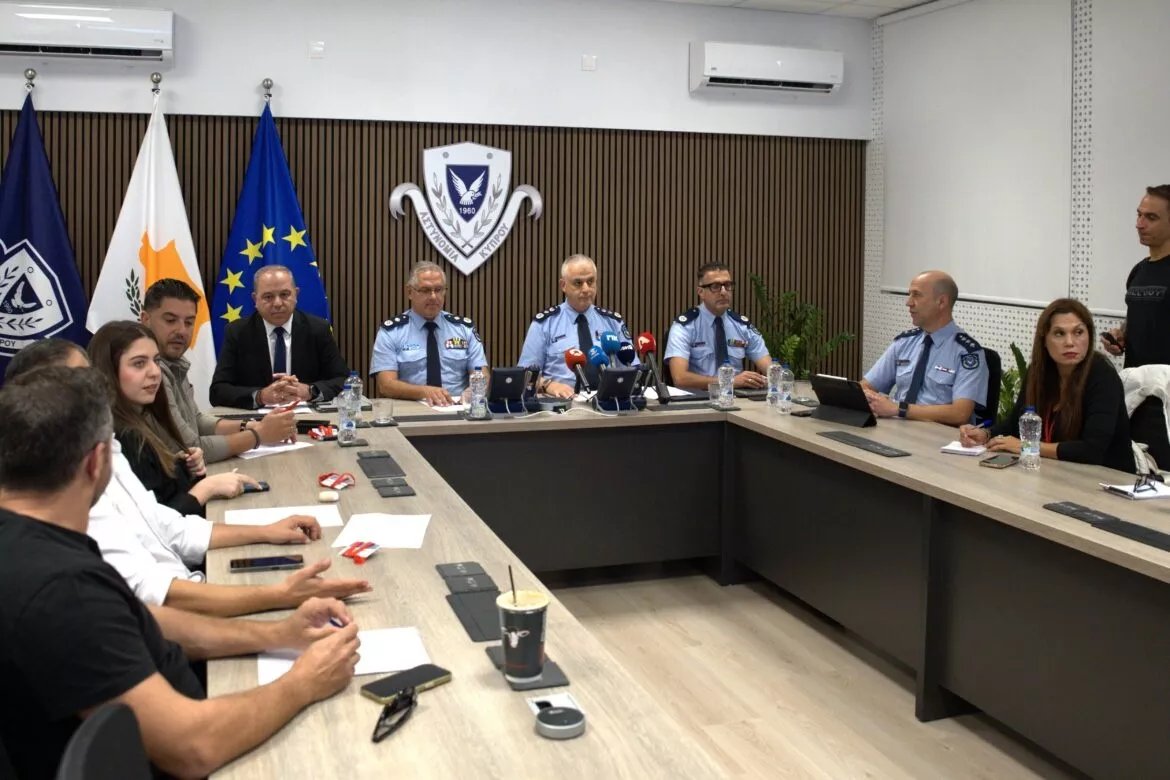
The Justice Ministry’s 2027 budget includes 4,842,500 euros to buy a building for the police’s new organised crime task force, dubbed the ‘Cypriot FBI’. Police Chief Themistos Arnaoutis unveiled the task force on Wednesday, although it has been operating since May, when it carried out its first operation.
The task force does not yet have premises, because efforts to buy the building have not been completed. The building chosen is on Iphigenias Street, near Nikis Avenue in Acropolis, Nicosia, and all its services will move there.
Arnaoutis told reporters the task force was not simply an administrative or organisational change, but a substantive reform of how the police organise and use their operational capabilities against serious and organised crime. Organised crime had changed dramatically in recent years, he added, with criminal organisations now operating more flexibly, using technology, building international links and working across several areas of crime at once.
Figures presented at the news conference showed that a European assessment has recorded 731 of the most threatening criminal networks, with more than 400,000 members of 118 nationalities. About 85 per cent of these networks use legal business structures to support or conceal their criminal activity.
The aim, Arnaoutis said, is to dismantle entire criminal networks, cut off their financial power and, where possible, prevent their criminal activity. He described the task force as one of the most important and far-reaching reforms in the ‘Police 2030’ programme to modernise the force.
The task force brings key operational capabilities under a single command and strengthens the link between intelligence, analysis and operations, he added. Intelligence gathering and assessment, investigations, data analysis, financial inquiries, technology and international cooperation now share common planning and operational priorities.
Four sub-directorates
The task force’s first head, Christos Andreou, said it comprises four sub-directorates that work together and support each other, with the shared aim of preventing crime and dismantling criminal networks. They are the Intelligence and Special Operations Sub-Directorate, the Anti-Drugs Sub-Directorate, the Organised Crime Investigation Sub-Directorate and the Strategic Analysis, International and European Relations Sub-Directorate.
Andreou said the task force shifts the operational focus from individual cases to the criminal network as a whole: its structure and connections, its funding mechanisms, its international relationships and the financial gains that allow it to keep operating.
Intelligence-led policing is central to the approach, with operational decisions based on sound intelligence analysis, risk assessment and a continually updated picture of criminal threats. The task force will act as an analysis centre for organised crime, aiming not only to investigate existing cases but to identify networks, new trends, connections and threats.
Its success would not be judged by the creation of a new structure, Andreou said. “It will be judged by its results.” He added that the measure would be whether its work contributed to a safer Cyprus and better protection for the public.
International cooperation
Cooperation with Europol, participation in EMPACT, the European Multidisciplinary Platform Against Criminal Threats, and direct cooperation with police in other countries are now built into the task force’s operations.
Operational cooperation with the Hellenic Police is particularly close. Cyprus follows Greece’s model in fighting crime. Depending on the needs of each case, the task force also works directly with other European police authorities, authorities in non-EU countries and international organisations.

