


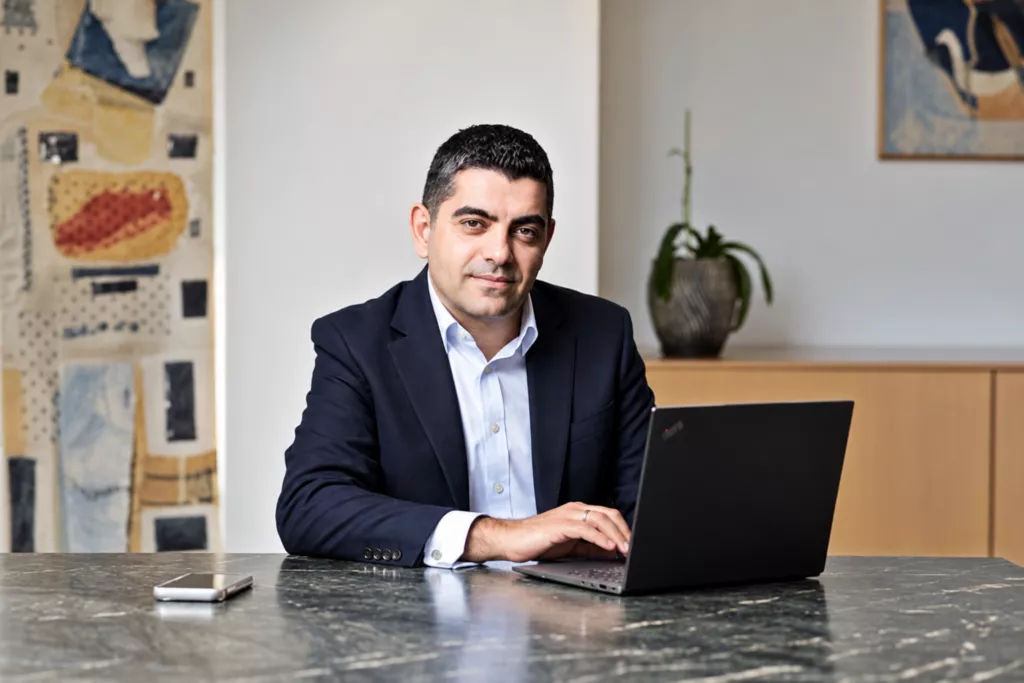
Demetris Nicolaou, Director of the Digital Transformation Division at Bank of Cyprus, gave an interview to Forbes Cyprus ahead of his appearance on a panel discussion at the magazine’s first conference, the Next Generation Banking & Fintech Summit, in Limassol on October 13.
The full interview appears in the Forbes Cyprus issue out on Sunday, October 4. It covers how artificial intelligence will make customer service more proactive, the new omnichannel role of bank branches and strict data security standards. It also sets out a broader vision for 2030: smart technology working in the background to make customers’ everyday lives simpler. Below is an extract.
We’re now talking about a shift from digital banking to AI banking. What does that mean in practice for customers, and how will it change their day-to-day relationship with the bank?
Until now, digital banking has let customers carry out transactions themselves, quickly and from anywhere, that used to mean a trip to a branch. AI banking goes a step further. Beyond digitising processes and products, it lets the bank understand better what customers need and help them get things done in a much more natural and immediate way.
A good example is our Conversational Banking initiative. Through our strategic partnership with Avenga and Microsoft, we’re developing a new platform using agentic AI and Microsoft Azure AI services.
The aim is for customers to gradually be able to talk to the bank in natural language, ask a question, get tailored information and, where it’s feasible and safe, complete banking tasks.
Put simply, we’re moving from “I open the app and look for how to do something” to “I tell the bank what I want to do and it helps me do it”.
But that’s only the intermediate stage. The next step is agent-to-agent capability. Specialised digital agents will be able to work together to complete complex tasks, with the customer’s approval and within a strict security framework. We’ve already piloted scenarios like this with Visa and Mastercard, and similar capabilities can be extended to banking products. Step by step, we’re moving from an experience where customers simply talk to the bank to a model where the bank can coordinate services and act on their behalf, always with transparency, control and their consent.
What’s the next big step in Bank of Cyprus’s digital transformation?
The next big step is moving from digital banking to a smarter, more personalised and interactive banking model built around conversation. We’ve already moved most of the everyday banking experience online. Our digital journey really began in 2017. Since then we’ve gone from the new BoC Mobile App and digital onboarding to services such as QuickLoans, JOEY, Fleksy and the Digital Housing Loan.
Now we’re moving into the next phase. We want our services to become more proactive and personalised, making responsible use of artificial intelligence and data. We’ll also use AI internally, so our people have better tools and can serve customers faster and more effectively. The goal isn’t to take people out of the equation. It’s to use technology so that both customers and the people serving them have a better experience.
How can artificial intelligence change the way Bank of Cyprus understands and anticipates its customers’ needs?
The big change AI brings is that it lets us make better use of the information we already hold, always within the right data protection and security framework. That makes our service more relevant to each customer’s real needs. If you remember, until recently the big debate was about how organisations could use the huge volumes of data they held to benefit both themselves and their customers. Today, with the help of AI, they can.
Soon, banking will become more proactive. The bank will be able to spot a possible need, present relevant options in good time or guide the customer to the next step.
What matters is that we’re not just talking about better marketing. We’re talking about better service. AI will be judged on how far it can cut the time and effort customers have to put in, and give them more meaningful, more personalised support.
Towards lifestyle banking
Which digital service do Bank of Cyprus customers use most today, and which do you think has the most room to grow?
Everyday banking through the BoC Mobile App is now at the heart of our relationship with customers. We serve more than 522,000 active digital users today, which shows how deeply digital banking has become part of their daily lives. QuickPay stands out in particular. More than 263,000 customers use it, making over 800,000 payments a month worth as much as 100 million euros.
The biggest growth potential, though, doesn’t necessarily lie in any one service. It lies in connecting all these services into a smarter, more personalised experience.
We’re also expanding into lifestyle banking, so that we’re there at the point and moment a customer’s need arises. That means banking won’t be confined to the app or the branch but will fit naturally into customers’ daily lives. Examples include Fleksy at the point of sale, the Car Dealer Portal when choosing a car, and Jinius in the wider ecosystem of purchases and business transactions.
A few years ago we moved from the branch to mobile banking. In the same way, over the coming years we’ll move to an AI, conversational and lifestyle banking experience, available right where the need arises. That’s where we believe the next big change lies.
Bank plus fintech: the future of finance
Fintechs were initially seen as a threat to traditional banks. Are they now competitors, partners or both?
They’re both, and I think that’s now the reality of the financial ecosystem. Because they operated under different rules, especially in the early years, fintechs and neobanks improved the user experience, payments and the speed at which new services can be launched. That has been good for the whole sector because it has accelerated innovation. As a bank, we now feel we can compete on equal terms in many areas, even if the rules still aren’t the same.
At the same time, there’s significant scope for collaboration. A good example is our strategic partnership with Wealthyhood and our 6 million euro investment in it.
Rather than assuming every technology solution has to be built in-house, we can work with specialised fintechs. We can combine their technology and agility with the bank’s customer base, trust, expertise and infrastructure. So the future isn’t just bank versus fintech. To a large extent, it’s also bank plus fintech.
Read more:

