


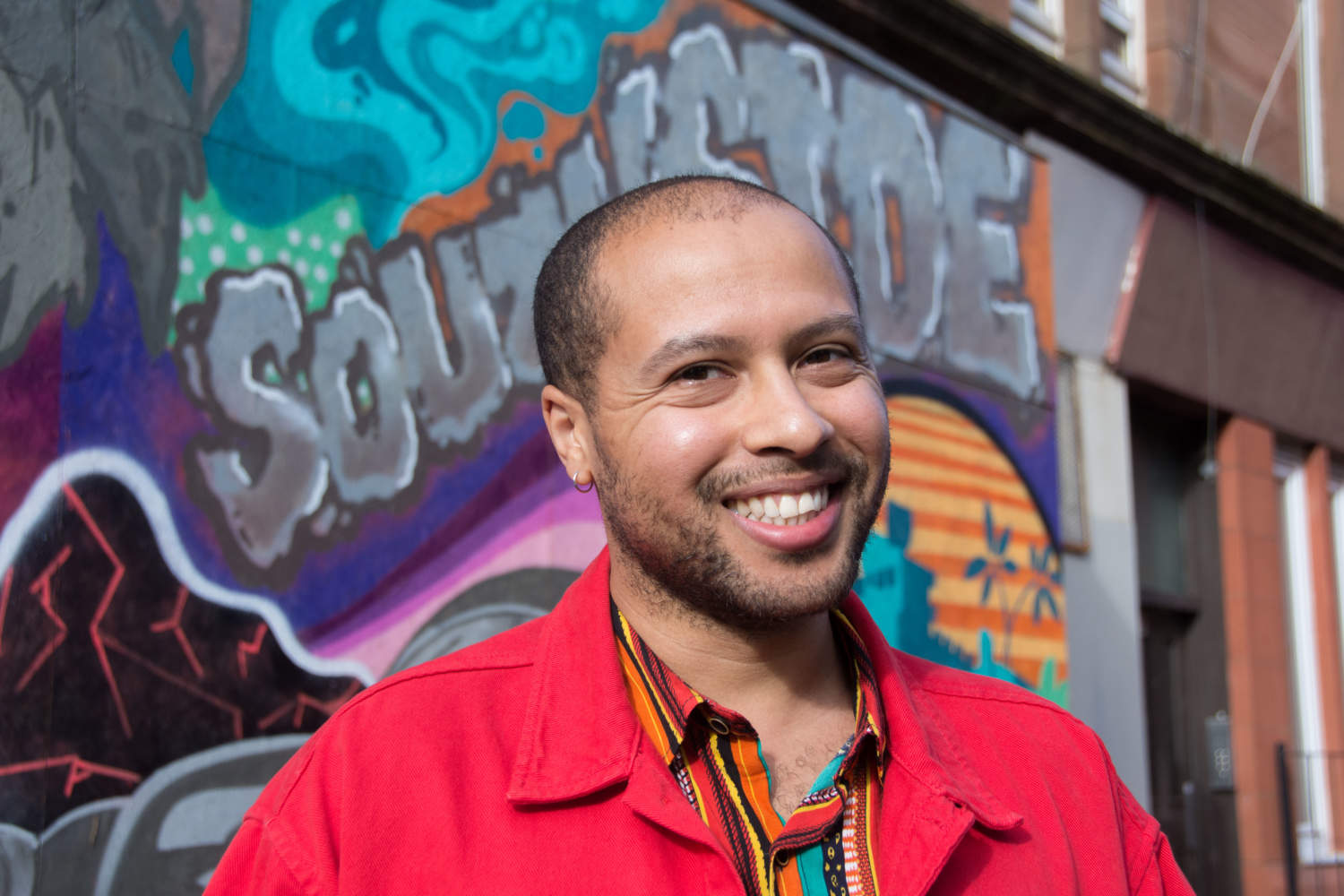
The BAFTA-winning poet and writer of Cypriot and Jamaican heritage has moved beyond the anger of his earlier work, turning his attention to brighter images: queer love, joy and the stories of Black queer people. On the occasion of his appearance at this year’s Queer Wave Cyprus, he speaks to Phileleftheros about the moment he stepped onto the stage at the Royal Festival Hall, as well as the people, communities and voices that continue to remain out of frame.
Two Black Boys in Paradise imagines a space where two Black boys can love each other safely. Why did you feel the need to tell this story?
So many queer films and TV shows are so tragic, which reflects part of the queer experience, but it isn’t the whole picture for us. I wanted to show queer love and queer joy, and in particular Black queer love and joy. I hadn’t seen many stories like Two Black Boys in Paradise in the mainstream, certainly not from the British perspective.
Could you ever have imagined that this story, which began as a poem, would one day win the BAFTA for British Short Animation?
At the beginning, we took it one step at a time. Deciding to work together with Ben Jackson and Baz Sells of One6th Animation Studio was easy because they were so passionate about my poem, which we adapted into the film. It was quite hard for them to secure the funding for it, but once that was in place, it was a painstaking journey to make the film. Because it’s a stop-motion animation, it took a very long time, but once it was made, I knew it was fantastic, beautiful, important and would have a huge impact on anyone who saw it. The next stage was getting people to see it, getting the film into festivals, and we entered a lot of film festivals – over 200 submissions to film festivals – and we were selected for over 70 and have won over 30 awards. So when it came to the BAFTA, we were quite far into the journey and I knew how much people loved the film, so I did dare to believe we would win because all the signs were pointing in the right direction.
How did you react when the result was announced?
When the result was announced, I was stood beside my boyfriend and I asked him if I should hug him or kiss him because I knew this would go on TV and I wanted him to feel comfortable. He said I should hug him, so that’s what I did, and then I made my way to the stage to make the acceptance speech, which I had written the night before, and tried to get the words out, though my heart was racing. It was an incredibly overwhelming moment. It was one that felt like a great honour, and I was accepting on behalf of our director and producer, who was stood beside me, and our team of over 100 people that worked on the film, 25 of whom were in the auditorium at the BAFTAs cheering for us.
Did you feel that moment carried a significance beyond your personal achievement as a creator?
It did make me think of when Moonlight won an Oscar, I think because there are so few Black queer films that get mainstream recognition and success. And it felt like a massive payoff for the five years of work Baz and Ben, and the rest of the team, put into the film. I knew how much it was going to mean for them as filmmakers and the opportunities it would create for everyone who worked on the film.
When accepting the award, you spoke about the lack of representation of Black gay men on screen. What is keeping these stories on the margins?
I think we’re seeing great representation in literature and in theatre, but film and TV just cost more money, so there aren’t as many ‘risks’ being taken on things that might not pay off financially for those investors. I hate to talk about Black queer stories as a risk, but unfortunately that’s the language that’s being used when I speak to people in the industry; anything that isn’t straight, white, mainstream is considered niche and risky in terms of finding an audience for it and making back the money spent on it. I’m hoping there are films and TV shows in production that will have this meaningful representation that is so sorely needed.
Cyprus and Jamaica are very different geographically, historically and culturally. What have you inherited from each?
Cyprus and Jamaica were both British Crown colonies, so there is a shared history there in terms of colonialism and my grandparents on both sides coming to the UK as British citizens. I think my grandparents wanted their children and grandchildren to have good educations, to get on in British society and have the good life that they dreamed of having for themselves.
My heritage felt represented in my grandparents’ homes and then in the friends I had from those communities; so my Jamaican friends at school and the Cypriot friends I made at university and in my adult life. I grew up with Cypriot food and, to some extent, the language; although I could understand some Greek, I was never a confident speaker.
Because of my mixed heritage and growing up in London, I’ve always felt like I’ve belonged to many cultures, including British, Cypriot and Jamaican. As I’ve gotten older, I also recognise queer culture as my culture too.
How do these two worlds meet in your writing?
I’ve used Greek and Jamaican patois in my writing, in my poetry, fiction and non-fiction. I will say I’ve written fictional characters with my same heritage, poetry about my family on both sides and my mixed identity. Cyprus tends to feature a little bit more than Jamaica because I’ve come to Cyprus more often.
What did presenting your work at Queer Wave Cyprus mean to you?
I’ve admired the festival from afar and haven’t had the opportunity to visit Cyprus when it’s been on, so I’m delighted that my first time at Queer Wave is to screen a film and lead a workshop. I feel like I am contributing to the community while also benefiting from it. The queer community in Cyprus seems to be going from strength to strength, with various queer organisations and growing mainstream support for the community.
Is it true that your award-winning novel The Black Flamingo began with an image you encountered on the island?
The starting point for The Black Flamingo was the sighting of a real black flamingo on the Limassol Salt Lake in April 2015. That striking visual metaphor spoke to me in a very deep way and unlocked a lot of my feelings about being part-Cypriot but perceived as Black first and foremost.
When did you realise that the difference that once made you feel like an outsider could become a source of strength and creativity?
First, when I did drag performances as The Black Flamingo, dressing up in black feathers and high heels with makeup on, exploring my heritage and identity and celebrating through poetry, lip sync and burlesque. I realised how much I had to draw from in terms of my cultural background and creativity. Those early drag performances felt very liberating for me, and then when I wrote the book The Black Flamingo and put that experience into the character of Michael in the book, it reached so many people, and a character very similar to me became so loved by many, which made me feel loved as well.
You have said that you do not want to write as though you are representing the entire Black queer community, but rather your own experience. Can a personal story nevertheless acquire a collective meaning?
Absolutely. I think of Moonlight again, and I couldn’t put my finger on how the characters are similar to me apart from being Black and queer; however, just the fact of them being on screen, and that film winning an Oscar and straight people and white people going to see the film, made me feel like they might be more cognizant of my humanity because they’ve watched a film about Black queer characters. Similarly, with the TV show Pose, there are some elements of the club scene that were like my own coming of age; however, in the specific scenarios, I didn’t really face as much hardship as the characters did. I think it’s important for that hardship to be shown so that people realise what our community has collectively been through and how that affects us all in one way or another.
Do artists have a responsibility to take a stand?
I think by making art you are making a stand. By spending your time on art, you are saying that art in itself is a valuable thing. Then you may try and make money from your art, or you may spend time trying to get your art out there. Whether you are showing a film in a festival or performing poetry at an open mic or putting your work online, whatever that work is about, you are saying art has a purpose in the world, and that is a stance. For the most part, my work is advocating for the rights and humanity and love and joy of Black and queer people, and that’s because of who I am. And I think if I were a different person, my art would be focused on different issues and communities.
I think it’s important, when you can, to amplify voices from communities you feel are underrepresented, to share your platform, not to speak for people who can speak for themselves. But I definitely think sharing the art of people who are targets of hate or oppression is really important, so I appreciate how Queer Wave is platforming trans people and Palestinian people in the festival, as they’ve been doing for many years.
Looking back, what is the common story you see running through your work?
I think identity and belonging are the common threads, as well as love, whether that’s self-love, familial love, friendship love or romantic love. I love love, and I love writing about it.
I think my writing when I was younger was necessarily angrier. As I’ve gotten older and have a platform, I realise I don’t need to shout to be heard, and so I can be more gentle in my delivery. I can be more nuanced in the ideas I want to convey. I can take my time between putting work out. I can change my mind about things. I can take myself and my work in different directions, and I look at my work as a whole and my own growth, legacy, and try and keep my creativity fresh by trying new things, whether it’s writing for different age groups or writing books, for the screen, for the stage, working with music. I need to get my words out there to a variety of audiences.
What is it that you are still searching for through your writing?
I’m searching for confidence in my voice. I’m searching for beautiful sentences, lasting images, transformative moments, and things that people want to reread or rewatch, and that show something new each time. I’d like my work to be impactful on the first read or viewing. I want it to work on a surface level, on a deeper subtextual level and then also on a lasting subconscious level.
(Cover image: Thomas Sammut)

