


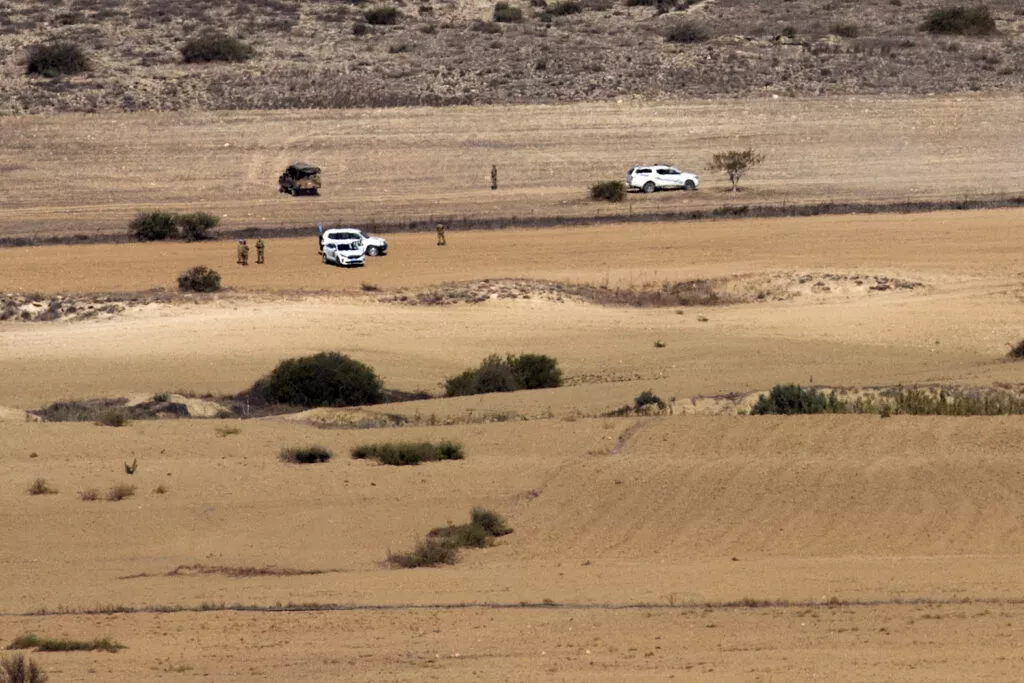
Last Wednesday’s incident in the Deneia buffer zone was not the first and is unlikely to be the last as long as tensions persist in Cyprus.
In this case, Turkish soldiers did not succeed in preventing Greek Cypriot farmers from cultivating their land. The Greek Cypriot side views such actions as attempts to challenge control of the land in practice, ultimately paving the way for Turkish Cypriots to cultivate it themselves. Similar disputes have arisen elsewhere along the buffer zone.
But what exactly is the buffer zone, and why does it matter who cultivates a handful of fields?
And why do residents of communities within the buffer zone, along with farmers and other professionals, continue to keep these areas active despite recurring tensions?
The figures offer part of the answer.
Greek Cypriot negotiator Menelaos Menelaou told parliament’s Refugee Committee that more than 10,000 people live in what is commonly known as the buffer zone, or the “neutral zone”, as he prefers to call it.
Thousands more enter and leave the area for work without living there, primarily farmers and, to a lesser extent, livestock farmers and other professionals.
The buffer zone is also far more than agricultural land. As Menelaou pointed out, entire communities lie within it, some of which tend to attract wider attention only when an incident involving Turkish forces occurs.
Not every incident becomes public. Around 1,000 incidents are recorded annually, but attention generally focuses on those that prompt United Nations intervention following representations by local authorities in affected communities or by the Republic of Cyprus government itself.
The Republic considers the buffer zone part of its territory, with the United Nations administering the area with its consent, despite the restrictions and disputes that arise there.
The scale of the territory helps explain its significance.
The buffer zone accounts for around 3% of the total territory of the Republic of Cyprus, covering approximately 346 square kilometres and stretching for 183 kilometres across the island.
According to the United Nations, the Green Line varies dramatically in width. In some populated areas of Nicosia it is only a few metres wide, while elsewhere, including around Athienou, it extends for several kilometres.
In addition to the buffer zone, the Republic of Cyprus does not exercise control over another approximately 254 square kilometres occupied by the British Sovereign Base Areas.
Communities face security and everyday problems
The buffer zone returned to the spotlight during a recent parliamentary discussion on security and other problems affecting communities within it. The issue was brought before parliament by AKEL MP Christos Christofides.
Among the matters raised were farmers’ safe access to their land and harassment by Turkish forces, difficulties obtaining permits to build homes, as well as water supply, street lighting and other infrastructure issues.
Menelaou told MPs that the buffer zone forms part of the territory of the Republic of Cyprus from which the National Guard disengaged following the end of hostilities during the Turkish invasion.
The purpose, he said, was to provide the UN peacekeeping force with the area it required to carry out its mandate effectively under UN Security Council Resolution 186 of 1964.
He said one of the peacekeeping force’s fundamental responsibilities is to help restore normal conditions and support the maintenance of law and order by the lawful state, the Republic of Cyprus.
Menelaou further said that the Republic of Cyprus has jurisdiction within the buffer zone and exercises it, to varying degrees, in cooperation with the United Nations.
He clarified that the Republic does not exercise jurisdiction over military matters, although channels and mechanisms exist for communication and consultation with the UN peacekeeping force on such issues.
In practical terms, he said, exercising the Republic’s jurisdiction in the buffer zone means allowing all forms of civilian activity to take place to the greatest possible extent.
Where civilians can and cannot enter freely
The United Nations says that, as part of UNFICYP’s mandate to help restore normal conditions, large parts of the buffer zone are farmed and/or inhabited.
Civilians can move freely into these areas.
In other parts of the buffer zone, however, civilian movement or activity requires specific authorisation from UNFICYP.
The permit system is a recurring concern for local authorities and residents of communities within the buffer zone, since anyone entering an area requiring authorisation without the appropriate permit can encounter difficulties.
Legal status remains at the centre of debate
The legal status of the buffer zone has also been examined at an event organised by the University of Nicosia School of Law and moderated by former Attorney-General Costas Clerides.
The school’s dean, Achilleas Emilianides, said the UN’s longstanding position is that UNFICYP bears responsibility for the area on the basis of the tacit acquiescence of the two opposing military forces – the Turkish occupation forces and the National Guard.
He said the UN has, since the 1990s, applied the doctrine of the buffer zone’s “integrity”.
Under that approach, not only are actions leading to the militarisation of the area or a change in the status quo prohibited, but so are civilian activities that UNFICYP considers capable of affecting the buffer zone’s integrity.
According to Emilianides, this has resulted in differing interpretations by the United Nations and the Republic of Cyprus over what constitutes a “violation” within the buffer zone.
At the same event, Maria Savvidou-Panayiotou, deputy director of the Cyprus Problem, Turkey and Occupied Areas Directorate at the Foreign Ministry, stressed that the Republic of Cyprus remains sovereign and retains control over the buffer zone.
She said that, despite this, the realities created by the occupation make UNFICYP’s presence and role necessary.

