


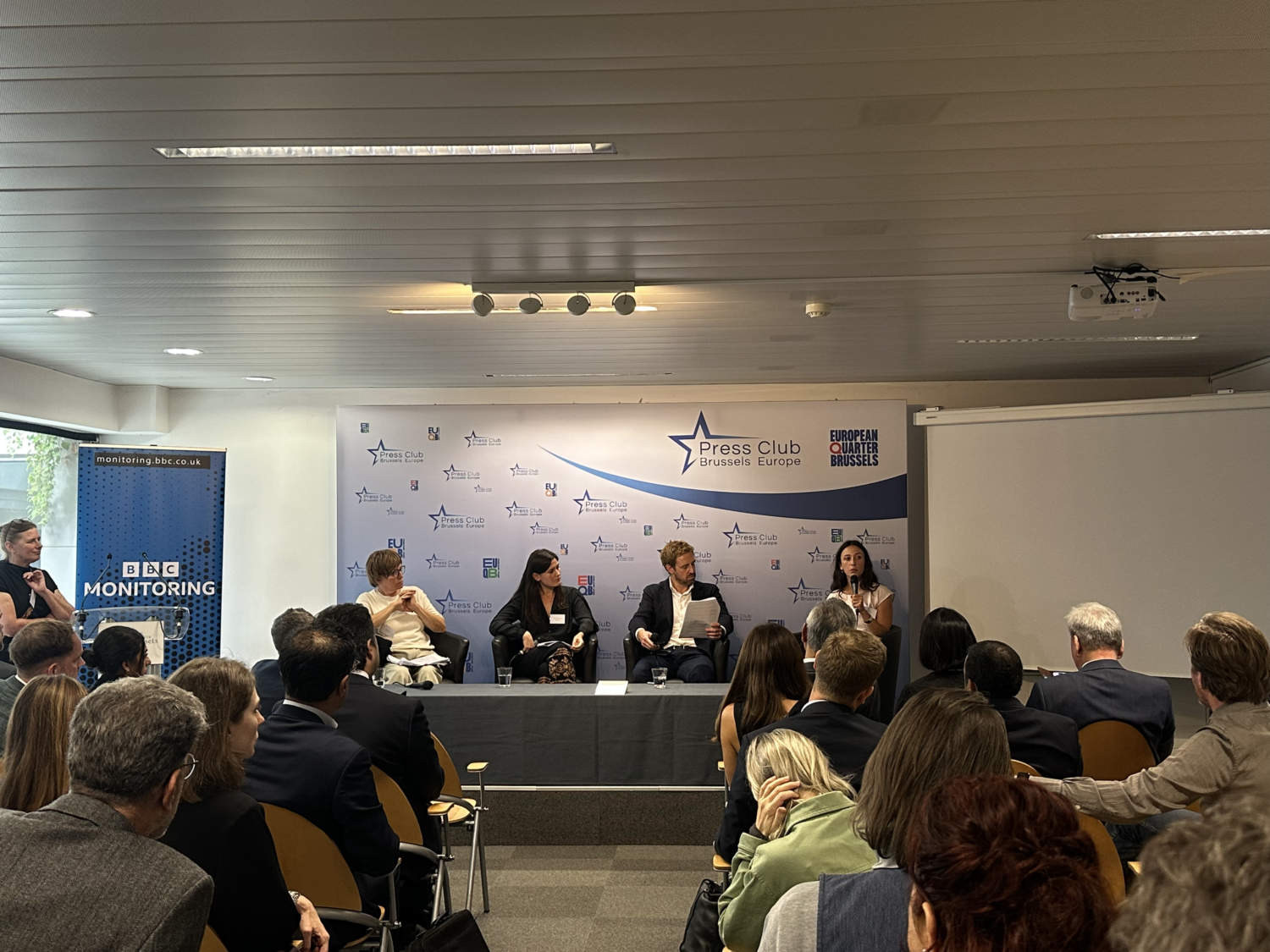
Europe’s credibility gap is becoming a political problem in the Middle East. From Gaza to Tunisia, European governments are facing a widening gap between the democratic principles they say they defend and the way those principles are perceived across parts of the Arab world.
That gap was a central theme of a discussion among BBC Monitoring analysts in Brussels on the changing perception of Europe in Arabic-language media. The discussion focused on news coverage, Russian influence operations and social media, but also on a broader question: what happens to democratic politics when governments are perceived as applying international rules inconsistently?
Since the Hamas attack on Israel in October 2023 and the Israeli genocide in Gaza, European governments have repeatedly invoked international law, civilian protection and the need for a political solution. At the same time, European leaders have expressed support for Israel’s right to defend itself.
BBC Monitoring analysts said those positions have become the basis for a persistent narrative in Arabic-language media that Europe applies different standards to different conflicts.
“Silence,” “complicity” and “double standards and bias” were the three broad narratives about Europe identified by Tess Mallinder Heron, a BBC analyst for the Middle East Team. She said thousands of articles had touched on versions of those themes.
Comparisons with Ukraine are driving the criticism
One of the most common comparisons is with Europe’s response to Russia’s full-scale invasion of Ukraine.
European governments described Russia’s invasion in terms of sovereignty and international law, imposed sanctions on Moscow and supported efforts to hold Russian officials accountable. In coverage of Gaza, Arab audiences have simultaneously seen many of the same governments emphasise Israel’s right to self-defense while the humanitarian situation in the territory has deteriorated.
An old statement by Ursula von der Leyen condemning attacks on Ukraine’s energy infrastructure was repeatedly circulated on Arabic-language social media after October 2023. Commentary accompanying the statement accused European leaders of applying one standard to Russia and another to Israel.
Other incidents have been used in similar ways. Clare Denning, a BBC analyst for the Russia team, cited a viral exchange involving former EU foreign-policy chief Josep Borrell. Asked whether the Hamas attack of October 7 constituted a war crime, Borrell answered yes. Asked whether Israel’s actions in Gaza constituted a war crime, he said he was not a lawyer and could not make that assessment.
The exchange subsequently circulated as a short piece of political messaging, with the focus reduced to a question of whether the same legal standard was being applied to both sides.
Russia is using an existing grievance
The BBC Monitoring discussion also examined the role of Russian media and social-media networks in Arabic.
Researchers have been tracking Russian outlets including RT Arabic and Sputnik Arabic, alongside networks of pro-Russian social-media accounts. After the Gaza war began, some accounts that had previously concentrated on Russia’s war in Ukraine shifted significant attention toward Gaza. They shared images of Palestinian casualties alongside commentary about Western policy.
Russian Arabic-language outlets also increased their coverage of the Israeli-Palestinian conflict. For Moscow, the issue provides an opportunity to connect an existing grievance about Western policy with its broader messaging about the international system. The argument is not necessarily that Russia must persuade audiences to support Moscow. Instead, the messaging can reinforce the proposition that Western governments are hypocritical and that the liberal international order does not apply its stated principles consistently.
Denning said RT Arabic has presented the West as making condemnations and issuing statements without taking meaningful action for Palestinians, while presenting Russia as a more consistent actor.
BBC Monitoring researchers have also identified Arabic-language pro-Russian accounts with large followings and connections to regional journalists and politicians. Some emerged after Russia’s full-scale invasion of Ukraine and later shifted their focus toward Gaza.
The effect of such campaigns on political attitudes remains difficult to measure. The analysts also cautioned against overstating the reach of RT Arabic. The distinction matters because Russian messaging does not necessarily have to create opposition to Europe from scratch. It can amplify grievances and perceptions that already exist.
Western media are part of the equation
The BBC Monitoring discussion also addressed whether European and Western media contribute to the perceptions that foreign influence operations subsequently exploit.
One audience member questioned whether differences between BBC Arabic and BBC English coverage, including the terminology used to describe conflicts, could affect perceptions. Another raised criticism of BBC coverage of Gaza.
Nick Beake, the BBC’s Brussels correspondent and moderator of the discussion, acknowledged the issue, saying it was “impossible to discuss allegations of Western hypocrisy without recognising that Western media coverage itself is part of the way the West is perceived.”
That creates a feedback loop.
A viewer who sees civilian suffering in Gaza may then hear European leaders defend Israel’s right to self-defense, encounter comparisons with Europe’s response to Ukraine and subsequently see a Russian or local influencer describing Western governments as hypocritical.
The Russian message does not necessarily need to persuade that viewer that Russia is trustworthy. It can instead reinforce an existing conclusion that European governments are not applying their stated principles consistently.
Tunisia shows how the argument can enter domestic politics
The discussion then moved beyond Gaza to the domestic politics of Arab states, with Tunisia presented as an example of how questions about European credibility can intersect with domestic political narratives.
The argument is not that European policy caused Tunisia’s democratic decline. Rather, the analysts discussed European credibility as one factor in the wider environment in which governments and political actors justify their policies.
President Kais Saied has increasingly portrayed foreign-funded civil society organisations as threats to national sovereignty. Human Rights Watch documents repeated statements by the president accusing associations of acting as extensions of foreign powers and describes a broader campaign against organisations receiving foreign funding.
In May 2024, for example, Saied accused organisations working with migrants and refugees of being “traitors” and “foreign agents.” Amnesty International subsequently documented arrests, investigations and restrictions involving organisations working with migrants and refugees.
The significance of the rhetoric extends beyond individual organisations. It changes how civil society organisations can be portrayed in domestic political debate: groups associated with human rights, democratic accountability or migrant protection can instead be characterised as vehicles for foreign interference.
That is where an international narrative about Western influence can become part of a domestic political argument.
China offers a different model of engagement
The BBC Monitoring panel also discussed China’s growing appeal in parts of the Arab world.
The analysts did not present this as evidence that Arab publics had broadly adopted Chinese political values. One explanation instead concerns the perception that China does not condition its engagement on political criticism of Arab governments to the same extent as European states.
Arab Barometer’s 2025 findings provide some evidence of these differing perceptions. The organisation reported that the European Union received more positive assessments than the United States overall, while individual European countries were viewed differently. Spain and Ireland benefited from perceptions of support for Palestinians, while Germany was viewed as Israel’s biggest European ally.
China, meanwhile, received particularly favourable views in Tunisia, at 69 percent, according to the findings cited by the panel.
The figures do not establish a single explanation for those views. They do, however, illustrate the different ways European, American and Chinese foreign policy can be perceived.
Chinese diplomacy can emphasise non-interference while offering infrastructure and financing without the same political conditions associated with some Western assistance. Russian messaging can emphasise an alternative to what it describes as Western hypocrisy. Arab governments can draw on similar arguments when resisting European pressure or criticism.
Syria provides a counterexample
The discussion of Syria provided an important qualification to the broader picture. According to the BBC analysts, perceptions of Europe have been relatively more positive in Syria, particularly following the lifting of sanctions. For Syrians, sanctions relief could be experienced in practical terms, including its potential implications for reconstruction and economic recovery.
That suggests that perceptions of Europe are not uniformly negative across the region.
Instead, views can vary according to how European policies are experienced and interpreted locally. Where European policy is associated with tangible improvements or support for reconstruction, it can retain credibility. Where European statements about international law are perceived as inconsistent with developments in Gaza — and, more recently, Iran — that credibility can come under greater pressure.
Cynicism is itself becoming a political tool
The panel’s discussion of Russian influence ultimately returned to the role of cynicism. Denning said Russia has been particularly effective at exploiting the idea that governments are hypocritical, international institutions are compromised and political principles are applied inconsistently.
That distinction is important for understanding how disinformation can operate.
A campaign does not necessarily need to persuade audiences to accept a specific alternative account. It can instead reinforce the belief that competing accounts are all equally untrustworthy.
If international law is perceived as selective, human rights as politically contingent and democratic governments as saying one thing while doing another, the consequences can extend beyond attitudes toward foreign policy.
The resulting distrust can affect perceptions of international institutions, journalism and civil society. In countries where governments are already challenging independent organisations, the language of foreign interference can provide an additional justification for restrictions.
This creates a link between international credibility and domestic political space.
European governments cannot determine every narrative circulating in Arabic-language media, nor can they prevent Russian or other actors from attempting to exploit existing grievances.
But the BBC Monitoring discussion points to a more immediate variable: the relationship between European governments’ stated principles and the policies they are seen to pursue.
That relationship is being assessed not only through official statements, but through television coverage, social media, comparisons with Ukraine and Gaza, and domestic political debates in countries such as Tunisia.
The resulting contest is therefore not simply about which foreign narrative reaches Arab audiences. It is also about how European policies are interpreted, and whether the institutions and values Europe seeks to promote retain credibility when measured against its actions.
(Sources: Human Rights Watch, Amnesty International).
Read more:

