


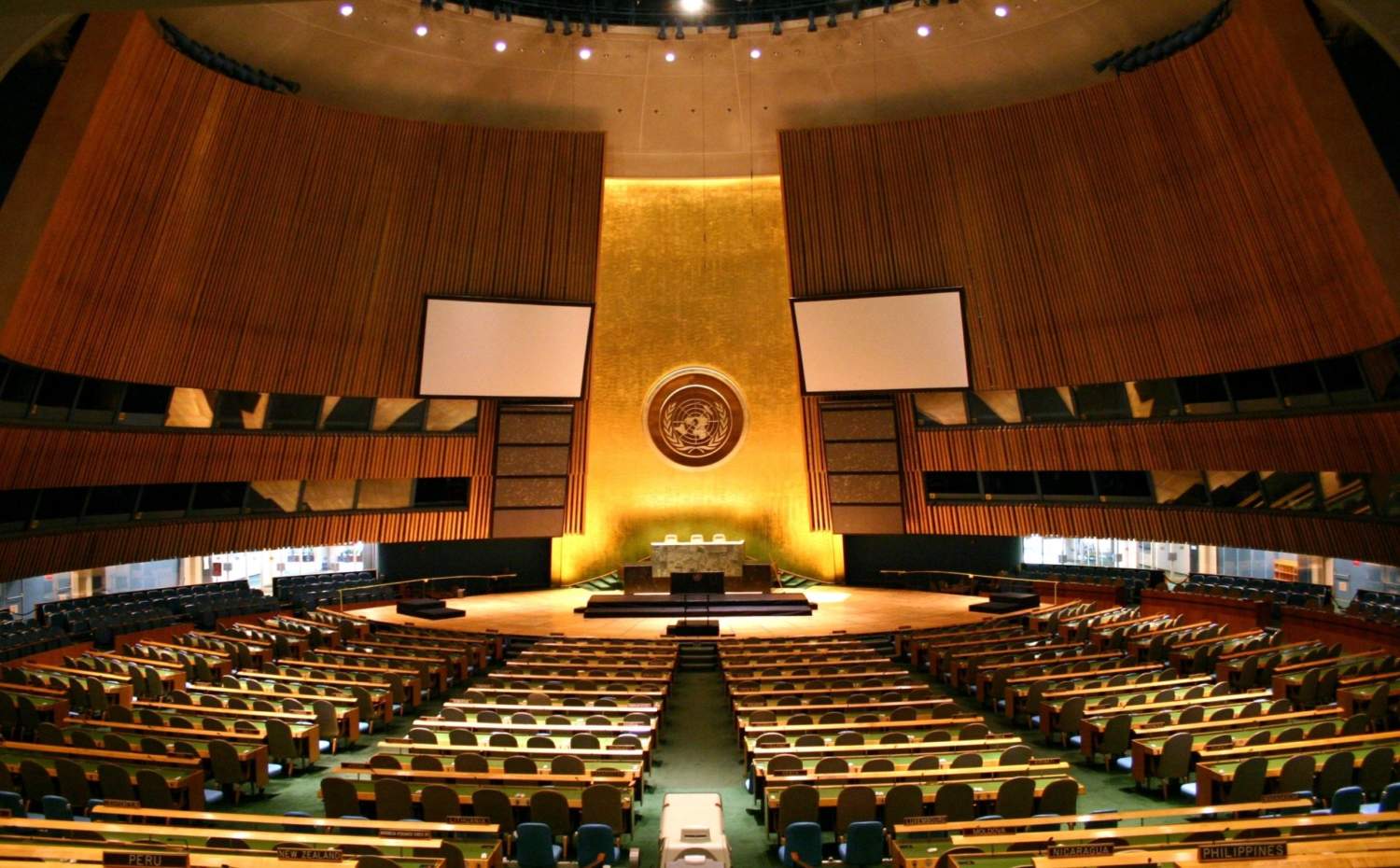
Every September, New York becomes the centre of international diplomacy as the leaders of United Nations member states gather for the General Assembly’s high-level week. For the Republic of Cyprus, taking part in this process for six decades has been an important step in its international representation and in promoting Cypriot positions.
The 81st General Assembly begins its work today, with President Nikos Christodoulides attending on behalf of Cyprus.
The General Assembly is the UN’s main policy-making body. It comprises all member states and provides a forum for discussion on issues covered by the UN Charter, with each of the UN’s 193 member states holding one equal vote. It was established under the UN Charter, signed in San Francisco on 26 June 1945 and which came into force on 24 October that year.
The Assembly holds its regular sessions from September to December each year, and meets as required afterwards. It debates specific issues through agenda items, which lead to the adoption of resolutions. Key decisions for the UN are also made this way, including appointing the Secretary-General on the Security Council’s recommendation, electing the Security Council’s non-permanent members, and approving the UN budget.
The UN’s original 51 member states were those that took part in its founding. The Assembly’s composition changed dramatically in the decades that followed, as decolonisation after the Second World War led to the independence of dozens of states in Asia and Africa, which subsequently joined the UN.
From independence to international representation
The Republic of Cyprus became a UN member on 20 September 1960, shortly after independence, through General Assembly resolution 1489 (XV). Since then it has taken part as a full, equal member state in the General Assembly, which has been one of the main international platforms for presenting Cyprus’s positions on the Cyprus problem, sovereignty, independence and territorial integrity. Cypriot diplomacy has used its participation in the Assembly to seek international support for these positions and to keep the Cyprus problem on the UN agenda.
“We also bring with us our faith in the United Nations and our unwavering devotion to the cause of peace, based on justice and freedom, the same freedom and justice for which the people of Cyprus are fighting and have long fought.” Those were the words of Zenon Rossides, Cyprus’s then permanent representative to the UN, who addressed the 15th General Assembly on Cyprus’s behalf in 1960, the country’s first appearance there. He said Cyprus, as one of the UN’s newest members, approached the debate with the hesitancy of a newcomer, and expressed hope the country could bring perspective and objectivity to the examination of global problems.
Cyprus’s unwavering faith in the UN and devotion to its principles and purposes was the theme of the first official address by a President of Cyprus, Archbishop Makarios, before the UN Plenary in New York on 7 June 1962. He expressed support for self-determination for all peoples under the Charter, and for peaceful measures to end colonialism, saying the Cypriot people, having been freed from foreign rule, felt a natural solidarity with peoples fighting for the dignity of national independence. He also expressed Cyprus’s support for the rapid implementation of the Declaration on the Granting of Independence to Colonial Countries and Peoples, resolution 1514 (XV), which he said Cyprus had warmly supported.
The General Assembly has held particular significance for Cyprus since it joined the UN in 1960, serving as a key venue for international representation and diplomatic action. Particularly after 1974, its resolutions helped keep the Cyprus problem an international issue and helped set out key principles on Cyprus’s sovereignty, independence and territorial integrity.
The Republic of Cyprus was being undermined by foreign powers, then Foreign Minister Spyros Kyprianou told the General Assembly’s 20th session on 14 October 1965. He said that since December 1963, various attempts had been made to keep the Cyprus issue outside the UN, but that the Cyprus government had eventually succeeded in bringing it there despite pressure against doing so. He said various attempts had also been made to satisfy other countries’ interests at Cyprus’s expense, and that the Cyprus problem had to be resolved according to the wishes of the Cypriot people and the principles of the UN Charter. Cyprus, he said, was a fully sovereign and independent state and an equal UN member, and no one had the right to violate or restrict its sovereignty and independence.
Three months after the Turkish invasion, in October 1974, President Makarios addressed the 29th General Assembly. He described the invasion as an international crime and called for international support for Cyprus’s struggle to preserve its independence, unity and territorial integrity, saying the solution to the Cyprus problem had to be based on the UN Charter and its resolutions. He also said that while Turkey had accepted Security Council resolution 353 of 20 July, which set out a framework for a peaceful solution and called on the parties to begin negotiations, it had shown no respect for it.
The General Assembly’s resolutions on Cyprus
The UN has dealt with aspects of the Cyprus problem since 1963, with both the Security Council and the General Assembly playing a significant role. General Assembly decisions have emphasised Charter principles such as respect for the sovereignty, independence and territorial integrity of states.
In 1965, resolution 2077 (XX) stated that Cyprus, as an equal UN member, was entitled under the Charter to full sovereignty and independence without foreign intervention, and called on all states to avoid any intervention against it.
After the 1974 coup and Turkish invasion, the General Assembly adopted resolution 3212 (XXIX), titled “Question of Cyprus”, in November 1974, approved by 117 votes in favour with none against. The resolution called on all states to respect Cyprus’s sovereignty, independence, territorial integrity and non-alignment, and to refrain from any act or intervention against it. It also said all refugees should return to their homes in safety, and called on the parties concerned to take urgent measures towards that end.
That resolution became an important reference point for the Assembly’s approach to the Cyprus problem. Others followed, including resolution 3395 (XXX), which reaffirmed the urgent need to continue efforts to fully implement resolution 3212, which the Security Council had endorsed in its own resolution 365 (1974), and called on all parties to avoid unilateral actions against it, including changes to Cyprus’s demographic composition.
The General Assembly’s role differs from that of the Security Council. It can set out policy positions and recommendations, but it does not have the Security Council’s enforcement powers. Its resolutions nonetheless carry significant weight and can affirm the Charter’s principles and the international community’s position.
Other resolutions on Cyprus followed: 31/12 (1976), 32/15 (1977), 33/15 (1978) and 34/30 (1979).
Resolution 37/253, adopted on 13 May 1983, was particularly significant. It affirmed the right of Cyprus and its people to full and effective sovereignty and control over the whole of Cypriot territory and its resources, and called on all states to support and help the Cyprus government exercise these rights. It condemned any action undermining that right, including the illegal issuance of title deeds, called for the immediate withdrawal of all occupying forces, and called for respect for the human rights and fundamental freedoms of all Cypriots, including freedom of movement and settlement and the right to property, as well as measures for the voluntary, safe return of refugees to their homes.
The General Assembly also addressed the issue of missing persons. Its resolution 3450 (1975) asked the Secretary-General to work closely with the International Committee of the Red Cross to help investigate and establish the fate of people missing as a result of the armed conflict. Resolutions 33/172 (1978), 36/164 (1981) and 37/181 (1982) followed.
The Security Council played a central role in creating the UN Peacekeeping Force in Cyprus (UNFICYP) in 1964, through resolution 186 (1964), and in mediation and peacekeeping efforts on the island. The General Assembly, meanwhile, mainly helped shape and reaffirm the UN’s core principles and policy positions on the Cyprus problem, keeping the issue on the wider international political agenda and reinforcing the international legitimacy of those principles.
The same High-Level Week that brings Cyprus’s leaders to New York each September also gives the country a platform beyond the Cyprus problem. Cyprus takes part in the UN’s broader discussions on peace and security, development, international law, climate change, human rights and other issues, and the week offers countries such as Cyprus the chance for bilateral meetings with other states’ leaders and ministers that may not be available through other channels.
Current challenges
Despite its institutional and political significance, the General Assembly faces significant challenges. One is the effectiveness and implementation of its decisions: it represents 193 states with different political systems, interests and geopolitical priorities, which can make broad consensus extremely difficult. Many of its resolutions are also advisory rather than binding, so their implementation depends largely on states’ political will.
Financial pressure on the UN is another major issue. Secretary-General António Guterres said this year that the Organisation faced “imminent financial collapse” because of unpaid contributions from member states, leading it to make significant cuts to its budget. In a letter to all 193 member states earlier this year, he asked them to either meet their mandatory financial obligations or revise the Organisation’s financial rules, in order to avoid collapse.
The move followed a refusal by the United States, the UN’s largest funder, to contribute to its regular and peacekeeping budgets, as well as its withdrawal from various organisations. Several other member states are also behind on their payments. A reform and cost-cutting effort is under way in 2026 under the “UN80” initiative, as funding has become a significant issue for the Organisation’s ability to respond to international crises.
(Information from Cyprus News Agency)

