


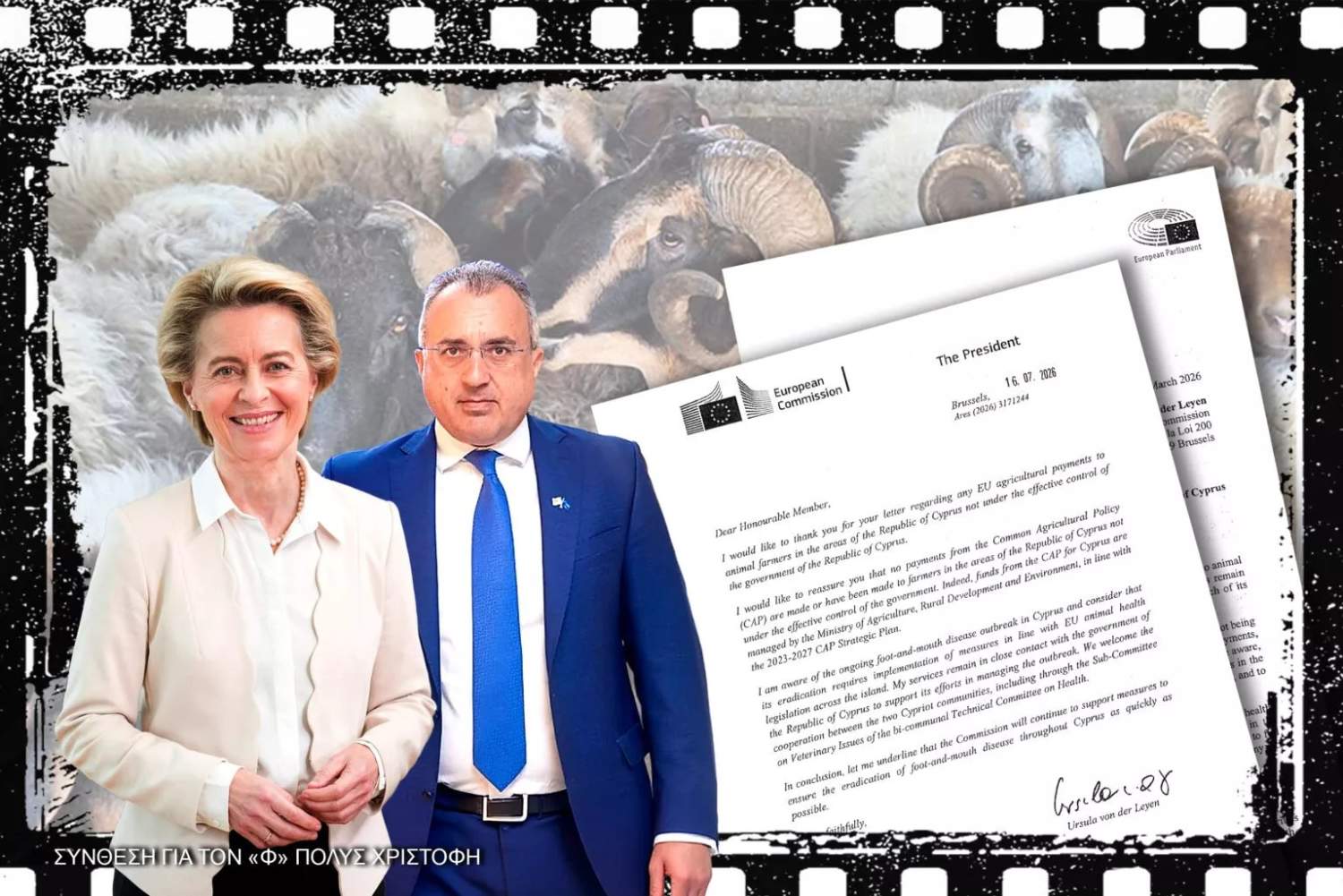
European Commission President Ursula von der Leyen has stated categorically that no compensation from the Common Agricultural Policy (CAP) fund is being paid, or has been paid, to livestock farmers in Cyprus’s occupied north, in a written reply to Cypriot MEP Michalis Hadjipantelas.
In her letter, von der Leyen said she was aware of the current foot-and-mouth disease outbreak in Cyprus and considered that eliminating it required applying measures in line with EU animal health legislation across the whole island. She stressed cooperation with the competent authorities of the Republic of Cyprus.
The exchange began with Hadjipantelas, who received a personal reply from the Commission President. His letter conveyed complaints from Greek Cypriot farmers, who argued it would be discriminatory for them to receive the same compensation as farmers in the occupied north who were not complying with European directives on culling animals in virus-infected units.
“Measures… across the whole island”
In her letter to Hadjipantelas, von der Leyen wrote:
“I would like to thank you for your letter regarding any EU agricultural support to livestock farmers in areas of the Republic of Cyprus not under the effective control of the Government of the Republic of Cyprus.
I would like to assure you that no payment under the Common Agricultural Policy (CAP) is being made, nor has been made, to farmers in areas of the Republic of Cyprus that are not under the effective control of the Government. Indeed, Cyprus’s CAP funds are managed by the Ministry of Agriculture, Rural Development and Environment, in accordance with the CAP Strategic Plan for the 2023-2027 period.
I am aware of the current foot-and-mouth disease outbreak in Cyprus and I consider that its elimination requires the application of measures in line with EU animal health legislation across the whole island. My services remain in close contact with the Government of the Republic of Cyprus in order to support its efforts to manage the outbreak.
We welcome cooperation between the two Cypriot communities, including cooperation through the Veterinary Issues Sub-Committee of the bicommunal Technical Committee on Health.
In conclusion, I would like to stress that the Commission will continue to support measures aimed at ensuring the elimination of foot-and-mouth disease across the whole of Cyprus as soon as possible.”
Hadjipantelas: “Same standards must apply”
In his letter, Hadjipantelas raised the foot-and-mouth problem in Cyprus with von der Leyen, along with the difficulties in applying European regulations in the occupied north.
“Farmers in the government-controlled areas of Cyprus, as in the other 26 member states, are subject to the full application of these protocols. The same standards must apply as a condition for any EU-funded support in areas where the Republic of Cyprus does not exercise effective control,” the Cypriot MEP wrote.
Hadjipantelas said any European payments to livestock farmers in the occupied areas were unacceptable without compliance with EU standards on animal health, animal welfare and food safety that apply across the Single Market. He said compliance could not be monitored or enforced in those areas by the Republic’s authorities, meaning such payments did not meet the required conditions, and warned that the Commission would be obliged to act to protect the Single Market should an epizootic disease break out in the occupied areas.
He also said the current foot-and-mouth outbreak among animals in the occupied north represented a potential threat to the Single Market, warning that the inability of authorities there to enforce disease-control measures had significant consequences for consumers across the Single Market as a whole.
Concluding his letter to the Commission President, Hadjipantelas called on the European Commission to review its position on the issue and ensure that any future funding would be subject to full compliance with European standards on animal health, animal welfare and food safety.
“Protecting consumers, safeguarding public health and preserving the integrity of the Single Market must remain of the utmost importance,” he said.

