


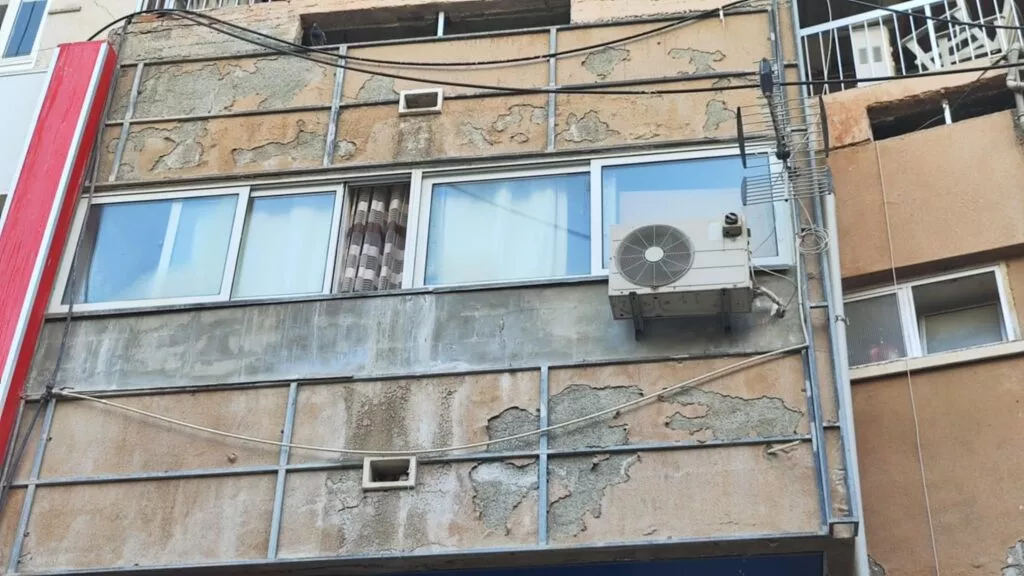
A Larnaca apartment block housing about 500 people may need to be evacuated after an initial assessment found it could be dangerous, creating a major social problem over where residents would be moved.
The next step depends on a report by a private engineer, who is expected to examine the building’s structural safety in greater depth.
Larnaca has another two or three high-risk buildings, while similar problems have also been found in Limassol. In one Limassol case, instructions have already been given to start eviction procedures, although the legal process is not considered straightforward.
In the Larnaca case, the first inspection has been completed and authorities are now waiting for the external engineer’s report. The building houses people staying through Airbnb, as well as foreign nationals and Cypriots living in other flats.
Larnaca DLGO (District Local Government Organisation) president Angelos Hadjicharalambous said that if the report finds the building is at risk, the lawful evacuation procedures will have to begin. He said the same applies to any building that puts residents in danger.
Hadjicharalambous also said social issues had to be taken into account and that it would not be right to evacuate buildings based only on an initial assessment. He said the report was expected within a matter of days so the appropriate decisions could be taken.
He said the same applied to another three or four apartment blocks, where decisions would need to be made soon.
There are also dangerous houses in Larnaca that are not occupied, meaning any measures would mainly concern passers-by.
The wider situation is difficult because Larnaca has received information on 565 buildings described as dangerous, but without reports on their exact structural condition and without a file for each building that would give authorities a complete picture.
That may mean the truly dangerous buildings could number 50 out of the 565, although any such figure would only be a guess. The exact picture will emerge only after each case is examined separately.
Before the collapse of an apartment block in Limassol, Larnaca had inspected 100 buildings. After that incident, the Larnaca DLGO president gave instructions to speed up checks on dangerous buildings.
In Limassol, one case involving an apartment complex that needs to be evacuated has been assigned to a law firm so eviction procedures can begin.
Limassol DLGO president Yiannis Tsouloftas told Philenews that residents had initially been given three months to leave but did not do so. They were later given another three days and, after there was no response, eviction procedures were launched, although the process is not expected to be easy. About 20 to 30 families live in the complex.
Tsouloftas said Limassol has another two or three dangerous apartment blocks that must be dealt with.

