


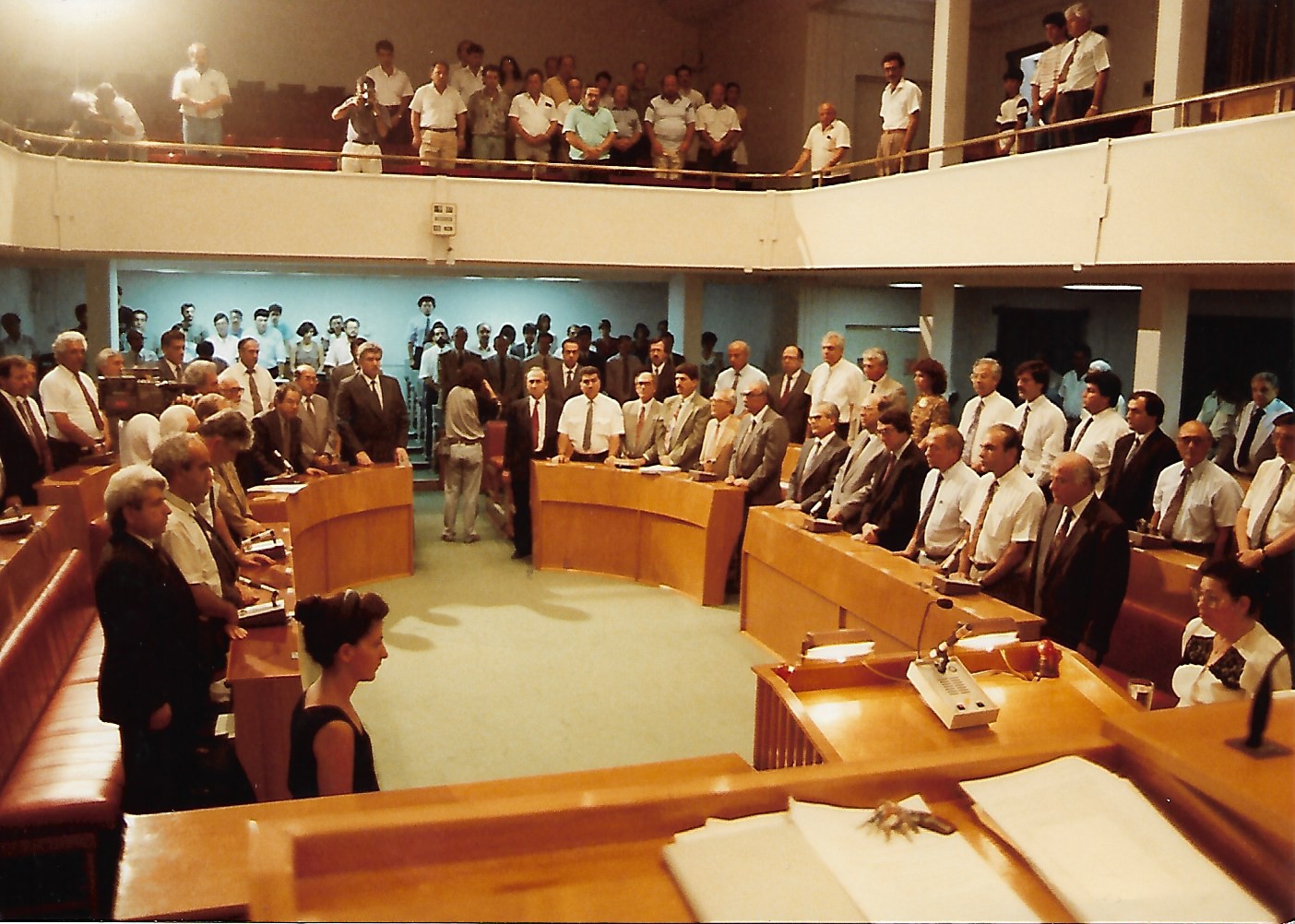
In the first half of the 1990s, I spent almost every day at the House of Representatives — that old British-built pile that, for lack of anything grander, had been anointed the temple of democracy. My arrival as a parliamentary reporter happened to coincide with a fresh class of legislators swept in by the 1991 elections.
So there were a lot of us rookies, figuring out — each in our own lane — how the Cypriot parliament actually worked. They met, debated, and voted. We took notes and filed stories.
Throughout that parliamentary term, I kept detailed notes from every committee session I covered — sometimes plenary sessions too. Notes on members’ questions, their floor interventions, ministers’ responses, the testimony of officials and technocrats. Almost nothing on press statements, because press statements were rare. If a pack of reporters clustered around a committee chair or a backbencher, it was because we needed to know what had happened in a session running at the same time as another one — and none of us could be in two rooms at once.
Anyone who spent time in that parliament will remember exactly what I’m describing. They’ll also remember that when a member briefed the press, they actually briefed the press — fully, fairly, on the record. Even on legislation they had tabled themselves, they’d walk through both sides: what they’d raised and how the ministry had responded. They weren’t using us as a backdrop for a personal highlight reel. They were giving voters — and the broader public — the information they were owed.
The second thing everyone will remember is the preparation. These members came to committee ready. Not just up to speed on the topic at hand — but fluent in the entire web of relevant statutes: what laws were implicated, what provisions intersected, what downstream effects might ripple through the code. And they treated everyone in the room with respect. No grandstanding. No finger-wagging. No theatrical pen-slamming to perform outrage for the cameras.
Today, when people hear the phrase temple of democracy — deployed to underscore just how central any parliament is to a functioning state — many just roll their eyes. Some smirk. Some wield it as a punchline about the very institution it was coined to honor.
I can’t say with certainty whether that cynicism is a direct response to how the Cypriot parliament operates today, or whether it comes from somewhere else. What I can say is that back then, we had every reason to take the title seriously.
But here is the thing about temples: whether they represent a religion or a system of government, they can only stand — structurally and institutionally — as long as people genuinely believe in what they embody. Without that belief, you don’t have a temple. You have a building counting down to its own collapse.
You don’t need to look far for a cautionary tale. Glance across the barbed wire — the buffer zone that has divided this island for decades — and you’ll see hundreds of churches, real temples, crumbling into ruin. Some were destroyed deliberately. Others fell to neglect, to indifference, to the slow grind of disregard. Intentional or not, the result is always the same.
The same rot is spreading in the temple of democracy. Slowly, steadily, the ranks of people who genuinely believe in the institution of parliament are thinning.
Actual legislators are becoming a dying breed.
What’s multiplying in their place are members who treat the floor of the House like another social media platform — and their parliamentary seats like a wall to post on.
The next election — which is not as far off as we’d like to think — will force a reckoning. Each of us will have to decide: do we send lawmakers to parliament, or do we send influencers? And yes, that includes politicians who have already started acting like influencers.
Because if we’re not paying attention, the first thing that gets destroyed won’t be some abstract institution. It will be democracy itself. And that is a loss none of us can afford.

