


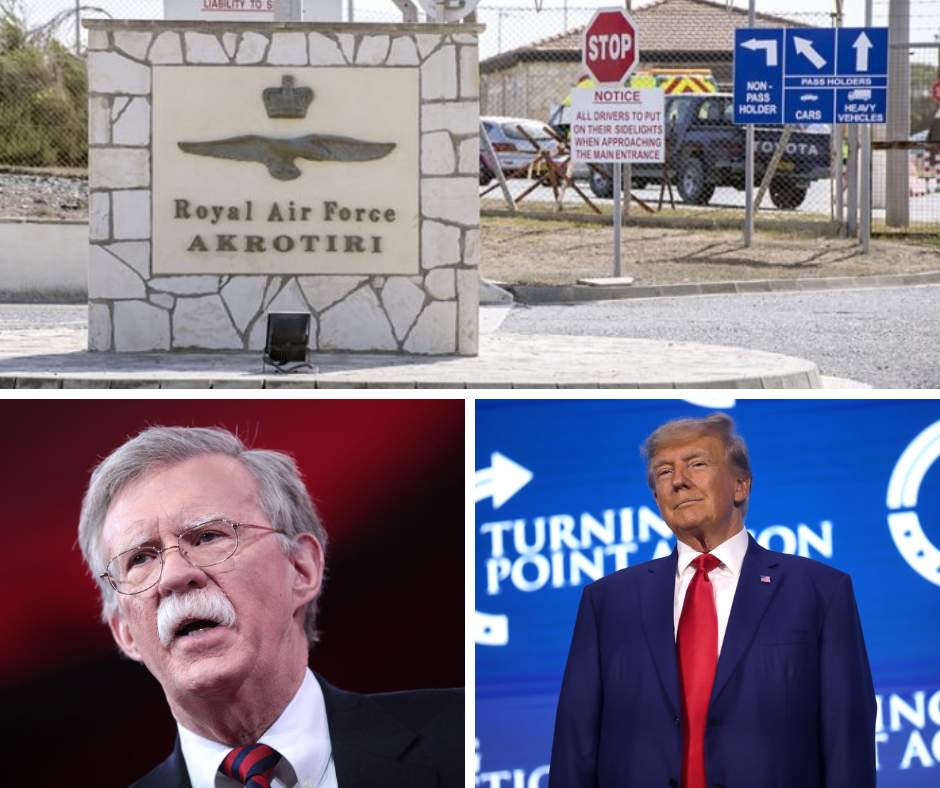
When discussions emerged about potential models for US control over Greenland, some analysts pointed to Cyprus—where Britain maintains two sovereign base areas. John Bolton, Donald Trump’s former national security adviser, has a blunt assessment of whether the US president grasps this arrangement: “I don’t think Trump understands the Cypriot model at all.”
In an interview with Polish publication Wirtualna Polska and Tomasz Waleński, Bolton revealed the behind-the-scenes reality of Trump’s obsession with purchasing Greenland, dismissing it as an ego-driven pursuit rather than strategic policy.
The Cyprus comparison
The so-called Cypriot model has emerged as a potential compromise for Greenland. Under this arrangement, a foreign state maintains permanent military bases on another country’s territory with almost complete control, but without taking over sovereignty of the entire host state.
Established in 1960 when Cyprus gained independence, the bases remain British sovereign territory, yet Cyprus retains full sovereignty over the rest of the island.
However, Bolton—who served as Trump’s national security adviser from April 2018 to September 2019—suggests this model holds no interest for the current US president.
“His psychological need consists of having a deed of ownership,” Bolton told Wirtualna Polska journalist Tomasz Waleński. “He never wanted merely to use the island—he wanted to see on the map that it belongs to the US.”
Bolton noted that the 1951 US-Denmark defence treaty already provides America with substantial rights in Greenland, including maintaining and expanding military installations such as the strategic Pituffik Space Base (formerly Thule Air Base). Yet for Trump, operating within existing frameworks isn’t sufficient.
“We showed the president then that there are many ways of operating within already existing agreements,” Bolton recalled of discussions during Trump’s first term. “It’s a far-sighted agreement. It’s not tied to one era; it remains fully useful as an initial framework for action.”
The problem, according to Bolton, is that such arrangements require shared sovereignty symbols—like jointly flying American and Danish flags at bases—which “may irritate Trump.”
“Denmark reacted negatively to this concept, claiming it doesn’t intend to relinquish any part of its sovereignty. Consequently, we still remain in considerable disagreement,” he said.
Trump ‘obsessed with Greenland‘
Bolton’s interview with Wirtualna Polska suggests that Trump’s pursuit of Greenland stems from the US president’s desire for a legacy-defining achievement.
“Trump once said that we need Greenland ‘psychologically’. He needs it psychologically, but the rest of the United States doesn’t,” Bolton commented.
The idea first emerged during Trump’s first term in 2018, when the president asked Bolton whether the US should simply purchase the island. When Danish Prime Minister Mette Frederiksen called the proposal absurd, Trump’s response was telling.
“Of course, the next day, one of the American reporters asked Trump about everything, including what he thought of her statement. He replied that she was a ‘nasty woman’ and the conversation ended there,” Bolton recounted.
According to Bolton, Trump sought a success that would write him into history textbooks alongside great 19th-century presidents. This year, the purchase of Greenland was meant to spectacularly mark the approaching 250th anniversary of American independence.
“You don’t threaten allies”
Bolton, who also served as US ambassador to the UN, delivered an unequivocal assessment of Trump’s approach to NATO allies.
“You don’t threaten allies with military force, you don’t threaten them with tariffs. The entire manner of conducting the discussion about Greenland was decidedly beyond the bounds of reason,” he said. “We didn’t need all this chaos—it has caused real damage to the North Atlantic Alliance.”
The former adviser acknowledged that cooperating with Trump is “unpleasant”—drawing on personal experience—but urged allies to “grit one’s teeth and think strategically about the interests of the entire Alliance.”
He warned against emotional responses that could backfire: “If Trump says: ‘Since you don’t want us, we’ll withdraw from NATO’, then some might get exactly what they wish for. That’s why one must think long-term.”
Bolton invoked advice from James Baker, Ronald Reagan’s White House chief of staff: “Keep your eye on the ball, keep your eye on the ball. And the ball in this case is NATO security as a whole.”
Watch Wall Street, not social media
Contrary to some European assessments, Bolton believes it wasn’t European unity that prompted Trump’s recent softening on Greenland threats. Instead, domestic factors proved decisive.
“I don’t see evidence that it was precisely European unity that stopped Trump on Greenland,” he said. “The stock market partly decided it, and partly the fact that even Republicans were criticising him quietly and saying he had to change course.”
According to Bolton, Trump treats stock indices like the S&P 500 and Dow Jones as personal approval ratings. When markets fall, he panics and changes course—particularly crucial now as the US approaches November’s mid-term elections.
“The White House in the coming months of 2026 will avoid sudden moves in policy if these were to threaten Wall Street’s financial results in even the slightest degree and discourage voters from going to the polls,” Bolton predicted.
He advised Europe to avoid point-scoring and verbal sparring: “Trump does this all the time, but others shouldn’t. It doesn’t improve anything.”
Trump did not know Britain is a nuclear power
Bolton’s book “The Room Where It Happened” famously documented Trump’s surprising knowledge gaps. During a Helsinki meeting, Trump allegedly asked advisers: “Isn’t Finland in some sense a satellite of Russia?” During talks with then-British Prime Minister Theresa May about nuclear weapons, he reportedly asked with surprise whether Britain was also a nuclear power.
“And Bolton insists this was no joke,” Waleński noted in his report for Wirtualna Polska.
Arctic as common EU-US ground
Despite the conflict over Greenland, Bolton identified the Arctic as an area where transatlantic cooperation remains vital. He noted that NATO chief Mark Rutte has repeatedly highlighted Arctic threats from Russia and China.
“The Arctic is today NATO’s new soft underbelly. And now we not only have a NATO versus Russia situation in the Arctic, but NATO versus Russia and China,” Bolton warned, describing scenarios of Chinese naval units transiting through the Bering Strait and Arctic to reach the North Atlantic.
Of the Arctic nations—Denmark, Greenland, Iceland, Sweden, Finland, Norway, Canada, the United States and Russia—only Russia isn’t a NATO member. “And only one is a threat,” Bolton observed.
‘Absurd proposals‘
Bolton also addressed Trump’s recent suggestion that NATO should invoke Article 5—the collective defence provision—to help patrol America’s southern border against immigration.
“Frankly, I don’t really understand what he means. A large part of his words is political theatre for the domestic audience,” Bolton assessed, calling it “a very big mistake.”
“Trump is treading on very dangerous ground,” he warned. Mocking NATO and Article 5 damages “the most powerful tool America possesses” and undermines security guarantees for countries like Poland and Estonia in the Kremlin’s eyes.
Bolton noted that the current security architecture has ensured America’s superpower status for 80 years. “Trump’s mockery of allies comes at the worst possible moment—when Russia and China are merely waiting for cracks in the Western bloc.”
This article is based on an interview conducted by Tomasz Waleński and published by Wirtualna Polska on 28 January 2026. John Bolton served as US national security adviser from April 2018 to September 2019 and previously as US ambassador to the United Nations
Read more:

