


The United States is considering a deal for Greenland modelled on the UK’s sovereign military bases in Cyprus, according to officials familiar with talks between NATO and President Donald Trump, the New York Times reported.
Two officials told the newspaper that discussions in Brussels on Wednesday centred on granting the US sovereignty over small pockets of Greenland where military bases are located—similar to how Britain’s Akrotiri and Dhekelia bases in Cyprus are regarded as British territory.
One official who attended NATO meetings compared the concept directly to the UK bases in Cyprus. A second official briefed on the discussions confirmed the Greenland idea was modelled after the sovereign British bases.
Trump claimed Wednesday he struck a framework deal with NATO over Greenland hours after alliance officials held the discussions, according to three senior officials familiar with the talks, the Times reported.
The announcement came amid a series of moves that appeared to pull the United States back from possible military and economic conflict with allies over Greenland, an autonomous territory of Denmark.
Trump withdrew tariff threats against European allies who resisted his demands for Greenland ownership and said he would not use force to assert American control.
He capped those concessions Wednesday evening with a Truth Social post saying he and NATO Secretary-General Mark Rutte had “formed the framework of a future deal with respect to Greenland and, in fact, the entire Arctic Region,” without offering details. “This solution, if consummated, will be a great one for the United States of America, and all NATO Nations,” he added.
Officials discussed the territorial compromise during Wednesday meetings in Brussels among top NATO military officers, according to senior Western officials familiar with the talks, the Times reported.
Officials said Rutte had been pursuing a compromise this week, but they did not know whether the concept of US sovereignty over small pockets of Greenland for military bases was part of Trump’s announced framework.
Asked for framework details, NATO said in a statement that “negotiations between Denmark, Greenland and the United States will go forward aimed at ensuring that Russia and China never gain a foothold — economically or militarily — in Greenland.”
Rutte did not release framework details. Allison Hart, a Rutte spokesperson, said he “did not propose any compromise to sovereignty during his meeting with the president in Davos.”
The Danish prime minister’s office did not immediately respond to a request for comment.
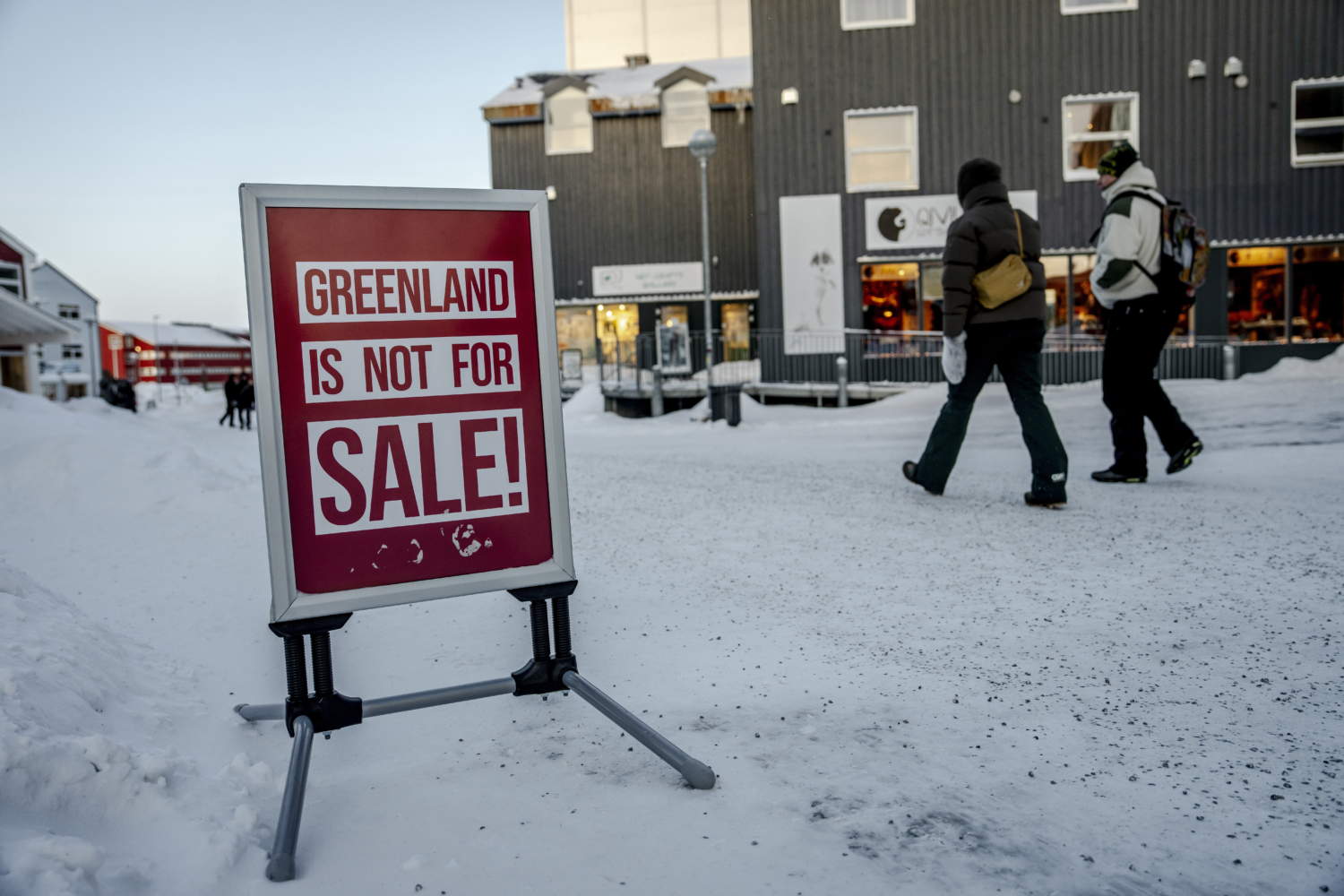
Aaja Chemnitz, a Greenlandic member of the Danish parliament, rejected Trump’s NATO deal claims.
“What we are witnessing these days in statements from Trump is completely absurd. NATO has absolutely no mandate to negotiate anything whatsoever without us in Greenland,” she said in a social media post.
“Nothing about us, without us,” she added, saying there is “total confusion being created.”
The framework news came hours after Trump told European leaders in Davos he would not settle for anything less than the United States taking ownership of Greenland, promising dire economic and security consequences for Europe if he did not get his way.
Addressing heads of state, billionaires and other world leaders, Trump said repeatedly the United States needed Greenland for national security purposes. Only the United States was strong enough to defend Greenland from external threats, and defending it made sense only if the United States owned it, he said.
He called for “immediate negotiations” to transfer ownership of the semi-autonomous island from Denmark and derided European countries as dependent on the United States. “Without us, most of the countries don’t even work,” he said.
The day captured Trump’s second-term approach to global power: alternating between coercing and humiliating once-close allies in pursuit of a goal he appears to see as a critical piece of his legacy.
“We probably won’t get anything unless I decide to use excessive strength and force where we would be, frankly, unstoppable,” Trump said. “But I won’t do that. That’s probably the biggest statement, because people thought I would use force. I don’t have to use force. I don’t want to use force. I won’t use force. All the United States is asking for is a place called Greenland.”
Moments later, Trump issued explicit and implicit threats to European leaders if they did not grant his wishes. He reminded the audience he had unilaterally taxed imports from countries across Europe and beyond, having already threatened to increase tariffs on Denmark and several European countries that expressed solidarity with Denmark and Greenland.
Some European leaders reacted to what they saw as the most positive note—his pledge not to deploy troops—and expressed hope they might reach a compromise over Greenland’s future.
Rasmus Jarlov, chairman of Denmark’s parliamentary defence committee, said authorities had heard “a lot worse” from Trump.
“I’m glad he’s ruling out military force,” Jarlov said. “I didn’t see in his remarks today an escalation. He insists he wants Greenland, but that’s not new. Of course, we still insist that we are not handing over Greenland.”
Trump left little room for compromise in his speech. Many European leaders have said they cannot countenance ceding ownership of Greenland to the United States but would be open to almost any other arrangement that expands America’s presence there. On Wednesday, Trump said again that would not suffice.
“You need the ownership to defend it,” Trump said. A moment later, he added: “Who the hell wants to defend a licence agreement or a lease?”
Read more:

