


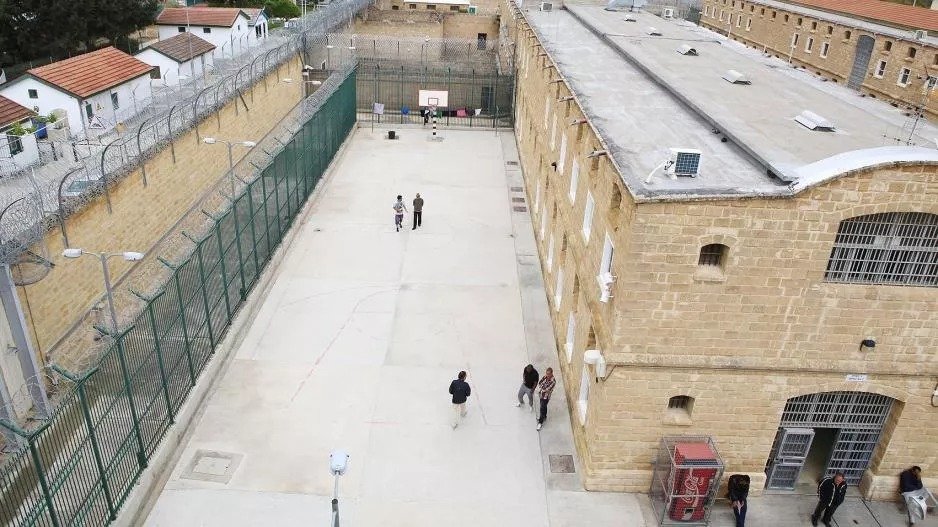
Whilst the government rushes to find immediate solutions to the shocking findings documented in the Council of Europe’s Committee for the Prevention of Torture (CPT) report on Central Prison, the problems are not new and have been recorded for over 15 years.
Phileleftheros examines the report through Dr Costas Paraskeva, associate professor of Public Law and Human Rights Law at the University of Cyprus, who served for 10 years as the Republic of Cyprus’s representative to the European Committee for the Prevention of Torture and Inhuman or Degrading Treatment or Punishment (CPT).
He was also a member of the ad hoc committee created by the then Justice Minister and current Attorney General, George Savvides, to make recommendations on the prison overcrowding problem.
Dr Paraskeva stresses that what is documented in the report released last Thursday is not new, except for the finding that hardcore convicts appear to be running two wings, whilst staff members turn a blind eye. The problems have been documented since 2000 and swept under the carpet, he said.
The professor spoke about changes needed in handling offenders and repeated his radical recommendation that those sentenced by courts to imprisonment under one year should serve alternative sentences instead of ending up in a cell. What purpose does it serve, he asks, to sentence someone to two or three months’ imprisonment?
The prison problems are chronic, he said, with the committee’s findings and observations repeated in every report. However, for the first time, they say that groups of prisoners have been created who impose punishments on inmates and that two wings are under their control.
It was an ad hoc visit, urgent, in light of the prevailing conditions. After the visit, Dr Paraskeva noted that if they do not see improvement, then the public statement procedure can follow, meaning a public announcement that Cyprus is not complying with the committee’s recommendations.
Another observation from the University of Cyprus professor is that the committee usually avoids referring to violations of Article 3 of the Convention on Human Rights. It appears that here the situation was deemed serious, which is why in two instances in its report it refers to Article 3 of the ECHR (European Convention on Human Rights) concerning the prohibition of torture and oppressive behaviour.
This is due to the group operating and creating an unsafe environment in the prison. The report documents many things, he said, even passive smoking by prisoners inside cells. These observations have been written for 20 years.
Particularly regarding the reference to prisoners who do not have personal toilets and urinate in buckets, they wrote it now, and they wrote it previously; it is not something new, he notes.
Chronic overcrowding problem
A general observation is overcrowding, which they have written about for decades and mention recommendations for how the problem can be controlled, he said. This is documented in CPT reports from 1999, 2003, 2006 and onwards. Nothing was done.
With these facts, our country’s image has been damaged, and someone whose extradition the Republic of Cyprus requests can invoke the report and the fact that conditions are not good, so that they will not be extradited.
There is a systematic reference to the situation that exists in the prisons, not now but for years, he said. The CPT has never said in its report to “solve the problems”. We have on one hand the huge problem with overcrowding, and our answer is increasing sentences. This does not align with modern philosophy. Is it the era today to sentence someone to two or three months’ imprisonment, Dr Paraskeva asked.
He adds that when he was on the ad hoc committee for the overcrowding issue, he had recommended that sentences under one year should be handled differently. If some petty criminal goes to prison, in the end, he will come out a dealer, he observes.
Why must he be sent to prison for two or three months and not serve another type of sentence? He notes that in any prison you go to, there is a price list: so much for a simple mobile phone, so much for a smartphone, and so much for drugs. The same applies to Cypriot prisons.
Follow the recommendations
According to the professor, the recommendations mentioned by the CPT should definitely be followed to decongest the prisons. The overcrowding problem is not related to whether new prisons will be built, Dr Paraskeva observes. If you build new prisons, convictions will also increase.
There are alternative sentences and electronic monitoring bracelets for defendants, too. Today, it is decided very easily that someone remains on remand instead of being released with conditions. Overcrowding is not a prison problem. The prisons must manage it.
Many bodies are involved in this, and the courts are the last cog that decides whether someone will end up in prison or not, he said.
Finally, the University of Cyprus professor notes that prisoners slept on the floor in the past, and they do so now. The problem is that with overcrowding, prisoner activities also stop or are limited, which is important for them to be occupied in something productive.
Three recommendations, no action
In 2020, the then Justice Minister of Nicos Anastasiades’s government, George Savvides, set up an ad hoc committee to submit recommendations to tackle the overcrowding problem.
The committee consisted of Anna Aristotelous, then prison director – chair; Athina Dimitriou, senior prison officer; Lemonia Kaoutzani, chair of the Parole Board; Costas Paraskeva, lawyer – lecturer in the Law Department of the University of Cyprus, Republic of Cyprus representative to the CPT, and Aristos Tsiartas, head of the Human Rights Section of the Justice Ministry.
The committee delivered its interim report in November 2021, with three recommendations for immediate mitigation of the overcrowding problem:
The first concerns alternative sanctions for specific offences by foreign nationals with migration status, so they are not sent to prison.
Second: Extension of sentence service outside prison through enhanced electronic monitoring (bracelet) for defendants.
Third: Drug users should be treated differently and not as convicts.
Of these three recommendations, extending detention with electronic monitoring for defendants was attempted. During Emily Yiolitis’s term as minister, a bill was prepared, but it met opposition in parliament and has since been dropped.
An effort is now being made to bring the bill back, but with parliament’s dissolution in early 2026, it is not expected that this will be voted on.
The government is pushing forward with the construction of a new wing with a capacity for 360 people, with an operational horizon of 2028, with the two prison guards’ unions urgently demanding new prisons.
However, the construction cost is prohibitive, as rough calculations put it at €200 million.
Read more:

