


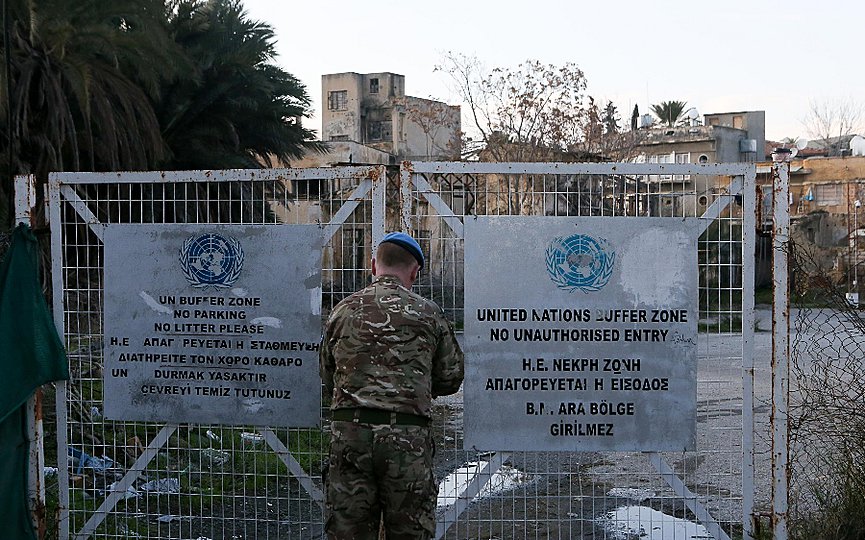
A resolution in the Ukraine conflict will pave the way for US intervention in the Cyprus issue and Greek-Turkish relations, which Washington plans to handle as a single package. This assessment comes from close observers of US movements, particularly those involving President Donald Trump.
Simultaneously, concerning the diplomatic efforts to restart Cyprus negotiations, reports clearly indicate that for obvious reasons, the Turkish side does not favour any substantive discussions during the Cypriot Presidency of the European Union.
The occupying power treats the Cyprus problem as part of its broader geopolitical strategy and a matter falling within its national sphere of influence. It views Cyprus as its own «strategic plot of land.»
Since the collapse of the Conference on Cyprus in Crans-Montana in 2017—a failure caused by Turkey—Ankara has adopted a new tactical approach without changing its core policy. This approach rests on three main pillars:
Turkey’s Three Strategic Pillars
Insistence on Two States: The persistent demand for a two-state solution is not new, but in recent years, it has become Ankara’s foremost political claim. Turkey champions this to derail any discussion related to the established negotiating framework (acquis). However, the two-state solution does not represent Ankara’s ultimate goal, which is a confederation—a model that would enable it to control the whole of Cyprus.
Cyprus as Counterweight to Israel: Ankara views Cyprus within the context of its rivalry with Israel. This indicates an exaggerated concern and largely a phobia on the part of the occupying power, which wants to prevent any Israeli penetration or control of the island, believing it will lose ground in its effort to hold Cyprus permanently hostage. Turkey has expressed such fears before, having previously feared France, Russia, and others. Clearly, Turkey tolerates only the presence of the British.
Guarantee System and Military Presence: Assessing the wider regional developments, the occupying power “cements” its demand to maintain the anachronistic system of guarantees and its military presence. Turkey sees scenarios for a guarantor role discussed in Ukraine and Gaza. Therefore, Ankara believes it gains an advantage regarding its demand to maintain Turkish guarantees in Cyprus. This issue will, once again, form an obstacle in any potential negotiation, as the Republic of Cyprus considers the issue of guarantees a red line. An EU member state simply cannot have a non-member, Turkey—which is also the occupying power—as its guarantor.
Trump’s Potential Intervention
Washington currently focuses on efforts to end the war in Ukraine. The American side’s interventions and methodology, as is known, operate outside the international framework. While no serious signs of US intervention in the Cyprus and Greek-Turkish disputes exist right now, the Americans maintain this possibility, as evidenced by the recent interview with US Ambassador to Ankara, Tom Barrack (Kathimerini Athens). Barrack referred to US moves concerning Greek-Turkish relations and Cyprus, noting that he had discussed the matter with President Trump.
The geopolitical game has clearly shifted, especially with the US stance and the general behaviour of President Trump. It remains clear that intervention will occur at some point if Washington believes the open issues threaten its strategic plans.
Many observers believe a US intervention would not necessarily strengthen Turkey regarding the outcome, as this would impact Israel. However, developments in Syria contradict this, as Trump previously gave Ankara the upper hand there. Therefore, all possibilities remain open.
What may differentiate the method of intervention is that the US has cultivated relations with Cyprus, which both Washington and other major players consider a stabilising factor in the region and a useful partner, especially due to its regional collaborations (such as the recent Cyprus-Lebanon EEZ agreement).
EU-Turkey Relations and SAVE
Much discussion surrounds EU-Turkish relations and how they might be leveraged concerning Cyprus and Greek-Turkish affairs. A clear difference exists compared to the past. Despite Turkish President Recep Tayyip Erdoğan recently stating that accession to the European Union remains a strategic goal, this is clearly unattainable, and Ankara knows it. Turkey’s interest lies in participating in Europe’s new defence architecture. It invests in this area, despite the difficulties and its partial exclusion from the European SAVE programme.
Turkey’s involvement in this sphere interests the United States, which invests in the new system and desires the participation of Britain and Turkey. Some European partners also want this. Consequently, the approach of Turkey and certain partners—primarily the US—towards EU-Turkish relations has changed, framing them within the context of Europe’s new defence and security architecture. Significant developments and pressures are expected in this domain.
Turkish Drillship Activity
The Turkish drillships are starting their work and will not stay confined to the current area; they will travel elsewhere. Activity is evident and may well expand south of Cyprus, though no announcements confirm this. Turkish Minister of Energy and Natural Resources, Alparslan Bayraktar, stated that four drillships—the Fatih, Yavuz, Kanuni, and Abdülhamid Han—currently operate in the Black Sea, while a fifth vessel sits in the Taşucu port in Mersin and a sixth in Istanbul. He also announced plans for six new exploratory drills in the Black Sea in 2026. Separately, Bayraktar recently signed an agreement with Pakistan for surveys to be conducted in 2026 in three offshore blocks and two onshore blocks. The occupying power of Turkey has already signed similar agreements with Somalia and Libya, in addition to the recent one with Pakistan.
Cyprus-Lebanon EEZ Deal
The Agreement on the Delimitation of the Exclusive Economic Zone between Cyprus and Lebanon, signed on November 26, 2025, in Beirut, «bolsters energy security for the benefit of their citizens’ welfare and the prospects of the Eastern Mediterranean as an alternative energy corridor for Europe.» This statement appears in the Foreign Ministry’s explanatory report to the Cabinet, submitted before the Cypriot Parliament unanimously ratified the bill last Thursday. Nicosia clearly frames all its movements with the understanding that these collaborations create facts on the ground, enhance energy prospects, and fortify the Cypriot EEZ.
The Beirut Agreement holds exceptional importance. As the report stresses, it «opens the way for finalising the negotiation and the Unitisation Agreement for Transboundary Hydrocarbon Reservoirs between Cyprus and Lebanon, providing the necessary legal certainty and security to investors for the development of the two states’ energy programmes.» Unitisation discussions have progressed, conducted parallel to the delimitation negotiations, and a government source stated they cover 90 per cent of the necessary details. Further discussions are needed for specifics before signing. According to the report, «following negotiations, delegations from Cyprus and Lebanon, led by Ambassador Tassos Tzionis and Mr. Fayez Rassamny respectively, reached a revised EEZ Agreement text in Beirut on September 16, 2025. The revised text maintains Points 1–6 of the 2007 Agreement and adds Points 23, 25, and 24 to the south and Point 7 to the north of the delimitation line.»
The Republic of Cyprus, as is known, has signed Delimitation Agreements with Egypt in 2003, Lebanon in 2025, and Israel in 2010, increasing its geopolitical importance and value. It has secured maritime borders with all neighbouring countries, though some pending issues remain with Syria, occupying Turkey, and Greece.
Turkey’s reaction to the Beirut Agreement clearly links to the fact that the deal overturns Ankara’s plans, primarily its ambitious «Blue Homeland» vision. Simultaneously, the deal creates irreversible facts and fait accompli, prompting the occupying power to raise its voice and issue threats.

