


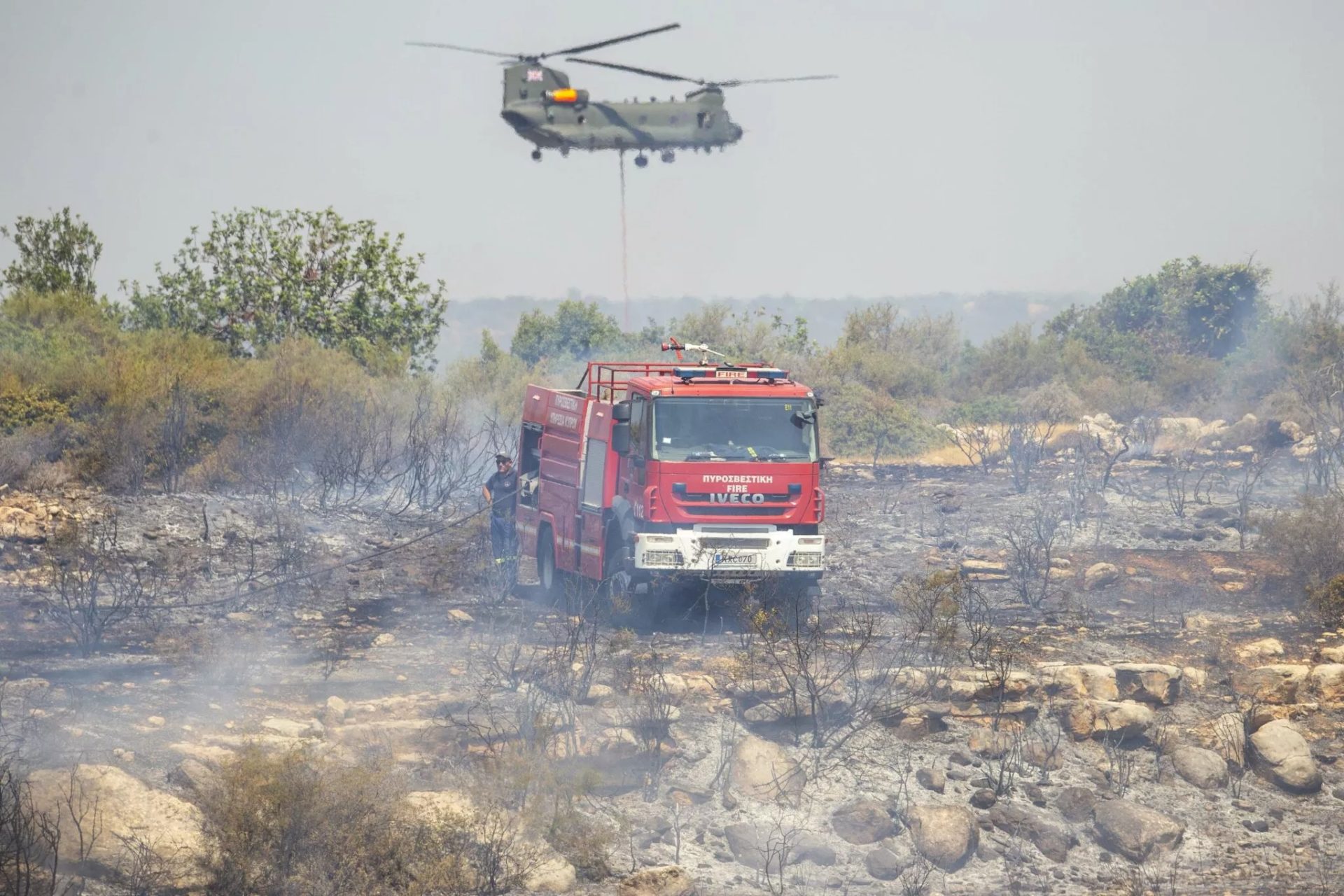
The outbreak of three simultaneous wildfires on Sunday required the assistance of aerial means for the first time so late in the season, exposing critical vulnerabilities in Cyprus’s aerial firefighting capacity.
Occurring just one week before the official start of winter, the fires—in the areas of Kathikas–Akoursos, Pachna, and Koili–Stroumbi—have necessitated an immediate review of fire prevention protocols as the country remains vulnerable to unseasonable weather conditions.
The demand for air support came weeks after the operational protocol dictated the release of the island’s primary fleet. Although the Republic of Cyprus possessed a record 14 primary firefighting aircraft during the 2025 summer season, all had been decommissioned by the end of October upon the conclusion of the anti-fire period.
Consequently, on Sunday, the Republic had access to only two Air Tractor 802 aeroplanes leased from Jordan, which are themselves scheduled to depart at the end of November. Compounding the operational shortage, the sole aeroplane owned by the Republic of Cyprus is currently non-operational due to damage. During the operation, one of the two Jordanian aircraft became inoperable due to a mechanical fault, leaving only a single plane conducting water drops for a period.
Given the severely restricted number of primary assets, support from secondary aerial means was requested, utilising an AW139 helicopter from the National Guard and a Bell 412 helicopter from the Police MAEP unit.
Support from the British Bases was not available as its aerial firefighting assistance to the Republic ended on 31 October and will not resume until 1 April. This meant the heavy-lifting Chinook helicopter, with its five-tonne water capacity, was not an option.
“The British Bases remain committed to supporting the Republic of Cyprus in firefighting efforts and have not withdrawn their longstanding assistance. We continue to offer support in tackling fires in the Republic of Cyprus, including the recent fire in Paphos. Our aerial firefighting capability concluded its seasonal operations on the same day as the Republic of Cyprus’ own aerial assets,” a statement by the British Bases said.
The increased risk of new fires, driven by unseasonably high temperatures and continued drought, immediately prompted the relevant authorities to order the immediate return of two Jordanian helicopters for a short period.
The fact that aerial resources were needed for three separate fires on 23 November has now led authorities to seriously consider that fire protection can no longer be limited to only the hot summer months.
The country is expected to revise both the duration and the philosophy of its anti-fire season protocols and the year-round operational availability of its aerial fleet.

