


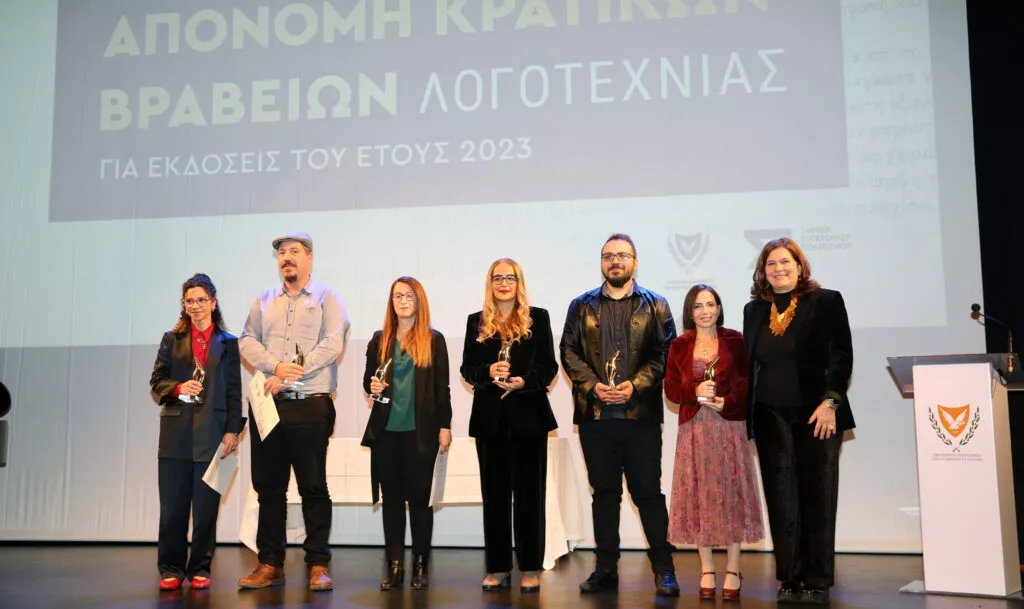
Apologies for the inelegant title—I tried to find something more classy, but failed.
Another incident, or rather another nail in the coffin of our long-suffering state institution for literary awards, came with the recent intervention by none other than the chairman of the State Literary Awards judging panel himself, Kyriacos Ioannou. The winners barely had time to savour their success before, within hours, they were transformed from laureates into virtual scapegoats for the “degradation” of Cypriot literature. As if it’s their fault they won.
This is something else entirely. A judging panel chairman questioning not only the awards themselves but the competence of his fellow judges—essentially because… he was outvoted (!). In other words, because he disagreed with the results reached by majority vote in the body he chaired. In doing so, he seems to contribute to precisely what he’s denouncing. That is, through such an intervention he “undermines the credibility of the State Literary Awards” and “drags the Deputy Ministry of Culture’s reputation through the mud.” Regardless of whether his arguments hold water or not.
This phenomenon may not be entirely new. Yet it’s unclear whether there’s any precedent worldwide for the chairman or member of such a judging panel to personally turn on an author because the other members, rightly or wrongly, judged their work worthy of the prize. Are we being serious? And to then quote—a man of letters, a scholar, a modern Greek studies expert—supposedly characteristic passages from the winning work, meaning entirely out of context and stripped of any framework.
Ioannou himself maintains he made this—in our view, to put it mildly—clumsy intervention in order to deliver an “electric shock” to the institution, to “bring it round.” Allow me to suggest he’s rather pulling its plug. In any case, the State Literary Awards have become one of the most crisis-ridden institutions, and all this noise generated almost every year has no positive impact whatsoever—not on the process, and certainly not on literary output itself.
They’re unlikely to get a single year of “peace.” If it’s not fierce public confrontation, it’ll be a procedural matter, a misstep, an oversight in the process, or a decision that sparks debate. Instead of functioning as a meeting point for the literary community, the institution ends up reflecting its pathologies. And—crucially—not just its own.
Worth remembering: last year, the judging panel, with the exact same composition, decided not to award the State Prize for Novel or the State Prize for Study/Essay, yet still announced the shortlist of frontrunner books that… weren’t quite good enough to win. Yet back then, there was no questioning of the panel’s competence, no public interventions from dissenting members. No issues were raised about knowledge of Cypriot dialect, nor about specialisms that “don’t suffice.”
The obvious question, then, is why these objections surface now. Perhaps because back then the chairman’s preferences were accepted? If the process suffers from structural problems in his judgment, why weren’t these raised from the outset? Or why weren’t they raised during the process rather than after the results were announced? Why, ultimately, didn’t he resign instead of waiting to see out his term?
This intervention, then—in its tone, intensity, and quality—opened up a series of issues that transcend personal minority positions on decisions and touch on how we understand criticism, disagreement, and responsibility within an institutional role. A judging panel, however it’s been appointed, cannot function publicly as a space for personal certainties. Disagreements are inevitable. What isn’t inevitable is the public undermining of decisions you’ve institutionally contributed to reaching.
The matter becomes even more tangled when the chairman himself attributes the non-awarding of specific books to ideological criteria. In the Cypriot literary landscape, historically, the problem hasn’t been hostility towards works with religious or national character. There are exceptions, but the rule is more likely to be hypersensitivity in favour of works that conform to dominant identities, aesthetics, and ideologies. Fair enough, provided they met quality criteria above all else. See the danger? Here lurks the risk of a one-dimensional reading: we all have the right to consider a work worthy or unworthy of an award, but not to wholesale attribute ideological motives simply because we disagree.
One wonders what atmosphere will prevail at the ceremony on 15th December and who will actually turn up. The only certainty is that, instead of recognition functioning as a lever of support and reward for creators, it ends up being returned to them almost as a burden. It’s an award that, amid the noise and contestation, seems to be offered with one hand and withdrawn—morally and symbolically—with the other. All the more so when one of these creators is a young writer, a debut author. Whilst the other, whose book Ioannou publicly stated essentially falls short of another he personally preferred (!), is one of the most distinguished and consistent representatives of modern Greek literature, having published over 20 books by the age of 43.
Unprecedented. These awards are given once a year. They should function as an opportunity for recognition, discussion, osmosis, even disagreement. But not contempt.

